Shengcheng Commandery Officer's Family Compound
Serve the People!The provincial capital commanders’ compound is the place where Wu Dawang, now middle-aged and long separated from Liu Lian, makes his final visit to her. Fifteen years after serving in the Division Commander’s household, he reaches a residence whose scale and authority have grown beyond the familiar military compound of his past. He is allowed through its outer entrance, but not into the house. Liu Lian’s message offers help at a distance; Wu answers by leaving her a wrapped object and departing into the snow. The compound thus becomes both a seat of elevated military status and the threshold at which an old intimacy ends without reunion.
Setting and Appearance
The compound stands in the military quarter of the provincial capital, where the former Division Commander has become Provincial Commander-in-Chief. Wu knows of the Commander’s rise through television and newspapers. His information about Liu Lian comes instead from fragments of gossip passed along by former comrades. She continues to live in the reflected prestige of her husband’s position, while Wu approaches as a visitor from the life he left behind.
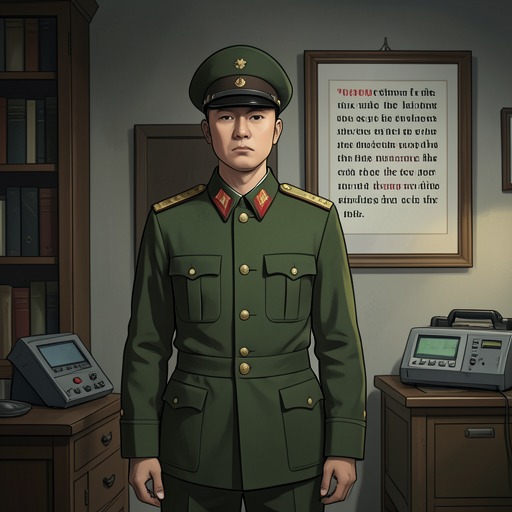
The main gate makes that difference visible. It is monumental, framed by pillars like city walls and faced with imported stone. Recessed electric lights and two large lanterns decorate its crossbeam; sentries with rifles stand on raised red-and-white platforms. Wu first watches from the pavement rather than approaching. He observes the entrance and its traffic until after ten at night, then leaves for the city. The pause outside establishes the gate as more than a point of entry: it is a public boundary separating Wu from the protected world within.
The next morning, Wu uses his army experience to pass the main sentries without challenge. The inner grounds nevertheless recall the garden and house where he worked fifteen years earlier. Flower beds and vegetable plots lie behind iron railings; a vine-covered trellis and a gate wide enough for cars frame the approach to Number One. The likeness to the former household links the provincial residence to his past, while its guarded entry and imposing outer gate emphasize how much the setting—and the people associated with it—have changed.
The Visit to Number One
At the smaller pedestrian gate, a sentry asks whom Wu has come to see. Wu identifies himself as the former household orderly and names Liu Lian. When asked whether the Commander and his wife know he is coming, Wu points to the fact that he has already passed the compound’s main gate. The sentry telephones the house, and Wu asks that Liu Lian be told his name and that he is waiting outside.
The response comes indirectly. The sentry returns with a sealed envelope and reports that Liu Lian is having her hair done and cannot invite Wu in. He adds that she has offered to help if Wu needs anything. The note inside is equally practical: Wu is invited to write down a request, including an amount and address if he wants money. The exchange gives him no private meeting and no conversation; the compound’s household answers his presence through a gatekeeper and a written message.
Wu looks toward the front door, folds the note back into its envelope, and reaches inside his coat for a stiff rectangular object wrapped in red silk. He asks the sentry to give it to Liu Lian, then turns away. The object’s contents are not disclosed. Its careful wrapping and delivery through the sentry make it the sole reply Wu leaves, in place of the request for help that Liu Lian has offered.
Memory, Rank, and Separation
The compound’s resemblance to the former Division Commander’s house gives Wu’s return a double perspective. The garden recalls the setting of his earlier service, but the provincial residence belongs to a higher station and a changed political landscape. In the years since Wu’s departure, the Commander’s advancement and Liu Lian’s continued place beside him have made the difference in status unmistakable. Wu can enter the grounds, yet his old role as orderly does not reopen the household to him.
That separation also contrasts with the practical arrangements that shaped Wu’s earlier military life. His marriage pledge to Zhao Ezi tied commendations, Party membership, advancement, and a move to the city to his prospects in the army. Later, Liu Lian promised to help with his family’s move when promotions resumed. During the Division’s restructuring, the Commander arranged city work and housing for Wu and his family, while household instability and the Commander’s temper meant Wu was told not to return to Liu Lian’s former post. The provincial compound is therefore associated both with the patronage that helped redirect Wu’s life and with the boundary that finally bars him from renewed access to Liu Lian.
The visit does not explain what Wu wants or what the wrapped object signifies. Its ending rests on that unanswered gesture: Liu Lian offers assistance in writing, Wu leaves something for her, and neither enters into a face-to-face exchange. The compound holds the memory of their former intimacy while enforcing their present distance, turning a return to a familiar kind of household into a departure rather than a reunion.