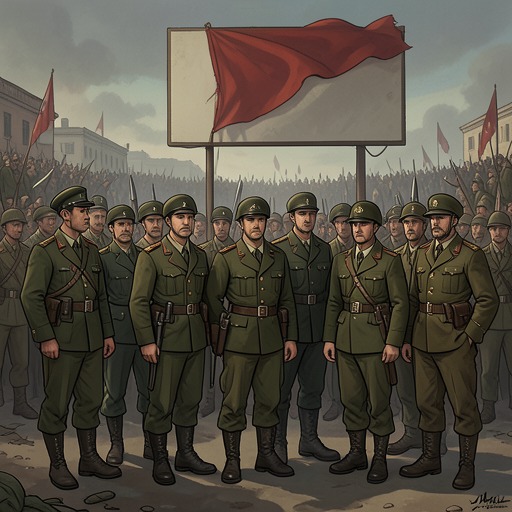
The Military’s Erasure of Wu Dawang’s Past
Serve the People!The Military’s Erasure of Wu Dawang’s Past is the institutional disappearance of a soldier whose private history has become inconvenient to a Division being dismantled. As the army reorganizes, his service is not simply brought to an end: his leave, assignment, access to the household where he served, and public farewell are all managed around him, while the Division’s new watchword becomes amnesia. The arrangement gives Wu Dawang material security, but leaves him outside the account of what is happening to his comrades and to the institution that shaped his life.
A Career Built on a Promise
Before the erasure begins, Wu Dawang has tied his future to a written marital pledge. After marrying Zhao Ezi, he promises to earn commendations within a year, join the Party within two, and become an official within three; if he fails to secure a city home for her, he vows not to return to Wujiagou unless she permits it. The pledge makes advancement more than a military ambition: it is the condition on which he has staked his marriage and his return home.
His early progress stalls. Although he works hard, he does not receive a commendation or join the Party, and letters from Zhao Ezi and her father intensify his fear of failing. A vacant Catering Squad sergeant’s post offers a route upward, and after he takes on the work he advances, joins the Party, and receives commendations. Yet the promised official’s four-pocket jacket remains out of reach. The narrative establishes how thoroughly institutional recognition has come to govern his sense of whether he can fulfill his obligations.
That record of service later becomes a source of vulnerability. After Wu Dawang is assigned to the Division Commander’s household, Liu Lian tells the company Captain and Political Instructor that she wants him to stay in the house while the Division Commander is away in Beijing. The request is framed as a matter of household security and orderly performance, and his superiors approve it. A private relationship is thus enabled through official channels, while the outward roles of Division Commander’s wife and General Orderly remain in place.
Reorganization and Unequal Protection
The institutional break arrives while Wu Dawang is away on furlough. Under pressure from forces the narration describes as invisible, the Division prepares to vanish from the state military system. Its Commander has volunteered to test a pilot scheme for streamlining and restructuring the army; in practice, the plan means disbanding the Division. Most companies are to be demobilized and a minority transferred, and promotions are suspended.
The consequences are not distributed evenly. The Political Instructor tells Wu Dawang that Liu Lian has personally explained his need for serious family leave, and that he may remain away for as long as urgent business does not require his return. The same briefing makes clear that his future has been specially protected: although promotions have been cancelled, the Division Commander has ordered a city job in Wu Dawang’s native province, with housing for his family and work for his wife. The arrangement gives him an exception at the moment when his promised promotion has become impossible through no individual failure of his own.
At the same time, the Division’s household has become unstable. Successive orderlies have angered the Division Commander, and Liu Lian has tried to smooth matters over. Given uncertainty about his temper, Wu Dawang is told not to resume his old post or even visit the house without pressing cause. The order keeps him away from the place where his service and private life had converged. He is relieved that his relationship with Liu Lian remains undiscovered, but the institutional explanation also closes off any ordinary return to that household.
A Departure Arranged Above His Head
During his month and a half of leave, Wu Dawang does not know what has happened in the barracks or what his officers and comrades have said about his disappearance. Liu Lian’s departure plan has worked: at the railway station an official specializing in long-distance berths for senior officers gives him a standard berth ticket and a special military travel permit, instructing him to keep the permit on his person. Once the official leaves, Wu Dawang is alone in the waiting room, and the solitude of his new position arrives abruptly.
When he returns to the Division, his welcome is strikingly hospitable. The Political Instructor offers hot water, scented soap, and a bowl of egg noodles, then lays out the decisions already made about his leave, the Division’s dissolution, the cancellation of promotions, and his city placement. Wu Dawang understands that his affair has not been exposed, but he is not told the full design behind the Division’s disappearance. The personal explanation and the organizational crisis reach him together, in a carefully managed account that reassures him about his own prospects while limiting what he can know.
The city job and housing are settled within a week. As his discharge approaches, Wu Dawang wanders around the barracks, visits comrades from his village, and washes his bedding and clothes. He begins to suspect that his relationship with Liu Lian has been part of a scheme choreographed behind the scenes, though he cannot accept that the Division Commander might have used the streamlining initiative for self-interested ends. Meanwhile, he sees signs of the broader upheaval: three battalions and four companies have already been sent to a remote frontier division, and departing soldiers sit through farewell dinners before venting their anger by smashing windows and equipment and weeping together.
Public Honors, Institutional Amnesia
The speed and care of Wu Dawang’s departure expose the gap between official ceremony and actual control. The Division supplies boxes, crates, and rope for his belongings, and his company prepares a lavish last supper before his train, scheduled for 12:30 that night. At the farewell meeting, the Political Instructor announces that he is receiving a special early discharge for a factory job in the city. The Head of Management then appears in person to announce a Third Order of Merit and praise him as an exemplary servant of the people, attributing the city job to his service. The assembled company responds with silent astonishment; neither Wu Dawang nor his Captain nor the Political Instructor had known the ceremony would take this form.
The honors give his exit a public story of exemplary service, even as the machinery of the Division is eliminating the setting in which that service was recorded. The narrator names the contradiction directly: while Wu Dawang worries about the barracks during his leave, the Division is concentrating on forgetting him, and the commanders are conducting an authorized operation to erase the Catering Squad Sergeant and his personal history. The text does not specify a complete formal procedure for deleting his record; it presents erasure through the coordinated disappearance of the Division, the closure of his old position, and the management of what he is told and where he may go.
The outcome is therefore both protection and exclusion. Wu Dawang leaves with a job and housing for his family, but his departure is arranged urgently and far above his head, and he is separated from the comrades whose service is being dispersed. Years later, returning to Liu Lian’s compound, he receives a brief note offering help with a practical need or money. He hands the sentry a stiff rectangular object wrapped in red silk to give to Liu Lian, then walks away into the snow. The episode closes not with the restoration of an official account, but with a private object and a remembered past that the institution’s amnesia cannot fully contain.