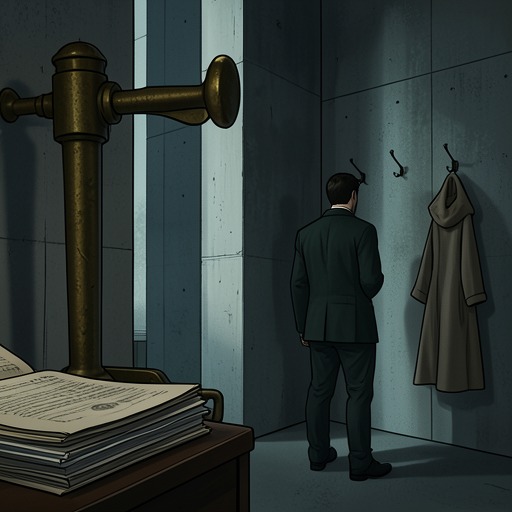
Wu Dawang and Zhao Ezi’s Premarital Pledge
Serve the People!Wu Dawang and Zhao Ezi’s Premarital Pledge turns a marriage into a written timetable for advancement: Wu binds himself to win commendations, join the Party, become an official, and move Zhao Ezi from Wujiagou to the city. The document is at once a promise to his future wife and her father, a measure of the ambitions imposed on him, and a recurring reminder that personal plans depend on institutions beyond his control. Its demands initially propel Wu’s military career; later, its return to the village marks the collapse of the hope it had embodied.
Origin and Terms
The pledge grows out of Zhao Ezi’s father’s doubts about the life Wu can offer his daughter. He points to Wu’s lack of Party membership and commendations, and to his poor prospects for promotion. Wu responds by kneeling and pleading to call Zhao Ezi’s father “Father.” He promises that if he does not meet the demands, he will not show his face in the village again, even for his funeral.
When challenged to show that he can carry out the promise, Wu offers to put it in writing. On a blank sheet of paper, he sets out a sequence of deadlines: commendations within one year, Party membership within two, and official rank within three. If he fails and cannot move Zhao Ezi to a new home in the city, where she can eat steamed rolls every day, he vows never to return to Wujiagou, dead or alive. He also promises to serve her in any way she chooses for the rest of his life if she allows him to come back, and imposes a further penalty on himself for complaining. The pledge combines career goals with domestic provision and personal abasement, making the marriage’s promised future depend on Wu’s success at each step.
From Written Promise to Military Ambition
The agreement is signed shortly before the marriage. Wu’s mother dies two weeks later, and the narrative marks this period as the point after which he is no longer master of his destiny or marital happiness. The pledge thus binds him to a future just as grief and obligation close in around him.
Back in the army, Wu works hard but receives no commendation; the following year, despite struggling, he is not admitted into the Party. Letters from Zhao Ezi or her father asking about his progress intensify his anxiety. When his name again fails to appear on the lists for Party membership and commendations, he contemplates suicide. The pledge is not merely a record of his ambition: its deadlines make each missed opportunity feel like a failure toward his wife and a threat of disgrace before her family.
A vacancy as Sergeant of the Catering Squad offers a possible route forward. The work is filthy and exhausting, but soldiers in the squad are known to advance quickly, and eight ambitious soldiers compete for the single position. Wu eventually transfers to the squad as Deputy Sergeant, taking responsibility for the company’s food and water. In the following year and a half, before he is appointed to the Division Commander’s household, he rises to full Sergeant, joins the Party, and receives commendations and awards with the Political Instructor’s help. The pledge’s early milestones are therefore achieved through a military path that rewards precisely the difficult service others sought to avoid.
The Unfulfilled Clause
Becoming an official remains the one clause Wu cannot fulfill. His blood pressure is judged too high on one occasion; on others, promotion quotas go to different companies or another battalion’s soldier is selected first. The causes vary, but the result is constant: the four-pocket jacket associated with official rank remains out of reach. Wu’s progress is real, yet it does not complete the promise on which his marriage was framed.
His transfer to the Division Commander’s household appears to improve his chances of promotion, but the institution that had offered a route upward is soon transformed. At a seminar in Beijing, the Division Commander volunteers his Division for a pilot scheme to streamline and restructure the army. The Division is to be disbanded, and promotions are cancelled for the time being. In the same briefing, however, the Political Instructor tells Wu that an exception is being made for him: a city job in his native province will be arranged, his family moved there, and work found for his wife. This offers a practical route toward the pledge’s promise of a city life, while the cancelled promotions leave its official-rank clause unresolved.
The Pledge Returned
After returning to Wujiagou on leave, Wu is still at home almost six weeks later. His visitor, a team leader, questions why he has not returned to the army or sought treatment if he is ill. In the courtyard, Wu has been preparing to build an energy-saving stove to reduce the family’s fuel costs, using skills learned in the army. The team leader notices the Serve the People! sign resting on a pile of yellow earth and kicks it apart before leaving. The following day, Zhao Ezi’s father arrives at Wu’s house with the folded pledge in an envelope.
Now old and without further prospects for advancement, Zhao Ezi’s father refuses the water his daughter offers and does not sit down. He says that allowing her to marry Wu was the greatest mistake of his life. Then he opens the pledge, strikes at Wu’s signature, throws the paper at his son-in-law, and returns to the commune to finish the canteen’s end-of-month accounts. The sheet falls to the sandy ground; its pale color is likened to Wu’s face. This public repudiation reverses the document’s original function: what Wu had written to persuade Zhao Ezi’s father to consent to the marriage is now returned as evidence of the promise’s failure.
Significance and Outcome
The pledge’s history links private obligation to the changing structure of military life. Wu’s written deadlines drive him to pursue service, Party membership, commendations, and promotion; the Catering Squad provides a path to several of those goals, but not to official rank. Later, the Division’s planned disbandment and cancelled promotions interrupt that path, while the promised urban job and family relocation offer another, narrower means of providing for Zhao Ezi.
The document’s return does not erase the achievements Wu did make, but it exposes the distance between measurable advancement and the future he promised. Its terms assumed that effort could be converted into rank and a city home; the intervening years show that promotion also depends on quotas and institutional decisions, and that restructuring can abruptly remove the route upward. When Zhao Ezi’s father flings the pledge back at him, the marriage bargain becomes a record of expectations that neither hard work nor military favor could fully secure.