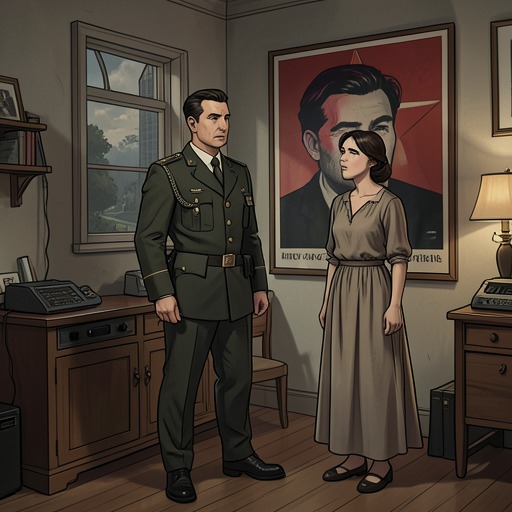
Wu Dawang breaks the Mao quotation frame and asserts control
Serve the People!Wu Dawang breaks the Mao quotation frame and asserts control in a pivotal scene with Liu Lian, when an affair previously conducted through private signals becomes a confrontation over domestic authority and his subordinate place in the household. A discarded uniform, the Serve the People! sign, and a broken framed quotation turn political obedience from an abstraction into objects in the room: Wu first obeys the sign’s reminder of his status, then physically damages a symbol of the order that has kept that status in place.
The household hierarchy enters the scene
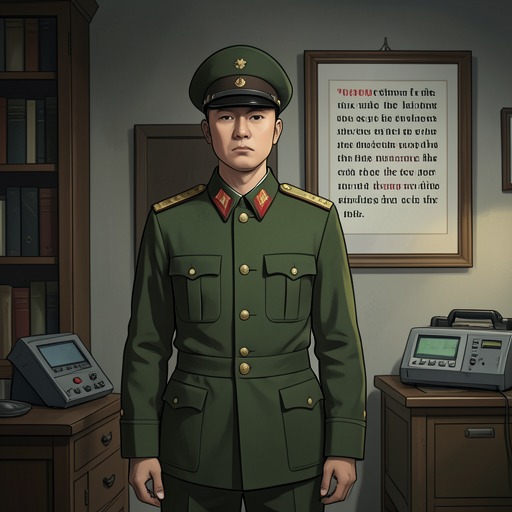
By this point, Wu has become accustomed to imagining himself as Liu Lian’s husband and the master of the house where he serves as orderly. The thought has not made him her actual equal: his position remains that of a soldier serving the Division Commander’s household. On this day, Liu Lian returns with ordinary toiletries, and Wu, hot from his work, hands her his uniform and tells her to wash it. His tone assumes the domestic authority he associates with a husband expecting care after work, although Liu Lian is not his wife.
Liu Lian does not take the uniform. Instead, she silently points toward the Serve the People! sign on the dining table. Her gesture invokes the arrangement that gives Wu his place in Compound Number One: the sign recalls the duty that binds him to serve the household, not to command it. For Wu, the sign’s message rings as a reminder that the authority he has privately imagined remains a fantasy. The brief exchange exposes the difference between his role-playing and the actual hierarchy, and makes a domestic request carry the weight of his professional subordination.
From the sign to the broken frame
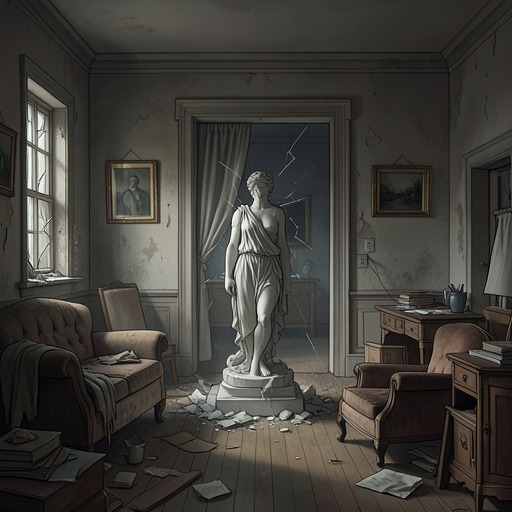
Wu withdraws his hand and lets the uniform fall. He squats, staring toward the vegetable garden and the cracked trunks of a small stand of poplars. Then he turns back, rushes through the house, and finds Liu Lian upstairs in the bathroom. He gathers her up and starts toward the bedroom; as she struggles to free herself, she knocks a framed red-and-yellow quotation by Mao off the wall. Wu steps on it, shattering the glass and leaving a dusty footprint across its words: “Without a People's Army, the People Have Nothing”.
The quotation breaks not through a deliberate plan to attack it but amid the confused movement between the bathroom and bedroom. Yet its damage changes the scene. The two look at the ruined frame, and Liu Lian warns that she could call Security. Wu answers that she was the one who made him come upstairs. His claim shifts responsibility for the broken quotation toward the private signal between them, while the shattered glass makes their intimate conflict visible as damage to an official symbol.
A private code, an exposed resentment
The Serve the People! sign has acquired a double meaning in their affair. Liu Lian points to it to remind Wu of his real status in the house; he understands it through the sexual code they have devised, as a summons to serve her in a private sense. She laughs at the mismatch. Her gesture was not an offer of domestic equality, but he has read it as an invitation, and the difference between those meanings exposes how precarious their arrangement is.
Liu Lian responds to the distressed expression on his face with compassion and places his hand on her breast. The familiar gesture begins as comfort, but Wu’s feelings break into the encounter with greater force. He carries her to the bed, further trampling the damaged quotation. The narration connects his sudden assertion of control to a sense of revenge for a past wrong and of getting the better of an oppressor; the scene thus joins sexual desire to his accumulated resentment without making him fully understand its source. The printed words and broken glass remain around him as debris while the private encounter takes on the charge of a revolt against a hierarchy he cannot otherwise name or overturn.
The aftermath and the meaning of the rupture
Afterward, Wu and Liu Lian lie still, looking up at the ceiling. Liu Lian says they have become animals; Wu replies that he does not care. When she asks where the outburst came from, he says he feels full of hatred inside and that it all came out just then. Asked whom he hates, he cannot say. The exchange supplies no settled political program or clearly identified enemy. Instead, it places the break in the frame beside an emotion that has surfaced bodily and remains unnamed.
The scene’s significance lies in its reversal of the service ritual. The sign that had reminded Wu to accept his subordinate position becomes, in his interpretation, a private summons; the quotation that declares the People’s dependence on their army is knocked down and marked by the soldier’s footprint. Neither object simply disappears: each remains part of the action, first directing Wu’s behavior and then bearing the consequence of his impulsive movement. The break registers a momentary breach in the discipline that has organized his military advancement and household role, but it does not establish that the hierarchy has been permanently overturned. Rather, Wu’s exposed resentment and his claim that Liu Lian called him upstairs make the affair itself a new arena in which service, authority, and control are contested.