Wu Dawang returns and begins the affair with Liu Lian
Serve the People!Wu Dawang returns to Liu Lian after rejecting her first advance, and the encounter turns his disciplined refusal into an affair. The reversal is shaped by his dependence on military advancement, his fear of losing the household post that may secure it, and Liu Lian’s authority over whether he may stay. As she invokes the public language of service to direct him, political duty becomes the idiom through which private desire is acted out; the impending dissolution of his division then cuts the affair short without exposing it to the Division Commander.
Background and Stakes
The encounter follows a choice that Wu Dawang had initially treated as a test of principle. After spending a sleepless night resisting Liu Lian, he returns to her household and asks for another chance, promising that if he again fails to satisfy her, he will go straight back to barracks. The promise is not only a response to personal rejection: his assignment in the Division Commander’s household has raised his prospects of promotion, and he fears that losing Liu Lian’s favor could undo the military future he has worked toward.
That future is already bound to a written promise made before Wu married Zhao Ezi. He pledged to earn commendations within a year, join the Party within two, and become an official within three; if those advances failed to let him move Zhao to a city, where she could eat steamed rolls every day, he vowed never to return to Wujiagou unless she permitted it. He also promised to serve her as she chose and not complain. The pledge makes his career more than an individual ambition: it is the means by which he expects to fulfill a bargain with his wife and father-in-law.
The bargain has proved difficult to honor. Wu labors without earning a commendation and struggles for admission to the Party; letters from Zhao and her father-in-law asking how he is progressing deepen his panic. The vacant position of Sergeant of the Catering Squad offers a way forward because its unpleasant, exhausting duties are known to bring rapid advancement. After Wu wins a place in the squad, he becomes its deputy sergeant, later rises to full sergeant, joins the Party, and receives commendations. His promotion to officialdom, however, remains out of reach. The post in the Division Commander’s household therefore carries the promise of another step toward the pledge—and makes the prospect of returning to barracks especially threatening.
The Return and Reversal
When Wu arrives, Liu Lian is still hurt by his earlier refusal. He lowers his eyes and asks her to give him another chance, offering to return to barracks if he fails her again. She remains cold and tells him not to prepare her usual soup: she wants only two boiled eggs, after which he should go back. Her response makes clear that his return has not yet repaired the injury caused by his refusal.
Wu tries to answer the rejection through service. He prepares sweetened egg-drop soup and writes a self-criticism admitting that his understanding of the Serve the People principle has been seriously mistaken. Carrying both upstairs, he offers practical care and an official-sounding account of his error together. Liu Lian refuses the gesture and says that it is too late: she has told the Political Instructor to send Wu back to his company and arrange his discharge at the end of the year, so that he can go home to look after his wife.
The order transforms the stakes of the exchange. Wu had imagined that his self-criticism might restore their relationship, but Liu Lian’s decision threatens his place in the household and his prospects. He understands that she is responding not to a sudden whim but to the deliberate advance he rejected the previous evening. The narrator distinguishes his new regret from simple regret at having passed up sex: Wu fears the consequences for his future, which he sees as liable to fall back into darkness.
Tears come to Wu’s eyes, and he falls to his knees before Liu Lian. He begs her to give him another chance and says that if he fails to serve the people this time, he will throw himself under a bus or in front of target practice. Liu Lian asks how he proposes to serve; he answers that he will do whatever she wants. She tells him to run naked three times around the drill ground. Wu places his written self-criticism on the floor and waits, poised to obey. The reversal is complete: he has moved from refusing her advance to offering himself in a humiliating test that she sets.
Service as Private Performance
Liu Lian’s test turns on the repeated public formula of service. As Wu reaches for his collar, she tells him to take off his clothes and says that he is serving the people. He removes his jacket, revealing an undershirt printed with the same message; when she repeats her command, he removes the shirt as well. She then tells him to continue, and after hesitating he takes off his trousers. The scene recasts the language of political duty as a private instruction between the two characters.
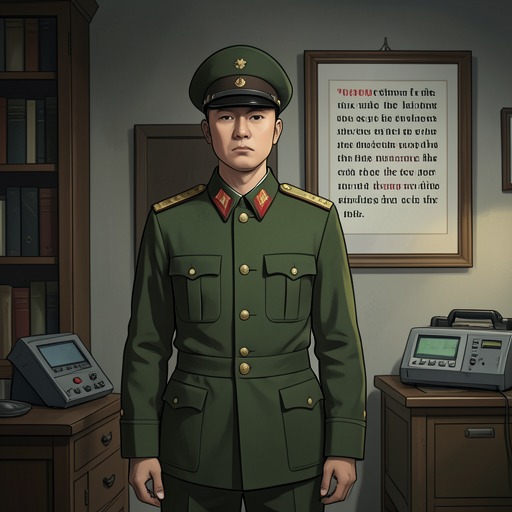
The transformation is especially sharp because Wu’s self-understanding has rested on political correctness and his experience of serving the public through military work. Now he repeats that ideal under Liu Lian’s direction, in a household where she can decide whether he remains in his post. The uniform and the slogan do not disappear from the scene; their meanings are redirected. What had marked Wu as a soldier and a model Party member becomes part of a performance in which he must demonstrate submission to Liu Lian.
Their gazes meet as antagonistic passion rises between them, and Liu Lian repeats the command to serve. The narrative presents the moment as both earnest and absurd: neither character, it says, fully grasps the ludicrousness of the roles they are playing. That farcical quality does not cancel the emotional force of the reversal. Instead, the public vocabulary supplies the scene’s structure, while the characters’ altered relationship gives it a new, private charge.
Affair and Interrupted Future
The encounter begins the affair, but its future is constrained from the outset by Wu’s career and family obligations. He remains a soldier pursuing promotion so that he can fulfill his pledge to Zhao Ezi, while his intimacy with Liu Lian develops in the very household that had improved his chances of advancement. The same post that draws him toward Liu Lian thus links desire to institutional dependence and to a promise made to his wife.
Later, as the division’s restructuring accelerates, the Political Instructor tells Wu that the Division Commander has volunteered to test a plan to streamline and restructure the army. The practical consequence is that the division will be disbanded. Promotions are canceled, but the Division Commander has ordered that an exception be made for Wu: he is to receive a job in a city in his native province, with his family moved there and suitable work found for his wife.
The restructuring also makes the affair more precarious. With personnel in the barracks unsettled, the Division Commander’s household has seen a high turnover of orderlies; each has somehow provoked the Commander’s anger, despite Liu Lian’s efforts to smooth matters over. The Political Instructor therefore tells Wu not to return to his old post or even visit the house unless there is pressing business. Wu feels enormous relief as he realizes that the affair has not been discovered. At the same time, his imminent departure brings the lovers’ unusual romance toward an abrupt close, leaving the promised reunion unfulfilled.
Narrative Significance
This action is a turning point in Wu’s relation to both political language and personal ambition. His first response to Liu Lian had been refusal; his return makes the cost of that refusal newly visible when she threatens to send him back and arrange his discharge. His plea, written self-criticism, and willingness to obey her test show how readily the language of public service can be made to serve a private relationship—and how the power to interpret that language belongs, in this household, to the woman who controls his position there.
The episode also binds the affair to the story’s larger pattern of promises and institutional reversals. Wu’s premarital pledge makes advancement the route to a better life for Zhao, but his closeness to Liu Lian becomes entangled with the same advancement. Later, the army’s reorganization cancels promotions, offers Wu an urban job, and removes him from Liu Lian’s household, closing one path even as it opens another. The affair begins in a moment of personal submission, but its ending is shaped by decisions made far beyond the couple: the restructuring of the division and the transfer of Wu’s life away from the post that brought them together.