Christianity
ShōgunChristianity in the novel is never only a private belief: it reaches into diplomacy, law, moral conduct, and the rites surrounding death. Its claim to offer a path to everlasting life is voiced by believers, yet the conduct of its institutions is questioned even by a devoted Christian. In Japan, its priests and adherents must also negotiate with rulers who distinguish religious presence from foreign political or military power. The result is a faith repeatedly tested by the gap between doctrine, institution, and action.
Faith and the Church
Brother Michael offers the clearest account of that internal tension. Recalling an eight-year journey and return, he describes the food, filth, and ugliness he encountered with revulsion, and condemns the morals and mistresses, greed, pomp, hypocrisy, and double standards of many churchmen. His criticism is not a rejection of Christianity: he insists that he found God and truth among some of them, in cathedrals and cloisters as well as among the Fathers. He ultimately affirms Catholic Christianity as the path to everlasting life, even while acknowledging how rarely he found a glimmer of the truth he sought.
Michael’s distinction between human wrongdoing and divine teaching sharpens his account. Terrible acts may be committed in God’s name, he says, but they do not therefore come from God; earthly life is a vale of tears and preparation for Everlasting Peace. His response holds judgment and devotion together rather than allowing one to erase the other. When John Blackthorne asks about the horrors of the Inquisition, prisons, and witch trials, Michael acknowledges terrible things and the scarcity of wisdom among people. Yet he can also say, “Even some heretics can be good, neh?” The line does not dissolve the divisions between confessions, but it makes room for moral recognition across them.
Religion and Japanese Sovereignty
Christian belief enters a political order in which foreign presence is conditional. Toranaga tells Blackthorne that foreigners are in the country by permission and that public mischief or quarrels are punishable by death. This is not presented as a theological argument; it is a statement of jurisdiction. Blackthorne’s account of Dutch letters of marque likewise meets questions about lawful authority: Toranaga asks whether the Netherlands had been a vassal of the Spanish king and whether its revolt makes Blackthorne’s allies rebels against their lawful ruler. Christian and European claims to legitimacy are thus examined through the political categories of rebellion, service, and permission.
The limits Toranaga sets on foreign conflict are equally explicit. He says no daimyo would permit one foreign nation to attack another on Japanese soil, or to kill Japanese people there. Although he acknowledges that an enemy might be harried on the high seas, he rejects a land attack in Japan, which he calls the Land of the Gods. The policy separates permission to practice or negotiate from permission to import foreign warfare. It also places Christian powers, particularly those connected to the Portuguese and the Jesuits, inside a Japanese framework of rule rather than granting them an independent right to act.
That boundary does not prevent religious diplomacy. Father Alvito promises to do what he can to persuade Lords Onoshi and Kiyama to ally with Toranaga. In return, Toranaga agrees that on the forty-first day the Jesuits may lay the foundation stone for the largest Christian temple in the Empire. The proposed temple is both a religious institution and the stated return within a political bargain. Elsewhere, Alvito urges Toranaga to trust in God; Toranaga replies, “I do, but more in Toranaga.” The exchange captures the difference between the priest’s appeal to providence and a ruler’s reliance on his own judgment without turning either position into a simple declaration of unbelief.
Christian Ethics and Conflict
Christianity also supplies a standard by which violence is judged, though the standard competes with other codes and political decisions. In a discussion of whether a man will kill, the stated reasons include that his opponent is unarmed and will not fight back, that he is Christian, and that Toranaga has decided the time is not right. The explanation makes clear that restraint can arise from several authorities at once: a rule against killing the defenseless, religious identity, and the command of a ruler. The account does not treat those grounds as interchangeable, even when they lead to the same refusal.
Forgiveness exposes the distance between Christian teaching and the instincts of Toranaga’s military circle. The conversation identifies the teaching attributed to Jesus—that a person should forgive an enemy—while Naga dismisses such forgiveness as stupid. Toranaga agrees that forgiving an enemy is foolish. The scene presents the doctrine plainly, but surrounds it with the practical suspicion of men who regard an enemy as a continuing danger. Christianity’s ethical claim remains audible without becoming the governing rule of their political world.
Death, Sacrifice, and Christian Memory
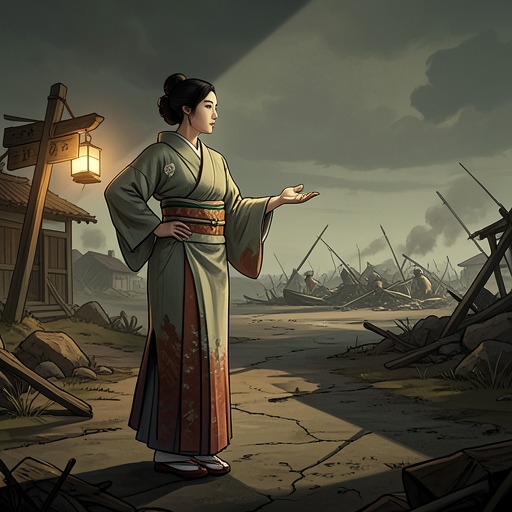
The faith’s most intimate role emerges in the treatment of Toda Mariko’s death. John Blackthorne tells Father Alvito that, just before she died, he gave her a benediction and what last rites he could, and repeated the rites at her cremation. Alvito answers that, according to their teaching, this would not be valid; two days before her death, however, Mariko had asked for and received absolution from the Father-Visitor and had been sanctified. The distinction places the authority of the sacrament within the Church, while confirming that Mariko had received its rite before her death.
Blackthorne concludes that Mariko knew she had to die and that, whatever happened, she was a sacrifice. Alvito agrees and asks God to bless and cherish her. Her funeral is to take place in the cathedral at Nagasaki, with the Father-Visitor conducting the service and part of her ashes entombed there. The rite gives her death a Christian destination as well as a public form of remembrance.
Toranaga’s response shows how that religious meaning also carries political consequence. He says Mariko was a very special person and that her example merits honor. He recognizes that her being both his vassal and a Christian will matter to other Christians and to people considering conversion. Her faith is therefore neither erased by her service to Toranaga nor confined to private consolation: it shapes how her death can be witnessed by a community and understood by potential adherents. Christianity remains divided between spiritual conviction, institutional authority, and political use, but Mariko’s example makes those dimensions converge in memory.