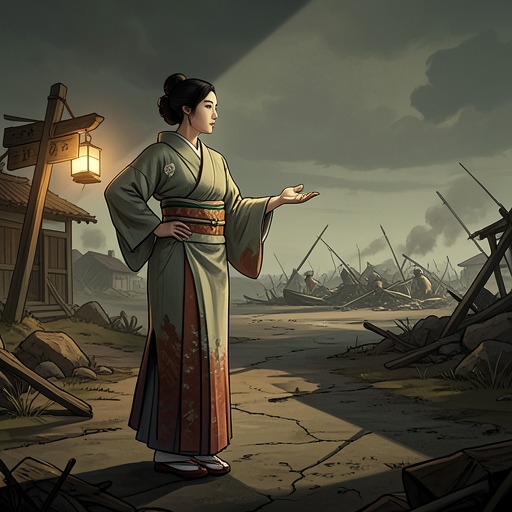
Eightfold Fence as Inner Refuge
ShōgunThe Eightfold Fence as Inner Refuge is Mariko’s image for a cultivated inner privacy: when walls and watchful ears offer no seclusion, a person can learn to withdraw inward and protect a space of solitude. The idea connects customs, language, attention, and poetic imagery to a practical discipline of endurance. John Blackthorne recalls it as he lies listening to violence outside his room, and the scene tests both its usefulness and its limits.
Privacy Without Seclusion
Mariko explains the Fence to Blackthorne after he complains about the lack of privacy around him: people are always nearby, and paper walls do little to block eyes or ears. Her answer is not that privacy can be secured by changing the room. Instead, she describes learning to disappear within oneself, building an inward refuge that cannot be entered simply because other people are physically close. In her account, this capacity is necessary for survival in a society where privacy is scarce; without it, people would be driven mad and turn on one another or themselves.
The Fence is not one technique but a protective space made possible by many practices. Mariko describes a maze of rituals, customs, and taboos, as well as linguistic nuances that let speakers politely avoid questions they do not wish to answer. These conventions provide ways to manage what others can see or learn without openly rejecting the social encounter. The inward refuge therefore depends both on private discipline and on shared forms of conduct: the individual withdraws, while ritual and language help make that withdrawal possible within public life.
Training Attention
Mariko presents the ability to close one’s ears as a learned skill, cultivated from childhood until it becomes second nature. Its first movement is to cleanse the mind of other people and shift attention to another plane. She offers watching a sunset and listening to rain as aids, asking Blackthorne to notice that rain has different sounds. If attention settles fully on such immediate experience, she says, the present vanishes.
Other exercises make the discipline deliberately paradoxical. Listening to blossoms falling or to rocks growing means attending not to visible events but to signs addressed to the inner center. Mariko connects these exercises to awareness of life’s transience and to the pursuit of harmony. The Fence thus does not depend on denying that the world is present: it redirects attention from intrusive people toward images that can be contemplated privately. Her laughter at the end of this explanation, after many flasks of sake, gives the teaching an intimate, playful setting without undoing its seriousness.
The Poem and Its Image
To explain what the Fence means, Mariko recalls a poem she identifies as among the earliest ever written, preserved in the Kojiko, which she describes as the first history book to have been written down about a thousand years earlier. In the poem, clouds rise for lovers to hide within, and an Eightfold Fence encloses the clouds. Its enclosing image makes concealment seem not merely defensive but sheltering: the lovers’ refuge is created by a boundary that lets them be together beyond the reach of the surrounding world.
The poem also gives the concept a scale beyond an individual coping practice. The Fence is at once an image of enclosure and a means of preserving a private inward life. Mariko’s teaching moves from the historical poem to ordinary habits of attention, joining a celebrated image of refuge to exercises that can be practiced amid daily exposure. Yet her warning not to mistake smiles, ceremony, and gentleness for complete openness complicates the image: outward courtesy does not guarantee inward access. People may remain distant and alone beneath the forms of social attentiveness.
Blackthorne’s Test of the Fence
The teaching returns to Blackthorne during the confrontation between Toda Buntaro and Mariko. Mariko has warned him not to interfere and reminded him to remember the Fence. As Buntaro’s fury continues outside, Blackthorne deliberately tries to redirect his thoughts. He considers the Musket Regiment, home, Felicity, the prospect of obtaining a ship, and his ties to Baccus, Toranaga, and Kasigi Omi. The remembered teaching becomes an immediate discipline: instead of listening to the quarrel, he attempts to place his attention elsewhere.
That effort does not hold once the sound of blows reaches him. At the second blow, Blackthorne is on his feet and opens the shoji, ready to confront the armed guard outside Mariko’s door. Fujiko intervenes, positions herself between Blackthorne and the guard, and leads him back into the room; afraid, she silently warns him to remain quiet. The sequence makes the Fence neither a simple cure for distress nor a guarantee of safety. It helps explain why Blackthorne tries to restrain himself, but the violence breaches the inward refuge he is attempting to create. Its significance lies in that tension: inward privacy can preserve composure under constant exposure, yet it cannot make another person’s suffering inaudible or remove the choice of whether to act.