Toranaga's Brown Army
ShōgunToranaga's Brown Army is the military faction identified with Toranaga, marked by brown uniforms and scarlet insignias bearing his cipher. The narrative presents it not only as an armed force but as a visible system of allegiance: its guards control access to fortified places, its escorts move Toranaga and his household through hostile territory, and its soldiers can turn a threatened confrontation with Ishido's Gray Army into a disciplined standoff rather than a general battle.
Identity and Appearance
Toranaga's Brown Army is distinguished from Ishido's Gray Army by color and insignia. When Blackthorne sees Hiro-matsu arriving in an open palanquin, the fifty samurai around him wear stark brown kimonos, black belts, and five scarlet insignias. The insignias are identified as Toranaga's cipher, while the samurai carry long spears with small flags. Their uniformity makes political affiliation immediately legible: Blackthorne has already seen gray-clad soldiers elsewhere, and the contrast helps him recognize that the two armed groups are not simply separate units but hostile factions.
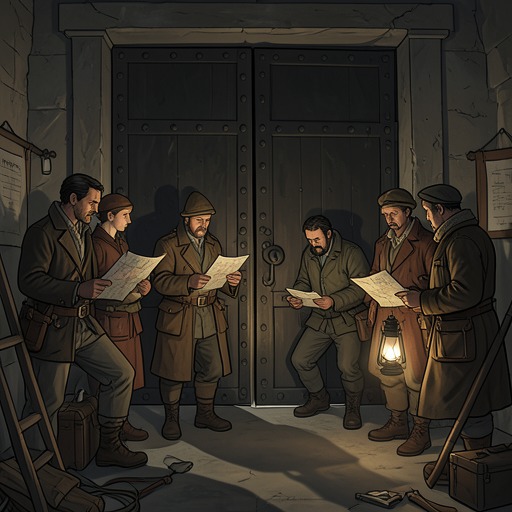
The army's presence is also spatial. At a fortified strongpoint within Osaka Castle, Blackthorne finds a great iron-fortified timber gate guarded by Toranaga's Brown Army; they are the only soldiers of that faction he has seen inside the castle. Their welcome for Hiro-matsu contrasts with the hostility the arriving party has faced from the Gray soldiers outside. The gate therefore marks more than a defensive boundary: it divides areas of access and allegiance within a place where control is contested.
Command and Military Presence
Hiro-matsu appears as a senior figure within the army's command structure. He travels in a palanquin with fifty uniformed samurai around him, and the ceremonial reading of his document at the castle gate establishes his authority through both military escort and formal procedure. His arrival provides Blackthorne with a firsthand view of the faction's order: the escort carries weapons and standards, while passage through the gate depends on an official presentation and recognition.
The army also supplies protection for Toranaga's movements. During the nighttime departure from Osaka, a force of sixty armed samurai assembles outside the gate. Every third man carries a flare, and the soldiers stand in neat lines while Yabu and Buntaro confer at the head of the column. Their armor, bows, quivers, and disciplined formation prepare them for a journey through dangerous territory. Blackthorne, dressed in a brown kimono but unarmed, is acutely aware of the contrast between his exposed position and the armed escort around him.
Conflict with Ishido's Gray Army
The hostility between the two factions becomes unmistakable when Blackthorne is taken by an ambushing party and a second group approaches. The newcomers include both Browns and Grays, with Toranaga's Brown Army in the vanguard. The two parties halt about seventy paces apart and take skirmish positions. The bandit leader draws his sword and demands that the approaching soldiers clear the way; his men unsheathe their own swords, and one stands behind Blackthorne with a raised blade. The dispute over who controls the captive threatens to become a fight between armed groups.
Yabu emerges from the opposing party and orders his men forward. He charges with a battle cry, and his force rushes with him, with the Grays not far behind. The episode shows the fragility of factional cooperation: soldiers from different sides may appear in the same moving column, yet their loyalties and immediate objectives remain distinct. Toranaga's Brown Army is prepared to assert its claim by force, but its action unfolds amid a larger, unstable contest rather than as an isolated encounter.
Protection, Discipline, and Political Function
During Toranaga's disguised passage through Osaka, Toranaga's Brown Army provides the armed screen that makes the deception possible. When Ishido parts the curtains of a litter and Toranaga is briefly exposed, Blackthorne draws attention to himself by behaving wildly. Ishido turns on him, draws his sword, and strikes him; Blackthorne lunges back, and the Brown soldiers close around him and the litters. The Gray soldiers leap to Ishido's defense, leaving the two forces facing one another in a standoff. Yabu restrains Ishido's sword arm, while Buntaro helps seize Blackthorne and then places himself behind Toranaga's litter, ready to shield his lord from arrows if fighting begins.
The column continues toward the gate, with Yabu falling into place as a rear guard while he fears that the Gray soldiers may recognize Toranaga and expose the escape. The episode makes the army's political function concrete: its soldiers must protect a leader whose presence cannot be openly acknowledged, and their discipline buys him the passage that the disguise alone cannot secure. Buntaro's protective position and the armed men around the litters turn personal loyalty into an immediate defensive formation.
That discipline is not the same as perfect security. In a separate nighttime intrusion into a fortified residence, an assassin scales a wall, crosses corridors, and kills a Brown guard at a door before entering. Brown sentries and patrols are present, but the intruder evades them. The episode gives the faction's defenses a limit: a guarded stronghold can still be penetrated by stealth, even as the army's visible strength shapes open confrontations.
Narrative Significance
Toranaga's Brown Army gives political division a physical form. Its brown dress and scarlet cipher identify service to Toranaga; its guarded gates and armed escorts make that service operational; and its encounters with Ishido's Gray Army show how quickly political rivalry can become armed confrontation. The soldiers' restraint during the Osaka standoff matters as much as their weapons: they surround Toranaga's litter, protect their lord, and hold their position without turning the crisis into an immediate battle. The faction's force is therefore expressed through both capacity for violence and the discipline to delay it.