Japanese Council of Regents
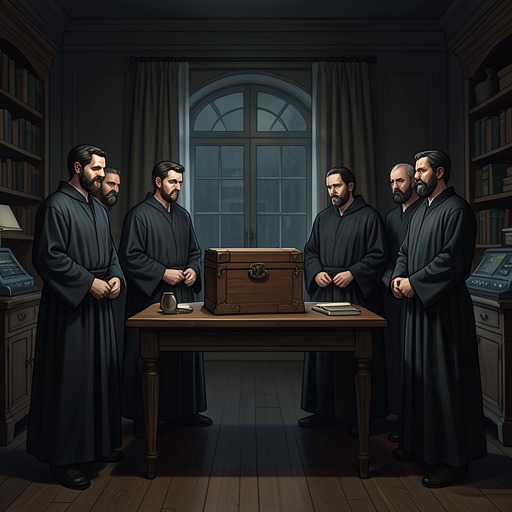
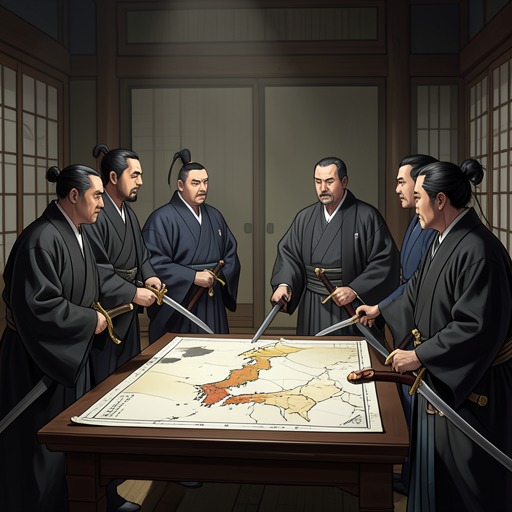
ShōgunThe Japanese Council of Regents is the five-daimyo military government created by the Taikō to rule the empire while his son Yaemon was underage. Its authority rests on the Taikō’s final arrangements and the regents’ public oaths, but its unanimity rule also restricts what it can do. The council therefore embodies the novel’s central political tension: a lawful effort to preserve the realm’s succession that leaves its two most powerful members struggling to control a system designed to prevent unilateral rule.
Creation and Constitutional Duties
The Taikō appointed five eminent daimyos on his deathbed to govern during Yaemon’s minority. At the time described, Yaemon is seven; the regents have sworn to preserve the realm intact until he reaches his fifteenth birthday and inherits. Their public, sacred pledge binds them both to the Taikō’s son and to his line, making continuity of succession the council’s stated purpose.
The regents also swore to govern unanimously. That requirement is more than a formal ideal: it means that no change can be made without agreement, and Yabu explains that the arrangement leaves little that can be altered before Yaemon inherits. The council’s legal authority is thus coupled to a procedural restraint. It is meant to rule in the heir’s name, but it cannot easily turn that authority into coordinated action when its members distrust one another.
Power and Political Deadlock
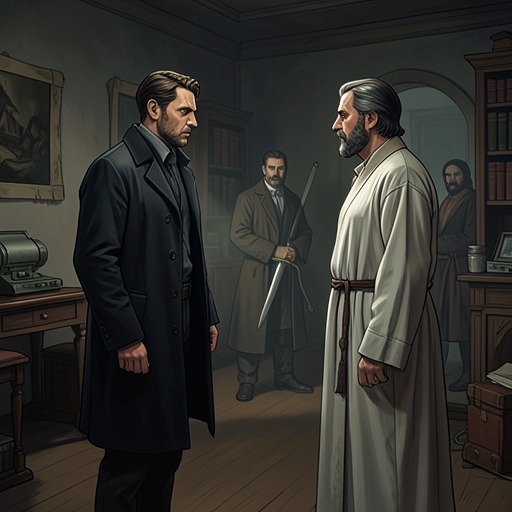
Although all five regents are eminent lords, the account distinguishes formal membership from practical influence: only Toranaga and Ishido possess real power. Toranaga is the council’s president, while Ishido is his chief rival. Their struggle unfolds within the council’s rules, but those rules do not dissolve the contest; instead, unanimity makes agreement difficult precisely when the stakes are highest.
Yabu describes the regents as despising one another so deeply that agreement is nearly impossible. In his analysis, neither Toranaga nor Ishido can yet carry the other three. His wife anticipates a different danger: that four might eventually unite against one through jealousy, fear, or ambition. Yabu imagines this as a recurring political cycle in which the isolated regent is defeated and loses his lands, after which the victors must appoint another fifth member and may face the same division again. This is his account of how the Taikō’s arrangement could be bent toward war, not evidence that every step of the cycle has already occurred.
The council’s structure therefore creates both a safeguard and a vulnerability. Unanimous rule obstructs any one regent from openly remaking the settlement, yet a sufficiently powerful coalition could threaten the member left outside it. The succession oath preserves a formal common purpose while personal rivalry makes that purpose increasingly difficult to serve.
Authority Beyond the Council
The council’s power reaches into the domains of individual daimyos. Yabu can exercise broad authority in Izu, but he recognizes that he remains subject to the council’s overriding authority and to the Taikō’s edicts, which remain legally in force. When he considers killing a Christian priest and suppressing Christianity in his domain, those overlapping constraints stop him: the Taikō had ordered Portuguese visitors protected and their religion tolerated within limits, with priests permitted to proselytize within limits. Yabu’s personal hostility cannot simply cancel the law that governs his domain.
The distinction between local command and imperial authority also shapes the council’s political setting. When Toranaga is away in Osaka for a confrontation with Ishido, Yabu and neighboring independent daimyos are invited to wait in Yedo for his return. Yabu understands that he and their families are, in practice, additional protection for Toranaga’s safe return from an enemy fortress. The arrangement makes political obedience tangible: great lords can be caught between their own interests, the council’s authority, and the security of the regent whose position they are expected to support.
Consequences for War and Negotiation
The council’s deadlock casts war as a danger that may emerge from within the legal order rather than from an open rejection of it. Yabu fears that the contest between Toranaga and Ishido will force lesser lords to choose a side; his image of four regents isolating one shows how a formally collective government can become a mechanism for concentrating power against a rival. The council’s vows restrain action, but they do not remove the ambition or fear that could make those vows politically fragile.
Its rules also form part of the wider negotiations among political and religious authorities. Toranaga promises Christian leaders that they may lay the foundation stone for a major temple in the empire on the forty-first day, while negotiating for their help in persuading other lords to support him. The scene presents religious permission and political support as linked bargaining resources; it does not establish that the council itself grants the promised land. Alongside the Taikō’s edicts and the authority of individual lords, the council is one of several powers whose rules and permissions shape what can be done.
As an institution, the Japanese Council of Regents is therefore more than a backdrop to the rivalry between Toranaga and Ishido. Its oath protects Yaemon’s claim, its unanimity rule limits immediate change, and its members’ division threatens to turn those safeguards into instruments of exclusion. The contrast between its carefully stated duties and the personal contest conducted under them gives the succession crisis its political force.