Thomas Woolgar’s Chronicle Manuscript
ShrineThomas Woolgar’s Chronicle Manuscript is a group of Latin writings attributed to the sixteenth-century priest Thomas Woolgar. Its account connects the deaths of three children and the execution of the nun Einor with a curse that the author believed remained active centuries later. The manuscript matters not only for the history it claims to preserve, but also for its unstable mixture of confession, self-exculpation, and supernatural testimony: its revelations unsettle Gerry Fenn without resolving whether Woolgar was recording events or the products of a troubled mind.
Physical form and recovery
The main documents consist of three books, each roughly twelve by eight inches, with stiff yellow vellum covers and leaves fastened with twisted vellum ties. Their dates run consecutively from 1556. The writing is carefully formed, though the brown ink has faded, and the text is in Latin. A bundle of loose leaves fell from one volume; unlike the orderly books, these pages were scrawled and difficult to read. One dated entry is from 1560, placing at least part of the testimony several years after the earlier volumes.
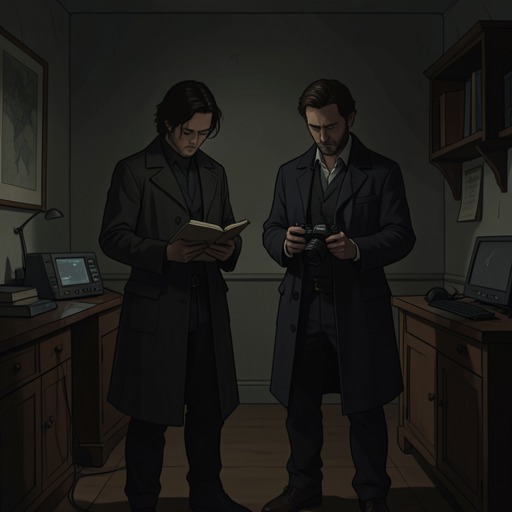
Gerry Fenn found the books while searching a church chest for older records. The chest also contained vestments, papers, service books, and an accounts ledger from St. Peter’s dated 1697, but those materials did not meet his immediate purpose. With a storm battering the church and the door shaking in the wind, he placed the three vellum books and their loose leaves in his bag and left the rest of the chest’s contents behind. The contrast between routine parish records and Woolgar’s troubled papers marks the chronicle as a startling personal testimony embedded in an otherwise ordinary archive.
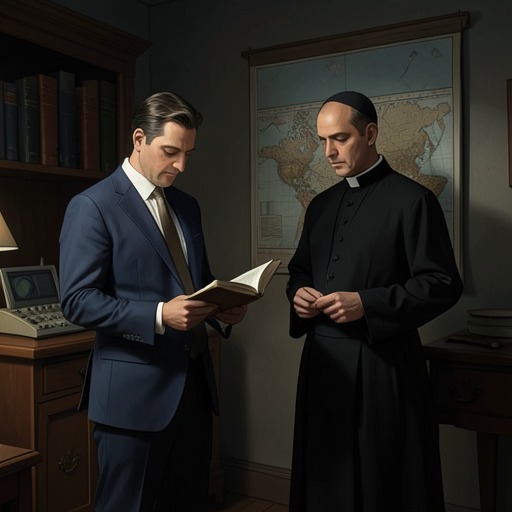
The manuscript reached Fenn in a second form through Monsignor Delgard’s notebook. Delgard had translated most or all of the old papers and added his own notes and initials. He warned that the handwriting was at points almost illegible, that the writer’s Latin was sometimes faulty, and that interpretation was necessary to make sense of unclear passages. His caution makes the translated text an explicitly mediated document: readers encounter Woolgar’s account through both the author’s disordered pages and Delgard’s editorial judgment.
Woolgar’s account of Einor
The dated testimony presents Woolgar as a priest who had once been content in Banfield, where he describes the village as his home and its people as those in his care. He recalls Einor as a nun widely regarded as virtuous: people sought her blessing, brought her gifts, and credited her with healing ailments. She gave some gifts to the priory and secretly stored others in the crypt of St. Joseph’s Church. Woolgar’s account therefore sets her public reputation for piety and generosity against the hidden misconduct he says he later witnessed.
Woolgar admits that he was Einor’s accomplice and describes himself as guilty, but he repeatedly shifts responsibility onto her, claiming that her influence and potions weakened his ability to resist. At other moments he acknowledges that his own will was involved. This conflict is central to the document’s character: it is a confession that also works to excuse its writer. He portrays Einor as more than a conventional witch, yet offers no stable explanation of what he believes she was. His report that she appeared to him after death, and that he feared her presence, is presented as his testimony rather than as independently established fact.
Accusations, trial, and execution
According to Woolgar, suspicion grew after three children disappeared over several months. He says that he and Einor were responsible for their deaths, while also describing the children as having been drawn to the nun because of her reputation. The Prioress’s declining health and the later abuse of two young novices further shape his account of the priory’s crisis. One novice, Rosemund, is described as Einor’s willing companion; another later died by suicide after confessing her involvement to the Prioress. These claims make the chronicle more than a supernatural narrative: it records the author’s account of abuse, deaths, concealment, and institutional scandal.
When the Prioress confronted him, Woolgar confessed to his conduct with Einor but concealed the full extent of his part in events. He says he accepted the explanation that Einor was a witch and heretic, and denounced her to an ecclesiastical officer. He also describes his father’s influence with the Church and the Prioress’s awareness that the truth could implicate him. The account thus places the prosecution within a web of personal and institutional interests, not simply a dispute over belief.
Woolgar then recounts how news of the accusations spread through Banfield and brought villagers to St. Joseph’s Church. Einor was found there with Rosemund and taken by the crowd. Woolgar says that he denied Einor’s accusation that he had been her partner in wrongdoing, and redirected the crowd’s attention to a supposed bodily sign associated with witchcraft. The villagers treated that sign as proof. His testimony describes a mob assault, an ordeal in water, a coerced confession, and Einor’s execution by hanging and fire. He records her curses against him and the people present, but the chronicle does not independently verify either the curse or the supernatural interpretation he gives it.
Removal, concealment, and the final warning
Woolgar writes that his father and a bishop later attributed his ravings to drugs and a disturbed mind. They removed him from Banfield and arranged for him to serve at a small church on his father’s estate, where his claims about the events were disregarded. He says that the church chest was moved there too, along with parish vestments. In his account, his father searched the records for material that might shame the Woolgar family, but found no earlier written admission of the affair or of wrongdoing against Einor. Woolgar’s own manuscript, concealed for a future reader, was the testimony that escaped that search.
In the 1560 entry, Woolgar says he had not seen the Prioress since his removal and had heard that Rosemund had been expelled from the priory. He describes years of containing his fear while others continued to regard him as mad. The document ends with his insistence that Einor’s spirit was not at rest and that his writing should warn whoever found it. He also links his continuing attachment to her with his guilt. The ending offers no independent confirmation of his fate; its force lies in the warning he leaves behind and in the uncertainty about whether he believed it himself.
Narrative significance and uncertainty
Monsignor Delgard’s notes identify the author as Thomas Woolgar, a priest of St. Joseph’s Church in Banfield who later served elsewhere, and record the end of the document. Fenn reads the translation late at night after finding Delgard absent, and the chronicle’s claims provoke a direct conflict between evidence and disbelief. Fenn wonders whether Woolgar was insane or whether the account explained the contemporary disturbances at St. Joseph’s Church. He cannot easily dismiss the possibility: earlier that day, he had experienced what he understood as a malignant presence in a church, and Nancy had also been frightened. Yet he remains reluctant to accept a supernatural explanation.
The manuscript therefore functions as a historical bridge and as an unreliable first-person account. Its precise dates, named institutions, and details about parish life give it the form of a record, while its confused passages, terror, self-justification, and uncertain translation complicate its authority. Woolgar’s narrative also shows how accusations of witchcraft could turn personal guilt and communal grief into a public prosecution, with the accused made to bear the blame that the writer himself partly admits. The chronicle connects that past to the novel’s present without settling whether the curse is real, whether Woolgar’s visions were delusions, or how much of the translated testimony can be trusted.