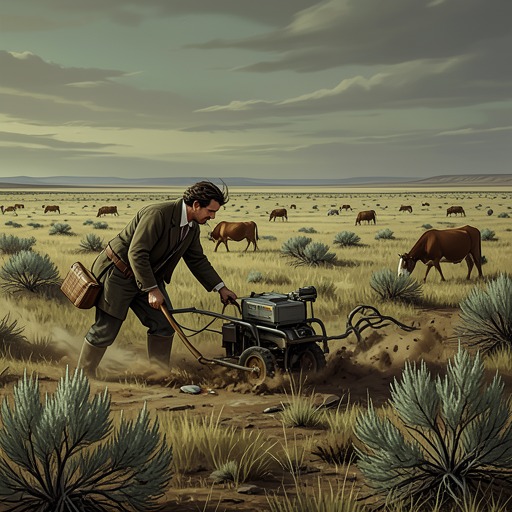
Aicao Songji
Silent SpringThe sage grouse is the bird most closely identified with the western sagebrush plains, a species whose life is bound to the plant that gives its habitat its character. In Rachel Carson’s account, the grouse is not simply an emblem of wild country: it depends on sage for food and shelter, and its courtship displays in turn help shape the ground beneath the shrubs. That reciprocal relationship makes the bird’s decline a warning that efforts to remake the land as grass pasture can unsettle an entire living system.
A Bird Shaped by the Sage
The sage grouse evolved alongside the plants and animals adapted to the demanding conditions of the high western plains and the lower mountain slopes. Carson describes the sage and grouse as exceptionally well matched to their habitat: the bird’s original range coincided with the range of sage, and, as the sage lands were reduced, grouse populations dwindled. Its distribution and fortunes thus track the fate of the landscape rather than an isolated change in a single species.
The relationship is practical and close. Low sage on foothill ranges shelters the grouse’s nests and young; denser stands serve as places to loaf and roost; and sage remains its staple food. The plant is not incidental cover that could readily be exchanged for another kind of vegetation. It provides necessities across the bird’s life, connecting habitat structure directly to survival and reproduction.
A Reciprocal Ecological Relationship
The grouse is also an active part of the relationship. Its conspicuous courtship displays help loosen soil beneath and around the sage, encouraging grasses to grow in the shelter of the shrubs. The connection therefore runs both ways: sage supports the grouse, while the bird’s behavior contributes to conditions in which grasses can establish within the sagebrush landscape. This is not a simple opposition between shrub and grass, but a mixed habitat whose components coexist and affect one another.
Carson places the grouse within a wider community that includes the pronghorn antelope and the vegetation of the plains. Together, these lives reflect long adaptation to a harsh environment. The resulting landscape is described as a natural system in balance, not as unused ground awaiting improvement. The grouse’s ecological significance lies in this network of dependencies: removing its principal habitat also means disrupting the conditions shared with other wild species.
Pressure to Replace Sage with Grass
Carson connects the shrinking sage lands to land-management programs driven by demands for more grazing land. In the name of progress, agencies sought grassland with less or no sage, treating the native vegetation as an obstacle to pasture. The resulting large-scale effort to alter the landscape threatened the grouse at the level on which its life depended: the sage itself.
The proposed improvement also rested on a mistaken view of the land’s productivity. Carson notes that grass can grow better between and beneath sage than in pure stands after the moisture-holding shrubs have been removed. Even if a program achieved its immediate objective, she argues, it would tear apart the closely connected fabric of life. Grouse and pronghorn would disappear with the sage, while deer would suffer as well. The losses would extend beyond wildlife: sheep could still starve in winter storms without sage, bitterbrush, and other wild vegetation, despite a summer growth of lush green grass.
The Consequences of Indiscriminate Spraying
Chemical treatment compounds the habitat change because it does not reliably spare plants beyond the intended target. Carson identifies this as a characteristic danger of indiscriminate spraying: the same application that kills sage can eliminate other vegetation, making the ecological damage broader than the stated management goal. The grouse’s dependence on the shrub means that destroying sage is not a narrowly botanical intervention; it removes nesting cover, shelter, and food at once.
The account invokes an example from Bridger National Forest in Wyoming. At the behest of cattlemen, the United States Forest Service sprayed roughly 10,000 acres of sage lands. Willows and the beavers dependent on them were also affected by the treatment; when William O. Douglas visited in 1959, the year of the spraying, he saw the willows shriveled and dying. That episode gives concrete form to the larger pattern Carson describes: a campaign directed at changing vegetation can damage connected habitats and the species that rely on them, while diminishing the landscape’s value for fishing, hunting, and other uses.
Significance in Carson’s Argument
The sage grouse serves as a measure of what is lost when a complex habitat is judged only by its usefulness for grazing. Its decline alongside the contraction of sage makes the consequences legible: a plant community shaped over long periods cannot be replaced without affecting the animals whose lives depend on it. The bird’s role in loosening soil further resists the idea that nature consists of passive resources arranged for human use; the grouse participates in the ongoing formation of its habitat.
Carson’s treatment also connects local land management to a broader warning about the shotgun approach to nature. A program may target sage in pursuit of pasture, yet its effects spread through vegetation, wildlife, and the people and industries that depend on a functioning landscape. The grouse’s fate is therefore not a separate conservation concern appended to the ranching question. It is evidence that the question has been framed too narrowly: destroying the sage can undermine the ecological and practical conditions that the supposed improvement is meant to serve.