Aldrin
Silent SpringAldrin is a chlorinated insecticide whose story in Silent Spring links a seemingly discrete chemical to transformations in soil and living tissue, reproductive effects in wildlife, and a large aerial spraying program near Detroit. Its significance lies not only in its immediate toxicity: the book emphasizes that exposure can accumulate, that aldrin may become dieldrin, and that chemical-control decisions can impose consequences beyond the target pest.
Identity and Transformation
Aldrin is described as a substance with a curious relation to dieldrin: although it exists as a separate chemical, it can become dieldrin in living tissues and in soil. Carrots taken from an aldrin-treated bed may therefore contain dieldrin residues. This conversion complicates detection. A chemist who knows aldrin was applied but tests only for aldrin can be misled about what remains, mistaking a transformed residue for its disappearance.
The transformation makes the distinction between the chemical applied and the chemical later found in the environment consequential. Aldrin is not simply a stable label attached to a spray program; its residues can change form after application, affecting what an analysis detects and how contamination is understood.
Exposure and Biological Effects
The book places aldrin within a wider account of pesticides that enter the body in small amounts and are stored over time. DDT, discussed as a comparison for fat-soluble pesticide storage, can accumulate in fatty organs and tissues even when intake begins at very low levels. The broader warning is that small, repeated exposures may persist because such chemicals are only slowly excreted, creating a risk of chronic poisoning and degenerative changes in the liver and other organs. These claims establish the book’s concern with cumulative exposure; they should not be mistaken for a specific measurement of aldrin storage in humans.
Aldrin’s effects are presented through evidence of acute toxicity and reproductive harm. A quantity about the size of an aspirin tablet is reported as sufficient to kill more than 400 quail, and human poisonings are also recorded, mostly in connection with industrial handling. The evidence distinguishes these immediate hazards from the longer shadow of impaired reproduction.
Pheasants that ate quantities too small to kill them laid few eggs, and the chicks that hatched soon died. The concern extends beyond birds: rats exposed to aldrin had fewer pregnancies, while their young were sickly and short-lived. Together, these observations make survival alone an inadequate measure of safety. An exposure that does not kill an adult animal may still diminish reproduction and the viability of its offspring.
The Detroit-Area Spraying
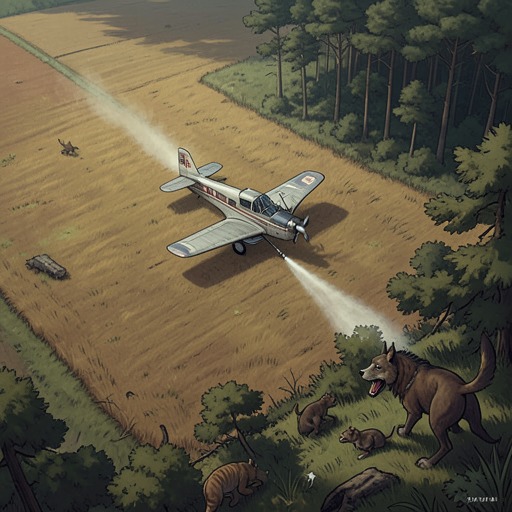
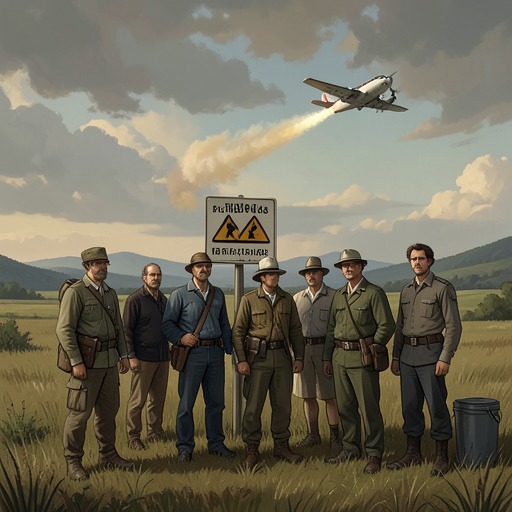
In the fall of 1959, about 27,000 acres in southeastern Michigan, including numerous Detroit suburbs, were heavily dusted from the air with aldrin pellets as part of a Japanese beetle control program. The scale and method made the choice of chemical a public and ecological issue: this was not an isolated application, but a broad intervention across populated suburbs and surrounding land.
The book notes that sections of Michigan, Kentucky, Iowa, Indiana, Illinois, and Missouri were experiencing chemical treatment in the name of beetle control. Michigan’s campaign was among the first large-scale aerial attacks on the Japanese beetle. Aldrin had not been selected because of any special suitability for that pest; it was chosen because it was the cheapest available compound. The contrast between the extent of the treatment and the stated reason for choosing the chemical sharpens the book’s criticism of cost-driven pesticide decisions.
Place in the Book’s Argument
Aldrin’s examples bring together several strands of the book’s warning: chemicals may change after application, residues can be difficult to identify, and effects may include reproductive failure as well as immediate deaths. The 1959 spraying gives these concerns a specific landscape and scale, while the choice of aldrin on grounds of price shows how administrative economy could govern a consequential environmental intervention.
The book’s larger account also situates pesticide programs within a postwar expansion of long-lasting poisons that alarmed Rachel Carson and her scientific colleagues. Aldrin thus serves as both a particular insecticide and a case through which Silent Spring examines the distance between a program’s stated target and its wider biological consequences. The evidence presented does not make every pesticide effect interchangeable; rather, it shows why chemical identity, transformation, exposure, and the purpose and scale of application must be considered together.