Annapolis Valley
Silent SpringThe Annapolis Valley, once one of Canada’s most concentrated fruit-growing regions, is the setting for A. D. Pickett’s decades-long effort to change how apple orchards were managed. In Rachel Carson’s account, the valley matters not only as an agricultural landscape but as a practical demonstration that growers could obtain good yields without relying on intensive chemical applications.
An orchard industry at a crossroads
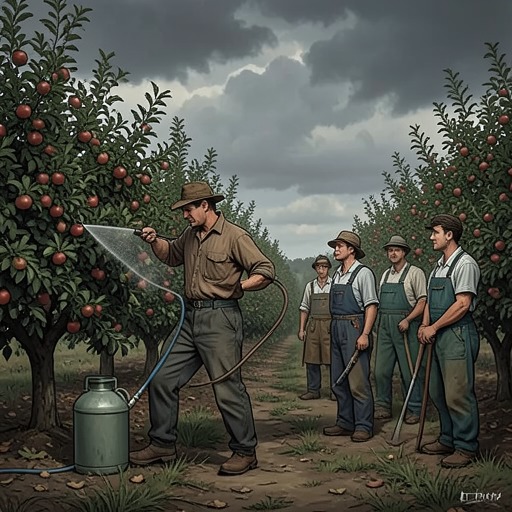
When Pickett began his work about thirty-five years before Carson wrote, orchardists were using insecticides—then inorganic chemicals—in the belief that chemicals would solve their pest problems. That confidence gave way to a recurring pattern: each intervention could create or expose another difficulty, including an unprecedented outbreak of mites. Pickett described the cycle as moving from crisis to crisis, trading one problem for another.
Rather than follow entomologists who continued to seek stronger toxic chemicals, Pickett and his associates chose a different course. They recognized nature as an ally and developed a program built around that premise. The valley thus becomes a specific counterexample to the assumption that effective pest management must mean ever more intensive chemical control.
A modified spray program
The program did not simply abandon insecticides. It made their use more restrained and selective, applying materials in markedly smaller quantities than customary practice. The account gives a concrete comparison: a treatment measured in ounces per 100 gallons, against the usual one or two pounds per 100 gallons. The two insecticides then in use were described as the least toxic of the modern ones, but Pickett hoped further research would replace them with safer, more selective materials.
This distinction is central to the valley’s example. The alternative was not a claim that every pest could be ignored or that existing chemicals were harmless; it was a deliberate departure from escalating toxicity, coupled with continued research toward safer options.
Results and significance
Orchardists following Pickett’s modified program produced as high a proportion of first-grade fruit as growers using intensive chemical applications, and obtained equally good production. The comparison made the approach consequential on agricultural terms: reduced reliance on heavy spraying did not require sacrificing marketable quality or output.
Carson places the Annapolis Valley among the rare examples of integrated control, alongside comparable work by some California entomologists. Its significance lies in the contrast between a chemical treadmill of crisis and escalation and a method that treated nature as an ally. The valley’s orchards show that a less intensive course could work in practice, while Pickett’s continuing search for safer materials kept the program open to further improvement.