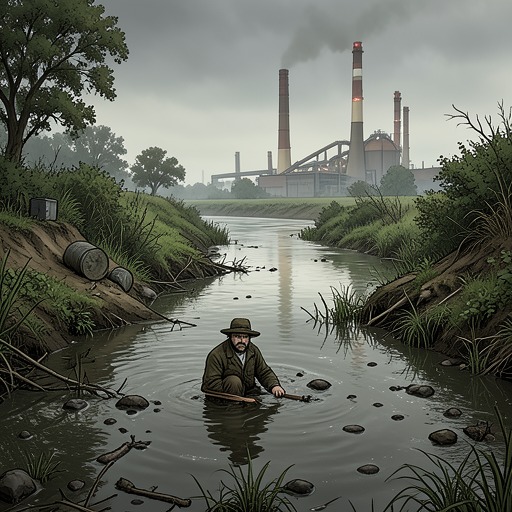
Austin Colorado River Fish Kill (1961)
Silent SpringThe Austin Colorado River Fish Kill (1961) began in mid-January when a pulse of insecticide-contaminated water entered Town Lake and moved down the Colorado River. Investigators traced the contamination to insecticide residues that had accumulated in storm sewers and were released during a high-pressure flushing operation. The episode killed fish across a long stretch of river, exposed routine industrial disposal practices, and left state officials warning that the river’s fish population could be changed for years.
The River and the First Signs
One of the most extensive fish kills described in the book occurred below Austin in 1961. Shortly after daylight on Sunday, January 15, dead fish appeared in the new Town Lake and in the river for roughly five miles below it; none had been observed the previous day. Reports of dead fish came from 50 miles downstream by Monday. The spreading reports showed that this was not a localized loss at the lake but a moving contamination event carried by the river.
By January 21, fish were dying 100 miles downstream. During the final week of January, authorities closed the locks on the Intracoastal Waterway to keep the toxic water out of Matagorda Bay, diverting it toward the Gulf of Mexico instead. The response marked the scale of the threat: the contamination had traveled far enough that officials were acting to prevent it from entering another major water body.
Tracing the Contamination
Investigators in Austin noticed an odor associated with chlordane and toxaphene, especially near the discharge from a storm sewer. Because that sewer had previously been linked to industrial waste problems, officers traced it upstream through the sewer system. Their investigation found benzene hexachloride at openings as far back as a feeder line from a chemical plant.
The plant produced DDT, benzene hexachloride, chlordane, toxaphene, and smaller quantities of other insecticides. Its manager acknowledged that powdered insecticide had recently been washed into the storm sewer. More consequentially, he admitted that disposing of insecticide spillage and residues in this way had been common practice for ten years. Fishery officers found other plants where rainwater or ordinary cleanup water could also carry insecticides into sewers, indicating that the problem extended beyond one discharge point.
The final link was the timing of a system-wide sewer flush. A few days before the lake and river became lethal to fish, several million gallons of water had been forced through the storm-sewer network under high pressure to clear debris. Insecticides lodged among accumulated gravel, sand, and rubble were dislodged and carried into Town Lake, then downstream. Chemical tests later confirmed insecticides in the river. The disaster thus followed not a single accidental spill alone, but the release of residues that had built up through recurring disposal practices and were mobilized by a large-scale cleaning operation.
Scale of the Fish Kill
The toxic mass continued to carry its effects downstream. For 140 miles below the lake, the fish kill was so extensive that later seining efforts brought up no fish. Observers recorded dead fish from 27 species, amounting to about 1,000 pounds for each mile of riverbank. The victims included channel catfish, the river’s chief game fish, as well as blue and flathead catfish, bullheads, four species of sunfish, shiners, dace, stone rollers, shad, and buffalo.
Some of the dead fish were exceptionally large and evidently old. Many flathead catfish weighed more than 25 pounds; local residents reportedly recovered some weighing 60 pounds. An 84-pound blue catfish was officially recorded. These fish made the loss more than a tally of individuals: their size testified to animals that had lived in the river for years, while their disappearance raised questions about the future of the river’s established fish community.
Consequences and Significance
The state Game and Fish Commission predicted that even without further pollution, the river’s fish population would be altered for years. Some species living at the limits of their natural range might never re-establish themselves; others, officials said, could recover only through extensive state stocking. The book also notes that the toxic water retained its lethal power more than 200 miles downstream, and that it was considered too dangerous to admit to the receiving waters there.
The event connects an apparently routine act of waste disposal and sewer maintenance to damage across an entire river corridor. Industrial residues had accumulated out of sight; flushing the sewers transferred them into open water, and the river carried the consequences far beyond the original source. By tracing the fish deaths back through the drainage system, the account makes the scale of the disaster legible as a chain of practices, releases, and downstream effects rather than as an isolated episode of unexplained mortality.