Bioaccumulation
Silent SpringBioaccumulation is the retention of a chemical within a living organism when exposure continues and the substance is stored faster, or for longer, than it is eliminated. In Silent Spring, Rachel Carson makes this process a bridge between the apparently small residues in ordinary food and the wider consequences of persistent pesticides: chemicals can accumulate within bodies and pass onward through food chains, while attempts to remake landscapes can disrupt the living systems through which exposure spreads.
How chemicals accumulate in the body
Carson explains that DDT’s properties shape its path through the body. The powder is not readily absorbed through the skin, a fact that can foster the misconception that it is harmless; dissolved in oil, as it usually is, DDT is toxic. It can be swallowed and absorbed slowly through the digestive tract, or enter through the lungs. Once inside, its solubility in fat leads to storage in fatty tissues and organs, including the adrenals, testes, and thyroid. Relatively large amounts also settle in the liver, kidneys, and the protective fatty mesenteries surrounding the intestines.
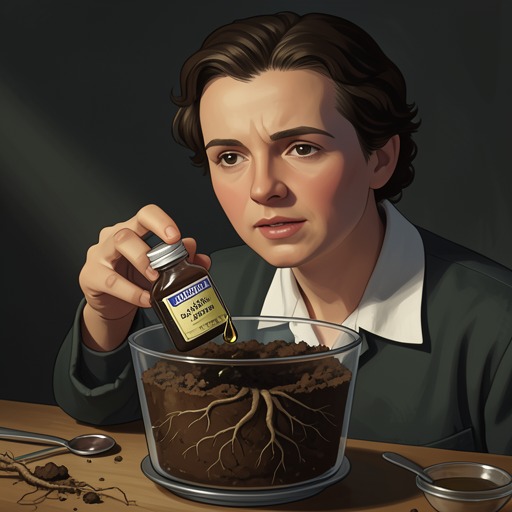
Storage begins with very small intakes, Carson stresses, including the residues present on most foodstuffs. It continues until the body has accumulated much higher levels. The fatty depots act as biological magnifiers: a dietary intake as low as one part per million can result in storage of roughly 10 to 15 parts per million. This is not merely a record of a recent exposure. It is a bodily reserve that can make the concentration within an organism greater than the concentration in the food that supplied it.
The persistence of that reserve gives bioaccumulation its chronic significance. Because small amounts of pesticide are stored cumulatively and excreted only slowly, repeated exposure can continue to add to the burden. Carson warns that chronic poisoning and degenerative changes in the liver and other organs are therefore a real concern. The process links an inconspicuous dose to a delayed effect: what is difficult to perceive at the moment of intake may remain present and build over time.
From individual storage to food-chain transfer
Bioaccumulation does not end at the boundary of one body. Carson describes pesticides passing from one organism to another through the links of a food chain. Her example begins in fields of alfalfa dusted with DDT. The crop is made into meal and fed to hens; the hens then lay eggs containing pesticide residue. The sequence turns a treatment applied to a field into exposure carried through feed and into food produced by animals.
The example’s force lies in its ordinary steps. The chemical does not need to be applied directly to the person or animal that ultimately encounters it. It can persist in treated plant material, move into an animal that eats that material, and be carried onward in a product used as food. Bioaccumulation within organisms thus belongs to a larger pattern of transfer: persistent substances can travel through relationships of feeding and production, connecting agricultural practice with exposure far from the original application.
The ecological setting of exposure
Carson’s account also places chemical effects within landscapes formed through long ecological change. The sage country of the high western plains and the lower mountain slopes is a land of harsh climatic extremes, shaped by the uplift of the Rocky Mountain system. Over ages, its plants and animals became adapted to those conditions. The pronghorn antelope and sage grouse are presented as lives fitted to a habitat in which sage is not an obstacle to improvement but part of the system that sustains them.
Against that background, Carson describes land-management agencies responding to cattlemen’s demand for more grazing land by seeking grassland without sage. This intention changes the habitat in which exposure and ecological consequences occur: the target is a complex plant community, but the intervention is not confined to a single desired species. Carson calls attention to the danger of this shotgun approach, in which spraying also eliminates plants that were not intended targets.
The example of the Bridger National Forest makes that selectivity problem concrete. William O. Douglas recounts that the United States Forest Service sprayed about 10,000 acres of sage country in Wyoming. Willows were killed by the same spray used against sagebrush, even though they had supported beavers and contributed to a region valued for recreation, fishing, and hunting. When Douglas visited in 1959, the year of the spraying, he saw willows shriveled and dying. The consequence is not bioaccumulation in the narrow sense of a chemical’s storage inside one body; it shows why the concept belongs to an account of ecological interdependence, where a chemical intervention can change the habitats and relations through which living things depend on one another.
A connected problem of evidence and policy
Carson began writing Silent Spring in 1958, aged fifty, after a professional life as a marine biologist and writer with the U.S. Fish and Wildlife Service. She and scientific colleagues had become alarmed by widespread use of DDT and other long-lasting poisons in agricultural control programs. Her treatment of bioaccumulation belongs to that larger investigation: instead of judging a pesticide only by the immediate result of an application, it asks what happens after the chemical enters organisms, remains there, and moves through food and habitat.
That change of scale matters. A field application, dietary residue, stored chemical, and altered landscape are not separate problems simply because they occur in different places or at different times. Carson’s examples join them into a continuous chain of exposure and consequence. Bioaccumulation names one crucial mechanism within that chain: the body can preserve a trace of chemical use, while food relationships and ecological disruption carry the implications outward.