Brook trout
Silent SpringBrook trout are both part of the ecological order that pesticide programs disrupt and direct evidence of their harm: they appear among the dead after streamside spraying and among fish vulnerable to DDT held in body fat. Their place in Silent Spring connects the long formation of western habitats to the immediate and delayed consequences of chemical control.
Habitat and Ecological Setting
Carson situates the western sage country within a landscape formed over millions of years by the uplift of the Rocky Mountain system. Harsh extremes of climate shaped the region, and its plants and animals evolved in relation to those conditions. Brook trout enter this account not as isolated specimens but as part of the wider natural communities whose histories and dependencies are altered when people try to remake the land.
The book repeatedly contrasts such evolved relationships with efforts to simplify habitats for human use. Land-management agencies, responding to cattlemen’s demand for more grazing land, sought grassland without sage. Carson presents this as an intervention in a system formed through long ecological processes, not a neutral improvement: the removal of vegetation changes the setting on which other forms of life depend.
Death in a Sprayed Stream
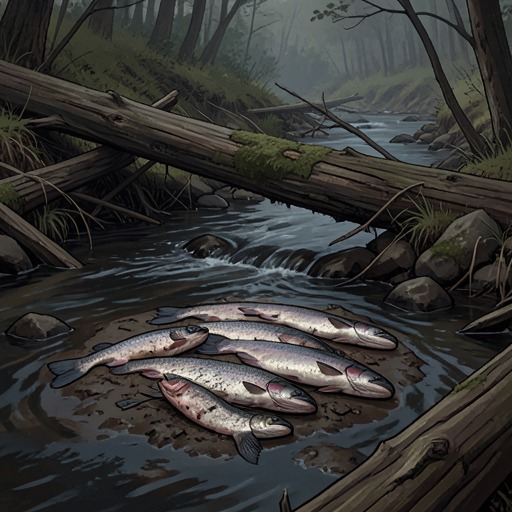
After spraying had ended in a stream, dead and dying fish were found along its banks within two days. Brook trout were among them, alongside young salmon; birds were also dying along roads and in the woods. Carson describes the stream’s life as stilled, contrasting the kill with its former abundance of aquatic organisms that served as food for salmon and trout, including caddisfly larvae, stonefly nymphs, and blackfly larvae.
The brook trout’s death belongs to a chain of consequences, rather than a narrowly targeted effect on a pest. The insecticide eliminated aquatic life that sustained fish, while fish themselves appeared among the immediate casualties. The scene gives concrete force to Carson’s argument that spraying can damage organisms and relationships beyond its intended target.
Delayed Exposure and Seasonal Stress
Carson also identifies a less visible danger: DDT stored in fish tissues can become lethal when an organism is under physiological stress and draws on stored fat for energy. Montana biologists found deaths among autumn-spawning fish in study streams, including brook trout, brown trout, and whitefish. Because these deaths could occur after the fishing season, they might go unreported.
This account shifts attention from the sudden, visible fish kill to mortality that appears later and under different circumstances. A fish’s stored fat, normally an energy reserve, becomes the route through which accumulated DDT exerts its lethal effect when stress changes how that reserve is used. Brook trout thus illustrate how pesticide harm can persist in an organism and emerge after the moment of application.
Significance in Carson’s Argument
Across these accounts, the brook trout links habitat change, the destruction of aquatic food, and the delayed effects of chemical exposure. Its presence among dead fish makes the consequences of spraying visible; its vulnerability during autumn spawning shows why visible aftermath alone cannot measure the damage. Carson uses the fish’s circumstances to challenge the assumption that pest-control programs can be judged by their immediate purpose or their immediate results: the affected system includes organisms, food sources, and consequences unfolding over time.