Caddisfly
Silent SpringCaddisflies are aquatic insects whose larvae help sustain salmon and trout, and whose slow recovery after pesticide contamination makes them a telling measure of ecological damage. In Rachel Carson’s account, they are not incidental stream life: their absence leaves young salmon with limited food and can persist after the first visible deaths have ended.
Life in the Stream
Before spraying, caddisfly larvae were among the varied aquatic organisms that formed the food of salmon and trout. They lived in protective cases assembled from leaves, stems, or gravel and held together with saliva. This specialized way of living places the larvae within a stream community that depends on both the water and the material carried through it.
Carson sets them alongside stonefly nymphs clinging to rocks in currents and blackfly larvae, presenting a diverse community rather than a single food source. When that community is disrupted, the consequences reach beyond the insects themselves: its members are prey for fish at different stages of growth.
DDT and the Food Supply
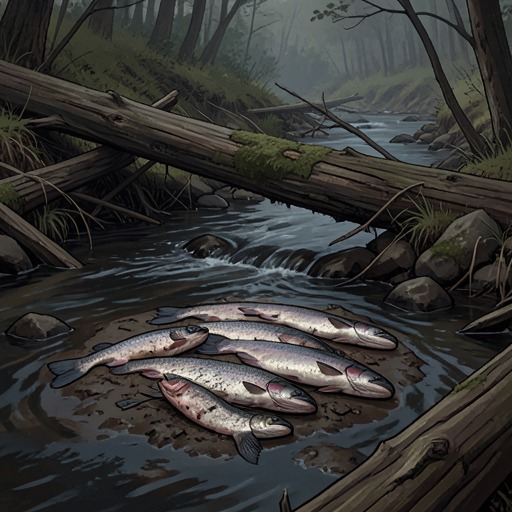
After spraying, dead and dying fish, including young salmon, appeared along a stream within two days. The damage extended to the organisms on which fish depended. Carson distinguishes the fast recovery of food suitable for the smallest salmon from the far slower return of larger aquatic insects, including caddisflies, stoneflies, and mayflies.
Even in the second year after DDT entered the stream, a foraging salmon parr might find little more than an occasional small stonefly. Large stoneflies, mayflies, and caddisflies remained absent. The delay matters: a stream can appear to have begun recovering while still lacking the larger prey needed by salmon in their second and third years.
Attempts at Recovery
To restore the natural food supply, Canadians tried transplanting caddisfly larvae and other insects into barren reaches of the Miramichi. The effort could not provide a durable remedy if spraying continued; repeated applications would wipe out the transplanted insects as well. The proposed repair thus exposed the central difficulty: replacing individual organisms cannot restore a food web while the cause of its destruction remains in place.
Carson’s use of caddisflies makes ecological recovery visible across time. Their absence records more than the loss of one kind of insect; it signals a continuing break in the stream’s food supply, one that outlasts the immediate fish deaths and constrains the return of salmon.