Cats
Silent SpringCats appear in Silent Spring not as incidental companions but as evidence of how broadly insecticide campaigns can reach. Their exposure links the treated landscape to household life: in Detroit-area spraying, a veterinarian saw cats among the animals suddenly made ill, while in Sheldon, Illinois, the first season of beetle-control spraying killed most farm cats. Carson also places these losses beside reports from malaria-control programs elsewhere, showing that the vulnerability was not confined to one town or one campaign.
Exposure and Household Effects
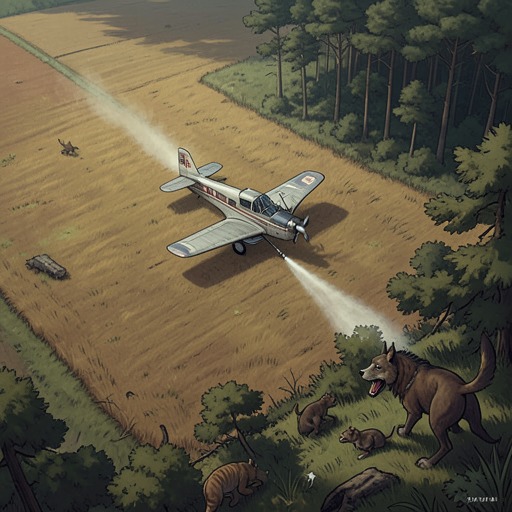
During an aerial application of aldrin pellets in southeastern Michigan in the fall of 1959, the effects of the operation were not limited to insects or wildlife. A local veterinarian reported that his office filled with clients whose dogs and cats had suddenly become ill. Cats seemed especially affected because of their habitual grooming: licking their coats and paws could bring pesticide residues into their bodies. The reported symptoms included severe diarrhea, vomiting, and convulsions. The veterinarian advised owners to keep the animals indoors when possible or wash their paws promptly after they had been outside. The warning had a clear limit, however: chlorinated hydrocarbons could not be washed away even from fruit, underscoring how difficult it was to avoid exposure once these chemicals had spread.
This account gives domestic exposure a distinct place in the book’s argument. The poison did not remain within the boundaries of the target area or the intended target species. Cats encountered it in their surroundings and, through grooming, could ingest residues picked up on their bodies. Their illness therefore connected a public control program to the private routines of households, while the advice to wash paws or restrict outdoor access revealed how little protection remained available after spraying.
Sheldon: Loss During Beetle Control
The consequences were more severe in Sheldon, Illinois, where chemical treatment was directed against the Japanese beetle. The fox squirrel, once relatively common in town, disappeared after spraying. Farm cats were also struck hard: in the first season of the campaign, ninety percent of them died from dieldrin. That figure makes the cost to domestic animals unusually stark. The campaign’s intended object was an insect, yet cats—animals living among the farms and homes within the treated area—became among its casualties.
Carson situates the Sheldon deaths within a wider record of feline sensitivity to insecticides, especially dieldrin. The scale of the loss was not presented as inexplicable: she points to earlier reports from other places as warning evidence. The disappearance of local animals and the steep mortality among farm cats thus form part of a recurring pattern, rather than an isolated accident that could be separated from the method of control.
Reports Beyond the United States
The book extends that pattern beyond Sheldon by recounting deaths during malaria-control programs carried out by the World Health Organization. In western Java, many cats were reported to have died. In central Java, the number killed was so great that the price of a cat more than doubled. Spraying in Venezuela was likewise reported to have reduced cats to rare animals. These accounts do not establish that every campaign or exposure produced the same outcome, but they show that losses of cats recurred in widely separated settings where insecticides were used against another target.
The reports also measure ecological disruption through an intimate, familiar species. In Java, the increased price of a cat signals how an environmental intervention could change everyday life; in Venezuela, cats’ reported rarity expresses the scale of disappearance in a simple, local measure. Set beside the Detroit illnesses and Sheldon deaths, these examples enlarge the subject from individual poisoning to population-level loss.
Significance in the Book
The cats’ experience illustrates the reach of persistent pesticides and the mismatch between a campaign’s stated target and its actual effects. A chemical applied to control insects could make animals ill through contact with treated surroundings, and grooming offered no reliable escape from contamination. In Sheldon, dieldrin’s consequences were counted in the near-disappearance of farm cats; in Java and Venezuela, the accounts describe losses extensive enough to alter local abundance and, in one case, price.
Carson’s treatment of cats also makes the wider problem of exposure concrete without treating household animals as separate from ecological life. Their fate appears alongside effects on wildlife and other mammals, suggesting that the boundary between a control program and the surrounding community was porous. Across these cases, cats register the consequences of chemical use in places where people lived and worked, and reveal that the cost of killing an insect could be borne by animals the campaign was not intended to harm.