DDT
Silent SpringDDT is a synthetic insecticide whose significance in Silent Spring rests not only on its toxicity at a particular dose but on its persistence: even small intakes can be stored in the body, passed between organisms, and concentrated through food chains. Rachel Carson presents it as a chemical that crosses the boundaries between a spray program and the wider environment, linking treated forests and leaves to earthworms, birds, and contaminated waters. The result is a case for understanding pesticide exposure as cumulative and ecological, rather than as a brief encounter between a chemical and its intended target.
Identity and Properties
DDT is short for dichloro-diphenyl-trichloro-ethane. The book identifies it as a compound first synthesized by a German chemist, then distinguishes its behavior according to how it is encountered. In powder form, it is not readily absorbed through the skin; dissolved in oil, as it usually is in the uses described, it is definitely toxic. When swallowed, it is absorbed slowly through the digestive system. These differences matter because the route and form of exposure shape what can be inferred from a particular contact; the insecticide cannot be described adequately by a single generalized statement about toxicity.
Carson emphasizes a further property that changes the meaning of low exposure: DDT storage begins even with the smallest conceivable intake. The chemical is accumulated and only slowly excreted, so repeated or continuing contact cannot be treated as though each dose disappears before the next arrives. The book’s account thereby distinguishes the persistence of the compound in an organism from the immediate effects of a large exposure. A small intake may be consequential not because it produces an obvious acute reaction, but because it joins a residue that remains in the body.
Persistence Through Food Chains
The storage of DDT becomes an ecological process when residues move from one organism to another. Carson describes the transfer of DDT and related chemicals through food chains, where the chemical taken up by one organism can become part of the exposure of its consumer. The book’s governing concern is not limited to whether a sprayed organism survives; it is what happens to the chemical after the spray has done its immediate work, and how its passage alters the risks faced by other species.
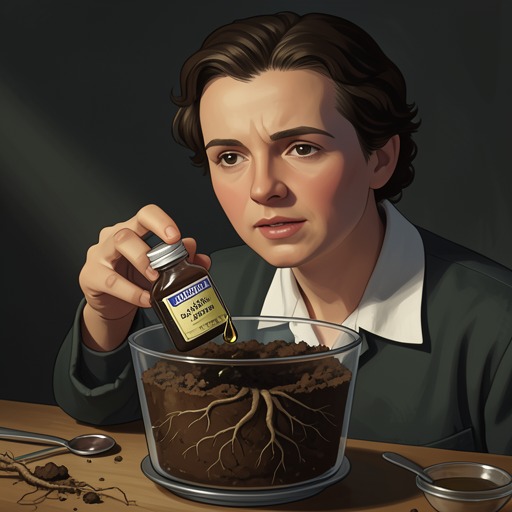
The robin example makes that transfer concrete. DDT applied to trees in spring, commonly at a rate of two to five pounds for a fifty-foot tree, reaches leaves eaten by caterpillars. The caterpillars swallow the insecticide along with their food. Earthworms then feed on the contaminated material, becoming what the book calls magnifiers of the poison. When robins return in spring, the worms provide another link in the cycle: as few as eleven large earthworms can transfer a lethal dose of DDT to a robin. The numerical detail reveals the disproportion between the scale of an individual meal and the accumulated burden carried through successive stages of the food chain.
The wider implication is that a chemical can move away from the place where it was applied and affect organisms that were never the intended targets. DDT’s persistence makes the food chain not merely a route of exposure but a means by which residues can accumulate and intensify. The account therefore connects pesticide use to ecological interdependence: the consequences of treating one part of a habitat may emerge later in the animals that feed upon it.
From Sprayed Landscapes to Contaminated Waters
Carson also places DDT within a broader picture of environmental contamination. The book challenges the assumption that waters can be considered unexposed simply because no direct spray is visible at a given moment. Its discussion of the waters’ widespread contamination turns attention from a single application to the dispersal and persistence of residues across environmental settings.
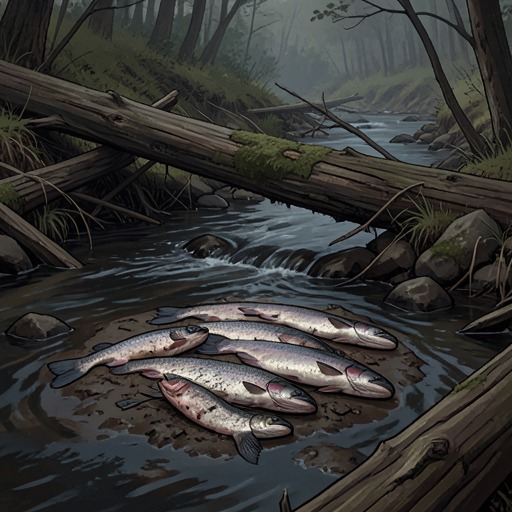
The account of the grebes shows how an investigation can change the apparent meaning of dead birds. Their deaths were first seen as a visible loss; analysis of their fatty tissues then revealed the presence of DDT. The contrast between the observable event and the chemical evidence is central to the book’s approach: the cause and extent of harm may not be apparent from the scene alone, and residues within an organism can disclose a history of exposure that outward observation cannot establish.
The same tension appears in Carson’s account of coastal areas subjected to repeated sprayings of DDT dissolved in fuel oil. Repetition matters: the exposure is not a solitary application but a recurring practice, with the chemical carried in an oily mixture into coastal environments. Across these examples, DDT’s effects are framed as a problem of movement and persistence, linking the method of application to residues detected in organisms and waters.
Biological Effects and Uncertainty
The book connects DDT residues with concerns about the reproduction of birds. Carson reports that analyses found high concentrations of DDT in the testes and ovaries of breeding birds. The finding is significant because it locates the chemical in reproductive organs, shifting attention from immediate poisoning to possible consequences for reproduction. It does not, by itself, settle every question about mechanism or outcome, but it gives the concern a measurable basis and supports the broader argument that stored residues can matter beyond the moment of exposure.
DDT also appears in the book’s discussion of biological mechanisms and cancer evidence. Carson identifies DDT as a proven uncoupler of oxidative phosphorylation, while noting that further study might clarify the properties of chlorinated hydrocarbons. Separately, she reports suspicious liver tumors in laboratory animals exposed to DDT. These are distinct kinds of evidence: one concerns a cellular process, the other experimental tumor findings. The account presents them as reasons for concern and investigation, not as proof that every exposure produces the same outcome in people.
Carson places these findings against the reality of mixed exposure. Under ordinary conditions, organisms are not exposed to only one chemical; insecticides from different major groups may occur together. She also describes Food and Drug Administration scientists’ discovery that malathion and another pesticide could interact, illustrating why the effects of a chemical mixture cannot safely be inferred by considering each substance alone. DDT’s risks therefore belong to a larger problem of cumulative and interacting exposures, in which both persistence and combination complicate the search for a simple threshold or isolated cause.
Natural Selection and the Stakes of Control
DDT’s significance extends beyond toxicology to the consequences of using chemical control as a recurring policy. The book notes that by 1945 the Japanese beetle had become a pest of only minor importance throughout much of the territory over which it had spread. Against that history, the later reliance on intensive eradication measures invites a question about whether a pest must be eliminated everywhere, rather than managed in light of its actual distribution and effects. Carson’s broader argument is that chemical intervention can alter the conditions under which species survive, and that those changes do not necessarily remain confined to the target species.
This concern connects to natural selection. In discussing the principle, Carson invokes Darwin and frames pesticide pressure as a force that can favor survival among organisms able to withstand it. The same intervention meant to suppress a pest may therefore change the population it acts upon, making chemical control part of an evolving ecological relationship rather than a final solution. DDT is emblematic because its environmental persistence compounds that problem: the chemical remains in organisms and moves through food chains even as the living systems around it respond.
The book’s account of DDT thus brings together several scales of consequence: the form and route of exposure, storage within an organism, transfer between species, contamination of waters, evidence of biological effects, and the possibility that repeated chemical control reshapes ecological relations. Its decisive warning is not that every trace produces an identical result, but that persistence makes the consequences of use difficult to confine to the place, species, or moment intended. DDT becomes a measure of the gap between the apparent precision of spraying and the wide, delayed reach of a chemical once it enters the web of life.