DDT Spraying and Salmon Loss in the Northwest Miramichi River Basin (1954)
Silent SpringDDT Spraying and Salmon Loss in the Northwest Miramichi River Basin (1954) was a Canadian forest-protection campaign whose June aerial spraying killed the aquatic insects sustaining salmon and trout, followed by severe losses among young salmon. Because the Fisheries Research Board of Canada had counted fish in the Northwest Miramichi stream since 1950, the destruction could be measured against a detailed record of life before the planes arrived. The episode shows how an intervention aimed at protecting forests could carry its poison into waterways, unravel food supplies, and leave a lasting mark on a stream ecosystem.
Causes and the Forest Campaign
The immediate setting was a surge in spruce budworm, a native insect that attacks several kinds of evergreens and becomes extraordinarily abundant in eastern Canada at intervals of about thirty-five years. After populations rose in the early 1950s, the Canadian Government began spraying DDT to protect balsams, a mainstay of the pulp and paper industry. Spraying began on a small scale, then accelerated sharply in 1953: millions of acres were treated instead of thousands. The Northwest Miramichi watershed was brought into this widening program the following year.
The planes’ objective was to suppress a forest pest, but their route crossed a watershed threaded with streams. In June 1954 they flew over the Northwest Miramichi forests, laying down a crisscross pattern of white mist. The spray contained one half pound of DDT per acre in an oil solution and filtered through the balsam forest. The account notes that the aircraft did not try to avoid streams or shut off their nozzles while passing over them. Even if they had, however, the spray could drift far in the lightest movement of air; the risk to water was not confined to the exact path of the planes.
The Stream Before and After Spraying
Before the intervention, young salmon fed on a rich assortment of aquatic life. Caddisfly larvae and mayfly nymphs clung to rocks in the currents; blackfly larvae occupied stones beneath riffles and where water spilled over slanting rock. These insects were not incidental details of the landscape: they formed the food base on which salmon and trout depended. Once DDT killed them, the stream’s capacity to feed its fish was damaged along with the fish themselves.
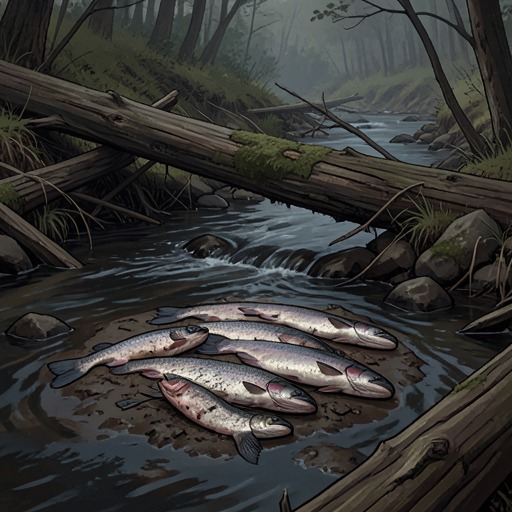
Signs of disaster appeared soon after spraying ended. Dead and dying fish, including many young salmon, were found along the banks within two days. Brook trout were also among the dead, and birds were dying along roads and in the woods. The stream’s life was stilled: its insect food supply had been killed, leaving young fish without the prey they had relied on. The damage thus extended beyond visible fish mortality. It struck the connected community that made the stream a viable habitat.
By August, none of the young salmon that had emerged from gravel beds that spring remained. A whole season’s spawning had come to nothing. Older juveniles also suffered: of every six fish from the 1953 hatch that had foraged in the stream as the planes approached, only one survived. Among the 1952 hatch, whose members were nearing their migration to sea, a third were lost. The losses fell across successive year classes, removing both the newest fish and a substantial portion of those close to leaving the stream.
Evidence and Long-Term Change
The scale of the loss was unusually well documented. The Fisheries Research Board of Canada had studied salmon in the Northwest Miramichi since 1950, making an annual census of the fish living in the stream. Its records established conditions before the spraying and made it possible to compare the aftermath with a measured baseline. The account emphasizes that this allowed damage to be assessed with an accuracy seldom matched elsewhere. The disaster was not inferred from a single dramatic sighting: earlier counts made it possible to trace how many fish remained in each cohort.
The survey also showed that the consequences were not limited to the immediate die-off. Repeated sprayings had completely altered the stream environment, killing the aquatic insects that salmon and trout ate. The intervention therefore left more than a short-lived pulse of poison or a temporary reduction in fish numbers: it changed the conditions on which stream life depended. In the book’s account, the sudden spectacle of dead fish sits within a longer process of ecological alteration, one whose full effects could be recognized because observations had begun years before the spraying.
Significance in the Book
The Northwest Miramichi episode makes the distance between a program’s declared target and its actual reach concrete. DDT was applied against spruce budworm in forests, yet it also entered streams and killed the insects that fed fish. The sequence links administrative purpose to ecological consequence without treating the watershed as a boundary that chemicals would respect: airborne drift, contaminated water, lost prey, and declining salmon were parts of the same event. The contrast is especially stark because the campaign sought to preserve economically important balsams while disrupting the aquatic life of the same landscape.
The case also demonstrates the importance of sustained observation. Without the Fisheries Research Board’s annual censuses beginning in 1950, the disappearance of the spring’s salmon or the sharply reduced survival of earlier hatchings would have been harder to quantify against ordinary variation. Here, records turn loss into evidence: they show not only that fish died, but which cohorts were affected and how extensively. The episode stands as one of the book’s accounts of the broad ecological costs of long-lasting pesticides, and of the way harm can travel from the intended target through the relationships that sustain other life.