Dutch elm disease
Silent SpringDutch elm disease is a fungal infection of the American elm whose spread through elm bark beetles prompted routine community spraying across much of the Midwest and New England. In the book, the disease becomes a test of what it means to protect a landscape: efforts to save the trees with broad insecticide applications threaten birds, while offering no lasting guarantee that the elms will survive. New York’s alternative—promptly removing and destroying infected wood—shows that the chemical response was not the only available course.
The disease and its route of spread
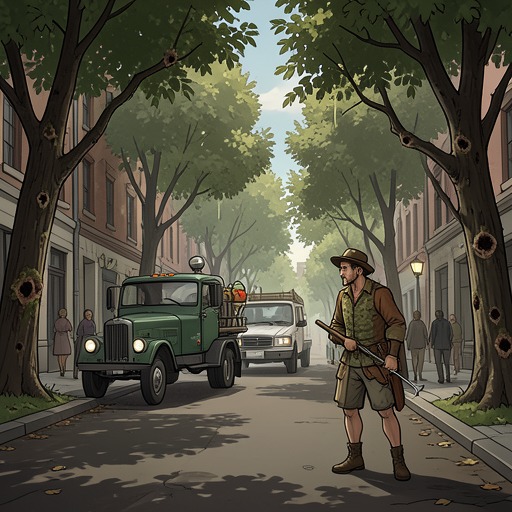
The American elm had shaped the public spaces of towns across the country, its branches forming green archways over streets, village squares, and college campuses. The disease imperiled this widely planted tree throughout its range. The book traces its arrival in the United States to about 1930, when it came from Europe in elm burl logs imported for the veneer industry.
The infection is caused by a fungus that invades the tree’s water-conducting vessels. Spores carried in the flow of sap spread through the tree; the fungus’s poisonous secretions and the physical obstruction of those vessels cause branches to wilt and, ultimately, the tree to die. The account thus makes the disease’s progress a matter of both biological invasion and disrupted circulation within the tree.
Elm bark beetles carry the disease from infected trees to healthy ones. The beetles tunnel galleries beneath the bark of dead elms, where the galleries become contaminated with fungal spores. Spores adhere to the insects’ bodies and travel with them when they fly. Because the beetles are the transmitting agent, control programs focused largely on suppressing them rather than directly treating the fungus inside the tree.
Spraying as a community response
In communities across the American elm’s strongholds, especially the Midwest and New England, intensive spraying became routine. This response connected the disease to a broader pattern described in the book: towns and cities, as well as forests and cultivated fields, were being exposed to lethal chemicals. As aerial distribution extended across millions of acres, doubts about the consequences grew.
The proposed remedy carried a stark ecological trade-off. Protecting the elm by spraying the insect that transmits its disease could also kill birds, while doing nothing to ensure that the trees would be saved. The book frames this as one of the ironies of chemical control: communities could endanger bird populations in the name of preserving elms, yet find that the trees continued to decline. The threatened loss was therefore not simply a choice between healthy trees and dead trees, but the possibility of losing both elms and birds.
The limits of chemical control
Regular spraying did not necessarily produce lasting protection. Greenwich, Connecticut, had sprayed for ten years, but a drought year then brought a renewed problem. The example undermines the notion that salvation for the elms could be secured simply by applying more insecticide: repeated expense and ecological risk did not amount to a durable answer.
The book also situates the elm campaign within a wider public unease over mass spraying. By the late 1950s, large campaigns against the gypsy moth had intensified misgivings about aerially distributing lethal chemicals over immense areas. In that context, the Dutch elm disease response illustrates how a local tree disease could become part of a much larger debate about public policy, environmental consequences, and the confidence placed in chemical control.
Sanitation as an alternative
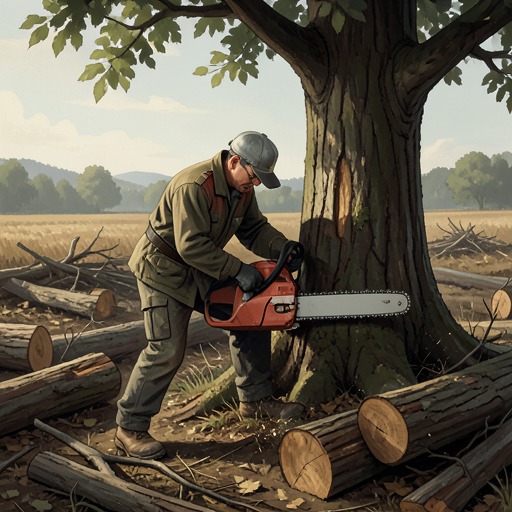
New York achieved a strong record in suppressing the disease without relying on community spraying. Its agricultural extension service did not recommend spraying as a general municipal method. Instead, the state relied on rigorous sanitation: infected or diseased wood was promptly removed and destroyed.
This contrast gives the disease story its practical and analytical force. If the beetle spreads spores from infected wood, removing that material addresses a specific link in the chain of transmission. The book presents New York’s approach as an alternative to treating an entire community with insecticide, and as evidence that control did not have to mean indiscriminate chemical exposure. The comparison does not erase the threat to the elms; it shifts attention from the promise of a spray nozzle to the consequences and effectiveness of the method chosen.
Ecological and narrative significance
The elm’s importance in the account is cultural as well as biological: it was a defining presence in streets and civic spaces, and its potential loss was a genuine concern. But the birds endangered by efforts to save it are not incidental casualties in the book’s reasoning. They expose the danger of managing one part of an interconnected landscape as though the intervention would stop at its intended target.
Dutch elm disease therefore serves as a case study in the limits of a narrowly framed remedy. The disease is real, its transmission route is identified, and communities face pressure to act; nevertheless, the scale and persistence of spraying can make the proposed cure a second threat. By placing routine chemical campaigns beside New York’s sanitation program, the book argues through contrast: protecting a valued species requires attention not only to the visible target, but also to the method’s wider effects and to less indiscriminate alternatives.