East Lansing
Silent SpringEast Lansing is the setting of one of the book’s clearest accounts of how routine pesticide programs transformed a place and the wildlife living in it. A study of robins at Michigan State University began before anyone suspected a danger; after spraying for Dutch elm disease spread across the campus and the city, dead birds, dwindling nests, and a sharply reduced spring population made the consequences impossible to ignore.
Campus and research setting
East Lansing was where Michigan State University’s campus study of robin populations became entangled with municipal pest control. In 1954, graduate student John Mehner chose robin populations as the subject of his doctoral research. The choice was accidental in one crucial respect: when he began, nobody suspected that the birds were at risk. The setting initially offered a defined area and a population that could be observed; subsequent spraying changed the conditions of the study and, increasingly, the subject it was meant to measure.
Spraying for Dutch elm disease began on a small scale on campus in 1954. The following year, East Lansing joined the effort, campus spraying expanded, and other local campaigns—including one against gypsy moths—added to the chemical treatment of the area. What had started as a study of robin populations thus unfolded alongside an intensifying program of pest control. The birds’ familiar return to the campus did not mean their habitat remained safe.
Robin deaths and reproductive decline
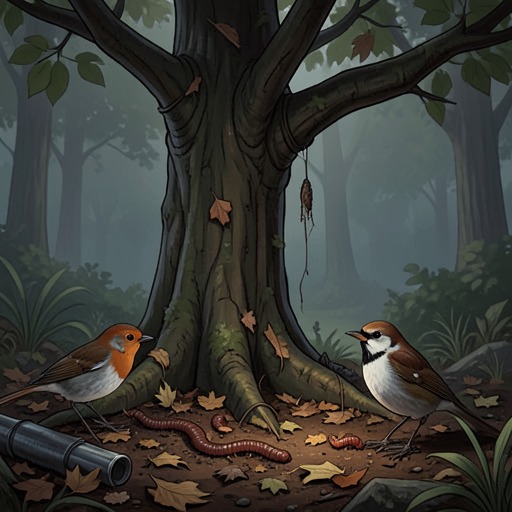
As robins returned to the campus, the pattern of their lives began to break down. Dead and dying birds appeared. Few were seen foraging normally or gathering at their customary roosts; few nests were built, and few young appeared. The same pattern recurred, making the decline more than an isolated observation. The consequences of spraying registered both in individual mortality and in the routines—feeding, roosting, nesting, and rearing young—through which a population sustains itself.
The scale of the change is especially clear in the campus count: by the account’s time of writing, only two or three dozen robins could be found each spring across Michigan State University’s 185 acres, compared with a conservatively estimated 370 adults before spraying. That contrast gives East Lansing’s history its force. The campus remained a familiar place for the birds, but familiarity offered no protection against a chemical regime that altered the conditions of their survival and reproduction.
A place made into evidence
East Lansing is more than a backdrop to the robin decline. Its campus supplied the defined area in which the consequences could be observed over time, while the overlap between research and spraying exposed the cost of conducting pest control without first understanding its effects. Mehner’s project had begun without a suspicion of danger; the events that followed changed the character of his work and deprived him of the material he had set out to study.
In the book’s wider account of pesticide use, the town’s experience turns a broad warning into a local record: an expanding control program, a population once counted in the hundreds, and a spring return reduced to only a few dozen birds. The significance of East Lansing lies in that sequence. The evidence of harm emerged not from a planned test of safety, but from watching a familiar population disappear from the place where it had been studied.