Edward Knipling
Silent SpringEdward Knipling was the United States Department of Agriculture entomologist who proposed and helped put into practice a radically different method of insect control: releasing sterilized males so that a pest population would reproduce itself out of existence. In Rachel Carson’s account, his screwworm campaign stands apart from broad chemical spraying. Rather than saturating a landscape with poison, it sought to turn the insect’s own reproductive behavior against the species, and its success on Curaçao and across Florida made the proposal a major demonstration of a non-insecticidal control strategy.
Researcher and proposal
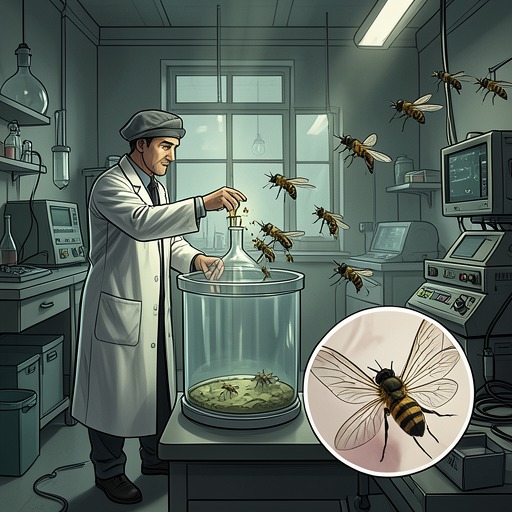
Knipling was chief of the United States Department of Agriculture’s Entomology Research Branch. About a quarter of a century before the program’s large-scale field application, he startled colleagues by proposing that mass release of sterilized insects could control a pest. Under suitable conditions, he reasoned, sterile males would compete successfully with normal wild males for mates. Repeated releases could then leave the population producing only infertile eggs, until it died out. The proposal treated the pest not simply as a target to be killed, but as a population whose reproduction could be interrupted.
The underlying possibility had been explored before Knipling’s practical campaign. In the late 1920s, researchers began investigating new approaches to insect control, and by the middle of the century workers had reported sterilizing at least a dozen insect species with X-rays or gamma rays. These were laboratory experiments, however, not yet a workable field method. Around 1950, Knipling began a concerted effort to make sterilization a weapon against a major livestock pest in the American South: the screwworm fly.
The screwworm problem and Curaçao test
The stakes were substantial. The screwworm had spread into southern Alabama and Georgia, and the livestock industry of the southeastern states faced annual losses reaching $20 million. Agriculture Department scientists in Texas had accumulated a large body of information about the fly’s biology. Drawing on that research, and following preliminary field trials on Florida islands, Knipling judged that the theory was ready for a full-scale test by 1954.
The test took place on Curaçao in the Caribbean, with the Dutch government’s agreement. Sterile flies were released into the population. Seven weeks after releases began, all eggs found were infertile; soon investigators could not find a single egg mass, sterile or otherwise. The screwworm was eradicated on the island. The speed and completeness of that result supplied the method with a powerful field demonstration: rather than killing each generation with poison, it had prevented a viable next generation from emerging.
Expansion to Florida and the Southeast
The Curaçao result prompted Florida livestock raisers to seek the same solution for their screwworm problem. The proposed undertaking was far more difficult: the area was about 300 times larger than the Caribbean island. In 1957, the United States Department of Agriculture began the program, taking advantage of an unexpected opportunity to start while screwworm populations were reduced and confined to a small area.
By the time the campaign was considered complete, 17 months later, 3.5 billion artificially reared, sterilized flies had been released over Florida and sections of Georgia and Alabama. The last known animal-wound infestation attributable to screwworms occurred in February 1959. Several adult flies were caught in traps in the following weeks; after that, no trace could be found. Carson describes the campaign as having made the screwworm extinct in the treated region, an outcome that carried the successful island experiment onto a continental scale.
Significance and limits of the method
The program’s importance in Carson’s account lies in the contrast between reproductive control and indiscriminate chemical killing. Knipling’s method depended on detailed knowledge of the pest, the deliberate mass rearing of insects, and the repeated release of sterile males. Its purpose was not merely to reduce numbers temporarily, but to make reproduction fail. The Curaçao and southeastern campaigns showed that this principle could work outside the laboratory and against a serious agricultural pest.
Knipling also looked toward chemical sterilization as a possible extension of the idea. By the time Carson discusses it, work on chemosterilants had grown substantially in only a few years, but remained experimental. Knipling argued that effective chemical insect sterilization might outperform some of the best-known insecticides. To illustrate the difference, Carson gives a hypothetical population of one million insects multiplying fivefold in each generation: an insecticide that killed 90 percent of each generation would still leave 125,000 insects after the third generation. The comparison underscores the logic behind Knipling’s approach—interfering with fertility could, in theory, drive a multiplying population down where repeated killing left survivors—but it does not turn the experimental chemical method into an established achievement of the screwworm program.
Knipling’s legacy in the narrative is therefore both concrete and methodological. The mass release of sterile flies eradicated the screwworm from Curaçao and was followed by a large, successful campaign in Florida and neighboring states. More broadly, the work offered an alternative to spraying lethal chemicals across whole environments: control could be directed at a pest’s life cycle, using biological knowledge and reproductive failure rather than indiscriminate toxicity as its central instrument.