Fisheries Research Board of Canada
Silent SpringThe Fisheries Research Board of Canada was the research body whose sustained census of salmon in the Northwest Miramichi turned the effects of DDT spraying from a general concern into a measurable ecological change. By recording fish populations from 1950 onward, it preserved the before-and-after evidence needed to assess losses, detect wider disruption in the streams, and recommend a lower spraying concentration.
A Long-Term Record of the River
Beginning in 1950, the Board conducted an annual census of fish living in the Northwest Miramichi. The records tracked adult salmon ascending the stream to spawn and counted young salmon by age group. They also documented the stream’s normal salmon population and the other fish species inhabiting it. This was not a snapshot assembled after a crisis: the years of prespraying observations established a baseline against which later changes could be judged.
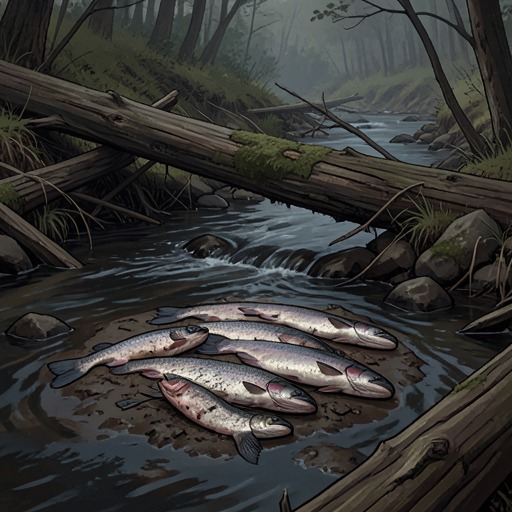
The resulting record made it possible to measure damage with unusual precision. After planes approached and spraying affected the stream, the population figures showed a sharp loss among young salmon: of every six young from the 1953 hatch that had foraged there, only one remained. The 1952 hatch, whose fish were nearly ready to go to sea, lost one-third of its numbers. The census therefore distinguished losses by age group and stage of development, rather than recording only an undifferentiated decline.
From Fish Counts to Ecological Change
The Board’s evidence revealed more than the immediate disappearance of young salmon. Its survey also identified a serious change in the streams, placing the fish losses within a broader alteration of the aquatic environment. The importance of the census lay in this combination: it documented individual losses while providing a record of the biological conditions against which wider disturbance could be recognized.
That method gave the findings weight in a debate often framed around the purposes of spraying. A detailed record collected before the intervention made it harder to treat subsequent losses as an unmeasured impression or an isolated observation. The Board’s work connected the timing of the spraying with changes in a previously monitored population and made the consequences legible in terms of actual numbers.
Research and Later Spraying Decisions
The Board’s role did not end with documenting damage. Canadian forestry officials reduced the concentration of DDT from half a pound to a quarter pound per acre on the Board’s recommendation, an effort to minimize the destruction of fish. The comparison with the United States was stark: the standard application there remained one pound per acre, a rate described as highly lethal.
The reduction was a mitigation measure, not a resolution of the underlying conflict. Spraying was presented as a stopgap intended to save trees from death through defoliation over successive years, and officials expected its unfortunate side effects to continue if the program continued. Observations over several years produced a mixed situation, offering little comfort to salmon-fishing interests so long as spraying persisted. The Board’s evidence could inform a change in dose, but it did not make the continuing intervention harmless.
The Board’s Significance
The Northwest Miramichi record shows the value of sustained ecological monitoring: without the annual census begun in 1950, there would have been no comparable account of adult spawners, young fish by age, and other stream species before the spraying. The Board’s records made a quantified assessment possible and supported a specific adjustment to later pesticide use.
In the account of the spraying, the Board serves as both observer and practical participant in environmental decision-making. Its work preserved evidence of what the river had supported, measured the losses after intervention, and supplied a recommendation that officials acted upon. The resulting concentration reduction mattered, but the continued spraying and its uncertain effects remained in view. The census thus documents both the power and the limits of applied research: it can make ecological damage measurable and shape policy without, by itself, ending the practices that cause it.