Florida
Silent SpringFlorida appears in Rachel Carson’s account not as a single, bounded episode but as a landscape where the consequences of pesticide use and the possibilities of other methods become visible. Its western coast supplied a long record of bald eagle nesting, its eastern salt marshes suffered after dieldrin treatment, and its livestock industry helped drive a large-scale experiment in insect sterilization. These episodes place Florida at the crossing of ecological history and public policy: a place where attempts to control one species could unsettle many others, and where a different approach was put to practical test.
A landscape shaped by ecological interdependence
The book’s account of Florida belongs to a wider description of landscapes formed through long interaction between land, climate, plants, and animals. In the West, Carson describes the high plains and lower mountain slopes as a land of severe climatic extremes, where plant and animal life evolved in close adaptation to local conditions. The pronghorn and sage grouse are presented as inhabitants of a natural system, not as isolated resources to be managed independently. That account concerns western sage country rather than Florida, but it establishes the book’s larger way of reading place: a landscape is a network of relationships, and changing its plant cover can alter the conditions on which animal life depends.
Carson sets that ecological view against land-management efforts that sought to replace sagebrush with grassland to satisfy demands for more grazing. She describes spraying as a broad intervention that could eliminate plants beyond its intended target. In the Bridger National Forest, the United States Forest Service sprayed about 10,000 acres of sage country; willows were also killed, and the change threatened the beavers dependent on them. The episode is not set in Florida, but its logic illuminates the Florida cases: chemical treatment directed at one problem can travel through a habitat and affect species and uses that were not the target.
Eagle nesting on the western coast
The most intensively studied bald eagles in North America, Carson reports, nested along a stretch of Florida’s western coast from Tampa to Fort Myers. The long-term record there was built by Charles Broley, a retired banker from Winnipeg who gained ornithological distinction by banding more than 1,000 young eagles. The scale and duration of his work made the coast a place where a change in reproduction could be measured against a substantial earlier record.
In the early years of Broley’s banding, he found about 125 active nests each year along his chosen stretch of coast and banded roughly 150 young annually. Production began to decline in 1947. Some nests held no eggs; others held eggs that did not hatch. The reported pattern therefore involved more than a simple decrease in the number of adult birds: it included failures at distinct stages of reproduction.
Carson says that the cause had not yet been definitely established, while noting evidence implicating insecticides. The qualification matters. The Florida nesting history is presented as a serious warning supported by observation, not as a conclusively solved case. The contrast between Broley’s earlier counts and the later failures gives the evidence its force: a well-observed population had changed, and the possibility that pesticides had impaired its ability to reproduce could not be dismissed.
Salt marsh treatment and a brief, destructive cascade
On Florida’s eastern coast, the Indian River country offers a more immediate account of chemical effects in a coastal ecosystem. Carson identifies the spring of 1955 as the setting for treatment of about 2,000 acres of salt marsh in St. Lucie County. Dieldrin was applied in an attempt to eliminate sandfly larvae. The treatment was directed at an insect, but the surrounding marsh and its food relations made the consequences much broader than the target.
Carson’s discussion places the episode within the life of salt marshes, estuaries, and sheltered inlets, environments where pesticides may be applied directly to control mosquitoes or other insects. The scale of the operation—thousands of acres treated—underscores that this was not a small, isolated application. The marsh was a connected habitat, and the poison’s effects did not stop at the point where the treatment was meant to act.
A parallel account came from the opposite coast of Florida. The late Dr. Herbert R. Mills observed a similar picture in Tampa Bay, where the National Audubon Society operated a seabird sanctuary that included Whiskey Stump Key. The sanctuary’s protective purpose stood in sharp contrast to the chemical damage around it: the refuge became, in Carson’s telling, an inadequate shelter amid local spraying. The contrast makes the place significant not only as a site of wildlife protection but as evidence that a designated sanctuary could not insulate birds from hazards spreading through the surrounding environment.
Florida as a center of the screw-worm campaign
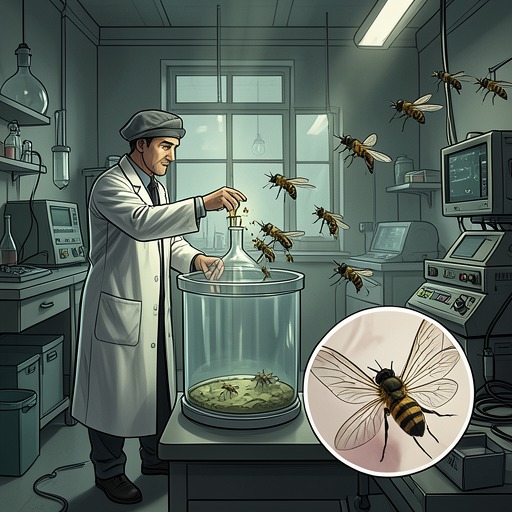
Florida also became a focal point in the effort to control the screw-worm fly, an insect whose larvae infest open wounds in warm-blooded animals. Carson describes the species as tropical or subtropical, normally restricted in the United States to the Southwest. Around 1933, however, it was accidentally introduced into Florida. The climate allowed it to survive the winter and establish populations, and it spread into southern Alabama and Georgia. Its expansion threatened the livestock industry of the southeastern states; in parts of Texas, deer deaths were also attributed to screw-worm infestation.
The book presents this spread as the background to a proposed alternative to repeated insecticide treatment. Dr. Knipling pursued insect sterilization as a possible weapon against a major livestock pest. After a successful experiment on Curaçao, Florida livestock raisers sought a comparable effort on a vastly larger scale. In 1957, the United States Department of Agriculture and the State of Florida joined in funding an eradication campaign. The comparison conveyed the difficulty: the Florida undertaking covered an area about 300 times as large as the small Caribbean island.
The operation depended on mass production. A specially built fly factory was to produce about 50 million screw-worm flies each week for the program. The scale of that production reflected a method fundamentally different from simply spreading poison across a landscape: the aim was to release sterile males so that reproduction would fail. Florida thus appears in two contrasting pesticide histories. In the marsh and coastal cases, chemical control harmed organisms beyond its intended target; in the screw-worm campaign, the state became a proving ground for a species-specific strategy intended to suppress reproduction.
Carson also notes the limits and possible extensions of that approach. Radiation sterilization posed practical difficulties, prompting scientists to search for chemical sterilants that might achieve similar results more easily. Researchers at the Department of Agriculture laboratory in Orlando, Florida, were investigating this direction. The mention of Orlando connects the statewide eradication ambition to continuing laboratory research, while the discussion preserves the distinction between an operational release program and a method still under investigation.
A place of warning and experiment
Across these episodes, Florida’s significance lies in the range of consequences and responses assembled within one state. On the western coast, Broley’s counts documented a decline in eagle nesting success, with insecticides implicated but not definitively proven as its cause. In the east, dieldrin treatment of 2,000 acres of St. Lucie County marshes illustrated the ecological risks of applying a powerful poison to a connected habitat. In Tampa Bay, a seabird sanctuary offered no complete refuge from the effects of its surroundings. In the south, the spread of the screw-worm fly helped prompt an ambitious alternative control campaign involving tens of millions of insects produced weekly.
The setting therefore resists a simple division between nature and human management. Florida’s climate enabled an accidentally introduced pest to establish itself, while policy and science shaped the response; meanwhile, coastal and wetland wildlife bore risks from chemical campaigns directed at other organisms. By placing documented reproductive change, marsh spraying, sanctuary protection, pest expansion, and insect sterilization within the same state, Carson makes Florida a concentrated example of the book’s central ecological argument: interventions must be judged not only by the target they are meant to control, but by the living relationships through which their effects spread.