Food-chain transfer of pesticides
Silent SpringFood-chain transfer of pesticides is the movement of persistent chemicals from treated plants or contaminated environments into organisms that consume them, and onward to predators. In Silent Spring, this process explains why the consequences of spraying can be indirect, delayed, and spread far beyond the original target: chemicals enter food, accumulate in prey, and reach animals that were never directly sprayed. The chain from elm leaves to earthworms to robins makes that movement concrete, while examples involving owls, shellfish, and migrating woodcocks widen its implications for wildlife and human exposure.
From application to food
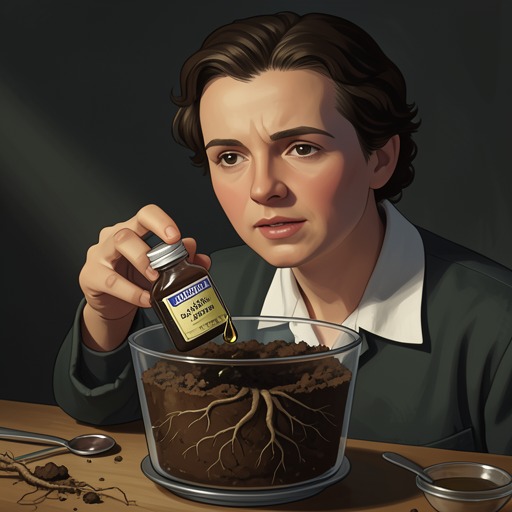
The transfer begins when an insecticide remains in the environment after treatment. In the elm-spraying example, the chemical film persists on leaves and bark despite rain. In autumn, treated leaves fall and collect in damp layers on the ground; earthworms feeding in the leaf litter swallow the insecticide along with their food. The spray’s effects therefore continue after the leaves leave the trees and enter the soil.
Earthworms do not simply pass the contamination along unchanged. DDT deposits were found throughout their digestive tracts, blood vessels, nerves, and body walls. Some worms die, while others survive with the pesticide concentrated in their bodies. When robins return in spring and feed on them, the chemical crosses another boundary—from contaminated plant matter into soil-dwelling prey, and from prey into a bird that may never have contacted the original spray directly.
The robin and the accumulating dose
The robin deaths illustrate the difference between direct exposure and food-chain poisoning. The account says the birds were apparently poisoned less by direct contact with insecticides than by eating earthworms. Observations of other animals fed campus worms supported the concern: crayfish died after consuming them, and a caged snake developed severe tremors after being fed worms from the same setting.
The quantities make the pathway particularly clear. As few as 11 large earthworms could transfer a lethal dose of DDT to a robin, while a bird might eat 10 to 12 worms in as many minutes. Eleven worms were thus only a small part of a day’s food. Not every robin received a lethal dose, but the birds’ survival did not mean the exposure was harmless: the account notes that another consequence could threaten the population even when poisoning did not kill each bird outright.
Beyond the first predator
Once a pesticide has entered prey, the chain can extend to predators that feed on contaminated animals. Earthworms are eaten by raccoons and opossums, as well as by shrews and moles. Those small mammals and other prey may, in turn, expose screech owls and barn owls. Several screech owls found dying in Wisconsin after heavy spring rains may have been poisoned through earthworms; hawks and owls of several kinds were also found in convulsions, possibly after eating birds or mice that had accumulated insecticides in their livers or other organs.
The risk is not confined to animals that forage on the ground or to their predators. Birds feeding in tree canopies by gleaning insects from leaves are also placed within the exposure pathway when foliage is sprayed. The account’s movement among leaf litter, worms, small mammals, birds, and predators presents ecological harm not as a single impact at the moment of application, but as a sequence of transfers through feeding relationships.
Shellfish and human exposure
The same principle applies in water. Oysters and clams may concentrate pesticides in their digestive organs and other tissues. Because people normally eat these shellfish whole, and sometimes raw, the absence of sudden visible deaths among aquatic animals cannot establish that the food is uncontaminated or safe.
A fisheries scientist draws the comparison with the robins: the birds did not die simply because DDT was sprayed over them; they died after eating earthworms that had already concentrated the pesticide. The parallel shifts attention from the conspicuous, immediate poisoning of fish or crustaceans to less visible residues carried in organisms that become food. Food-chain transfer therefore turns a local pest-control treatment into a wider exposure question, connecting environmental persistence, animal diets, and the human food supply.