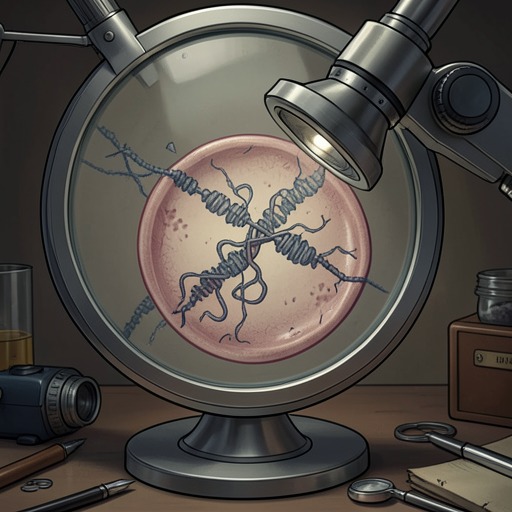
Genetic heritage
Silent SpringGenetic heritage is the inheritance of life across generations: a link shaped by evolution, embodied in genes, and carried forward into the future. In Silent Spring, Rachel Carson treats it as a possession humanity holds only temporarily, and argues that chemicals capable of damaging chromosomes threaten not just individual health but the continuity of life itself. The concept gathers the book’s concern with pesticides into a question of what present generations may pass on to those who follow.
A Possession Held in Trust
Carson describes genetic heritage as more valuable than any individual life because it connects the past with the future. Genes make each person what they are, but they also hold the possibilities of what humanity may become—possibilities that may promise or threaten. This inheritance was shaped across immense stretches of evolution; Carson evokes two billion years of evolution and selection of living protoplasm to convey its depth. The present generation possesses that legacy only for a moment. Its responsibility is therefore not confined to avoiding immediate injury: it must also consider the effects that may be carried forward.
The book places this concern within a broader account of life’s adaptation to particular places. In the West, the land of sage formed under harsh climatic extremes, and plant and animal life evolved in relation to those conditions. The pronghorn antelope and sage grouse exemplify species adjusted to that habitat. Genetic heritage is thus not presented as an abstraction detached from the living world: it belongs to organisms and to the relationships that have developed between them and their environment.
From Chemical Exposure to Genetic Injury
Carson draws a comparison between radiation and chemicals that imitate its effects. Laboratory studies, she reports, had duplicated in chemicals a range of injuries associated with radiation. Some pesticides, including herbicides as well as insecticides, belonged to this radiomimetic group. They could damage chromosomes, interfere with normal cell division, or cause mutations. The danger, in this account, lies in the capacity of chemical agents to act directly upon the material through which inheritance is transmitted.
The possible consequences do not stop with the exposed person. Genetic injury may lead to disease in the individual, or its effects may become apparent in future generations. Carson emphasizes the time lag that can separate an initial injury from its eventual outcome: radiation-damaged cells may be killed, or, after years, become malignant. Her parallel between radiation and chemicals makes delayed harm part of the argument, not an exception to it. An exposure may matter long after the moment when it occurred, and its significance may extend beyond the person who first encountered it.
Chromosomal Abnormalities and Uncertain Consequences
Carson also considers chromosome abnormalities associated with disease and developmental outcomes. She points to a Wisconsin investigation suggesting that an extra attached chromosome fragment, although seriously damaging, is not necessarily fatal. The investigators thought this condition might account for a substantial share of otherwise unexplained cases in which a child is born with multiple defects, often including intellectual disability. The field was still new, and researchers were concentrating on identifying the abnormalities associated with disease.
That uncertainty does not, for Carson, make the threat negligible. It makes the prospect of adding chromosome-damaging substances to the environment more pressing: the effects of such substances could correspond to injuries already associated with serious conditions, even while the science of those conditions remained incomplete. Her argument does not claim that every exposure produces a particular outcome. Instead, it asks readers to take seriously the demonstrated capacity to damage genetic material and the possibility that the damage may reach future generations.
Ecological Change and the Cost of Control
The vulnerability of inheritance has a counterpart in the transformation of landscapes. Carson describes agencies seeking more grazing land by removing sage to create grassland, despite the way the high plains and lower mountain slopes had developed as a distinctive system. She recounts that spraying intended to eliminate sage also killed other plants. In the Bridger National Forest, the U.S. Forest Service sprayed about 10,000 acres of sage country; willows, along with the habitat and resources they provided to beavers, were also lost to the indiscriminate spray. This destruction makes visible a recurring danger in Carson’s account: a measure aimed at changing one part of nature can damage connected forms of life beyond its intended target.
The book’s account of pesticide programs likewise places genetic risk within the broader history of chemical control. After the war, Rachel Carson and her scientific colleagues grew alarmed at the widespread use of DDT and other persistent poisons in agricultural programs. In the fall of 1959, about 27,000 acres in southeastern Michigan, including suburbs of Detroit, were dusted from the air with aldrin. Elsewhere, a beetle that had initially spread rapidly in the United States had, by 1945, become a minor pest across much of its range, largely because imported parasitic insects and fatal disease organisms had established restraints on it. These examples put chemical intervention beside alternatives and ecological processes that can limit pests without treating a living landscape as a single problem to be erased.
The Inheritance at Stake
Carson makes the stakes explicit by asking whether the threat to genetic heritage can be reduced, rather than accepted as the price of convenience. She frames the choice against the modest ends sometimes pursued through chemical control: a sproutless potato or a mosquitoless patio. The contrast is between short-term elimination of an unwanted plant or insect and the possible injury of a biological inheritance accumulated over evolutionary time. The question is not simply whether a pesticide achieves its immediate target, but what else it may damage and what consequences may persist.
Genetic heritage therefore connects individual exposure, future generations, and the integrity of the living environment. Its central force in Carson’s argument comes from the mismatch between the brief time required to apply a chemical and the immense duration of the inheritance placed at risk. Because that inheritance belongs temporarily to the present, decisions about chemical use carry consequences beyond the immediate moment and beyond the individual who makes or bears them.