George Wallace
Silent SpringGeorge Wallace is the ornithologist whose investigation of robins at Michigan State University campus revealed that routine Dutch elm disease spraying could turn familiar nesting grounds into a killing ground. His observations and laboratory findings traced the damage beyond immediate deaths: birds disappeared, nests failed, eggs did not hatch, and breeding adults carried high concentrations of DDT in their reproductive organs. In Rachel Carson’s account, Wallace’s work makes pesticide harm legible as both a local die-off and a disruption of reproduction that could continue even where birds survived long enough to nest.
Identity and Research Setting
Wallace was a professor at Michigan State University and an ornithologist studying the effects of Dutch elm disease spraying on bird life, especially robins. His graduate student John Mehner began the relevant doctoral work, and their research brought attention to what intensive spraying meant for birds in communities where the American elm was abundant. Across the Midwest and New England, spraying had become routine; at Michigan State University campus, the campus itself offered a place to observe robins returning to familiar territories and then vanishing from ordinary routines.
The account places Wallace’s research within a wider alarm about long-lasting poisons. In 1958, Rachel Carson began the book that became Silent Spring after she and scientific colleagues had grown concerned about widespread DDT use and other persistent poisons in agricultural control programs. Wallace’s findings give that broad concern a precise field of evidence: not simply that chemicals were dangerous in principle, but that a recurring landscape practice coincided with a recognizable pattern of death and reproductive failure among birds.
The Campus as a Killing Ground
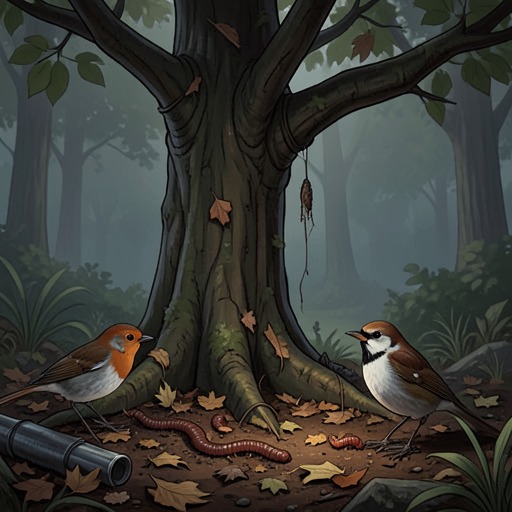
As robins returned to the campus, dead and dying birds began to appear. Few were seen foraging as usual or gathering at their customary roosts; few nests were built, and few young appeared. The pattern recurred rather than passing as an isolated incident. Migrating robins arrived in successive waves, and Wallace estimated that a wave could be eliminated in about a week. New arrivals then entered the same danger, with some birds showing the agonized tremors that precede death.
Wallace described the campus as a graveyard for most robins attempting to settle there in spring. At first, he suspected a nervous-system disease. The observed deaths instead pointed toward insecticide exposure, contradicting assurances from people associated with the insecticide industry that the sprays were harmless to birds. The force of his evidence lies partly in this reversal: the familiar spring return of the robins did not mean that the campus remained safe for them. The birds came back to their territories, but the conditions awaiting them had changed.
From Adult Deaths to Failed Reproduction
Wallace’s records showed that the damage could not be measured only by counting birds that died before nesting. Robins and other birds built nests but laid no eggs; some laid eggs and incubated them without producing hatchlings. One robin sat faithfully on its eggs for 21 days, although the normal incubation period was 13. The prolonged, unsuccessful nesting made the injury visible as a failure of reproduction, not merely the immediate loss of adult birds.
The evidence also connected these outcomes to pesticide residues in breeding birds. In testimony to a congressional committee in 1960, Wallace reported high concentrations of DDT in the testes and ovaries of birds. Ten males had between 30 and 109 parts per million in their testes; two females had 151 and 211 parts per million in the egg follicles of their ovaries. These measurements gave chemical specificity to the field observations: the reproductive organs of breeding birds contained substantial residues while nests and eggs were failing.
Significance and Limits of the Record
Wallace’s contribution in Carson’s narrative is to make the consequences of routine spraying visible through successive, concrete signs: fewer ordinary activities, dead and dying robins, missing nests and young, and eggs that remained unhatched beyond their expected incubation period. His observations shift the scale of the problem from an abstract dispute over whether sprays are safe to a documented sequence of ecological and reproductive effects in a particular place.
The campus episode also shows why a bird count alone would not capture the full harm. Some robins died before completing the nesting cycle; others attempted to reproduce but produced no young. Wallace’s records and chemical analyses therefore describe both immediate mortality and injury that could prevent the next generation from appearing. The recurring spring arrival followed by renewed losses gives the evidence its bleak structure: the robins’ return was not recovery, but the start of another cycle of exposure. Through Wallace’s work, the birds are not incidental casualties in a discussion of pest control; their failed nesting becomes evidence of what the spraying did to the living community the policy was supposed to leave unharmed.