Heptachlor
Silent SpringHeptachlor is presented in Silent Spring as a persistent insecticide whose effects can extend beyond its immediate target: it accumulates in fatty tissue, changes into a more toxic substance, and can remain in soil for years. The account’s agricultural case makes that persistence tangible: treatment intended to control a pest was followed by recurring damage to hop vines, while the treated ground remained poisonous and no corrective procedure could be recommended.
Chemical properties and persistence
Marketed both as a constituent of chlordane and as a separate formulation, heptachlor is described as having a strong capacity for storage in fat. The book reports that a dietary concentration as low as one part per million produces measurable amounts in the body. It also describes a transformation into heptachlor epoxide, a chemically distinct substance that forms in soil and in the tissues of plants and animals. Tests on birds indicated that this epoxide was more toxic than heptachlor; heptachlor, in turn, was reported as four times as toxic as chlordane.
The discussion places heptachlor within a broader account of long-lived insecticides. Heptachlor, or a more toxic chemical derived from it, was reported to persist for at least nine years. That duration gives the compound significance beyond the moment of application: contamination could outlast the control campaign and remain in the environment long after the intended treatment.
Accumulation and exposure
The book explains that pesticide storage in the body can begin with very small intake and continue as exposure accumulates. Because DDT is fat-soluble, the discussion of body storage focuses on fatty tissues and organs; it further warns that stored pesticides are only slowly excreted, creating a risk of chronic poisoning and degenerative changes in the liver and other organs. This broader account of accumulation supplies a framework for understanding why persistent chemicals such as heptachlor matter even when exposure is not described as a single dramatic poisoning.
The account also stresses that people and other organisms may encounter combinations of chemicals rather than one substance in isolation. Researchers found that simultaneous administration of malathion and certain other organic phosphates could produce poisoning far more severe than the effects expected from adding their separate toxicities. This finding is not a heptachlor-specific interaction, but it reinforces the book’s wider warning that environmental exposure and chemical effects cannot always be assessed one compound at a time.
The hop-field failure
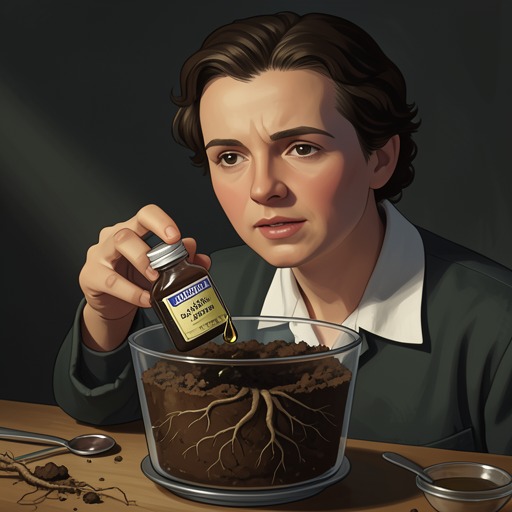
In 1955, hop growers began a large-scale effort to control strawberry root weevil larvae that had become abundant on hop roots. Acting on advice from agricultural experts and insecticide manufacturers, they chose heptachlor. Within a year, vines in treated yards were wilting and dying. Untreated fields showed no such trouble, and the damage stopped at the boundary between treated and untreated ground.
The growers replanted the affected hills at considerable expense, but the replacement roots were dead the following year. Four years after application, heptachlor still remained in the soil. Scientists could not predict how long the ground would stay poisonous or recommend a procedure to correct the condition. The sequence—treatment, damage limited to treated fields, failed replanting, and persistent contamination—turns the intended pest-control measure into a case of long-term agricultural harm.
Ecological reach and significance
Elsewhere, the book describes how pesticide residues can move through ecological relationships and remain detectable in wildlife. In the Louisiana fire-ant program, woodcocks that wintered in the state and bred farther north carried residues of the pesticides used against the ants. Their feeding on earthworms offered a clear route of exposure: the birds probed for worms, and surviving worms in Louisiana were part of the contaminated food chain. The passage names dieldrin or a form of heptachlor among residues found in birds from the wider investigation, connecting pesticide use on land with contamination that could travel through food and across seasonal ranges.
Heptachlor therefore occupies two related roles in the book’s argument. Its chemical persistence and conversion into a more toxic compound show why application does not mark the end of a pesticide’s effects; the hop-field case shows how those effects can endure as a practical problem for growers, while the wildlife evidence points to exposure beyond the treated site. The consequence is a challenge to the idea that an insecticide can be judged only by whether it initially controls its target: its persistence, transformations, and movement through living systems also shape the outcome.