Housefly
Silent SpringThe Housefly is both a familiar carrier of human disease and a measure of how quickly chemical control can lose its force. In the account, insecticides first appear to offer powerful, rapid suppression; within a few years, resistant flies and mosquitoes undermine that promise. The housefly’s story therefore runs from public-health threat to chemical-control failure, and then to a tentative experiment in sterilization that seeks to prevent reproduction rather than poison insects outright.
Disease and public-health significance
The housefly does not need to bite to matter as a disease vector. By contact, it can contaminate human food with the bacillus of dysentery; in many parts of the world it may also contribute to the transmission of eye diseases. The book places it among insects whose associations with human disease are ancient, alongside mosquitoes that transmit malaria, yellow fever, and encephalitis, body lice associated with typhus, rat fleas associated with plague, and tsetse flies that transmit African sleeping sickness. That context makes the fly’s control more than a matter of nuisance: its presence is linked to routes by which disease reaches people.
The unraveling of insecticide control
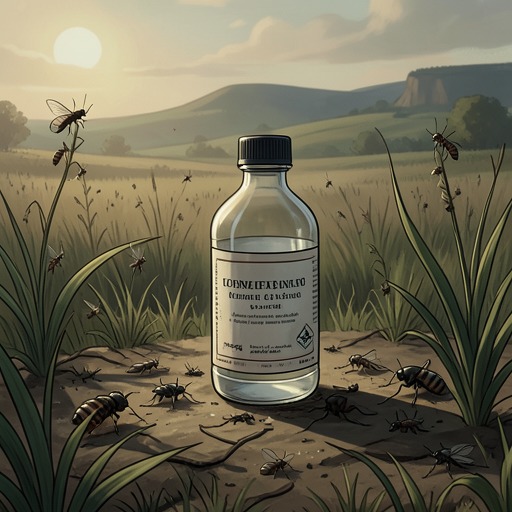
The account describes resistance emerging soon after extensive residual spraying against flies and mosquitoes. In 1948, chlordane was introduced as a supplement to DDT and initially provided good control for two years. By August 1950, however, chlordane-resistant houseflies had appeared; by the end of that year, houseflies and Culex mosquitoes seemed resistant to it. The pattern was not simply that one treatment failed: as new chemicals were brought into use, resistance followed.
By the end of 1951, DDT, methoxychlor, chlordane, heptachlor, and benzene hexachloride had all joined the list of chemicals no longer effective against the flies. Meanwhile, their numbers had become “fantastically abundant.” The contradiction is central to the episode: repeated chemical intervention did not secure lasting suppression, and the target population’s abundance rose even as the control arsenal expanded.
The same pattern appeared in other settings. In the Tennessee Valley, resistance to DDT among flies had become widespread by 1948. Attempts to restore control with dieldrin achieved little; in some places, strong resistance developed within only two months. Control agencies then moved through the available chlorinated hydrocarbons and turned to organic phosphates, only to encounter the same recurring resistance. The sequence shows why changing the poison did not resolve the underlying problem: each new chemical could lose its effectiveness as resistance developed.
The book also notes that this was not confined to the United States. In Sardinia, the cycle was repeated during the late 1940s. In Denmark, DDT products were first used in 1944, yet fly control had failed in many places by 1947. In parts of Egypt, flies were already resistant to DDT by 1948, and BHC resistance was also reported. These comparisons turn resistance from a local mishap into a recurring consequence of insecticide-based control.
The practical conclusion was a retreat from the promise of ever-stronger chemicals: experts judged that housefly control had escaped insecticidal techniques and would once more have to rely on general sanitation. The fly thus becomes an example of a broader reversal in the book’s argument. Chemical measures can temporarily change the balance, but they do not guarantee permanent control, and their repeated failure restores the importance of basic environmental measures.
Chemical sterilization as an alternative
Because the housefly had become virtually uncontrollable by insecticides, the United States Department of Agriculture explored a different method: sterilizing flies with chemicals incorporated into suitable food. Scientists at the department’s laboratory in Orlando, Florida, tested the approach in laboratory experiments and field trials. Unlike a poison intended to kill an insect directly, a sterilant could be combined with bait and introduced into the fly’s natural environment; insects feeding on it would become sterile, with the intended result that sterile flies would eventually predominate and the population would breed itself out of existence.
A 1961 pilot test on an island in the Florida Keys showed both the promise and the limit of the method. Within five weeks, the fly population was nearly wiped out. Repopulation followed from nearby islands, so the result did not amount to lasting eradication. The trial was nevertheless considered successful as a pilot project: it demonstrated rapid suppression while making clear that an island population could be replenished from outside the treated area.
The proposal was attractive in part because radiation-based sterilization presented practical difficulties. Such a program required the artificial rearing of insects and the release of sterile males in numbers exceeding the wild population. That strategy was considered feasible for the screw-worm, described as not abundant, but more than doubling the population of houseflies—even temporarily—could be objectionable. Chemical sterilization appeared to avoid that particular problem by treating flies through bait placed in their environment rather than flooding the area with released insects.
The method also brought its own technical constraint. Testing whether chemicals sterilized insects was more difficult than testing chemical poisons: evaluating one chemical took 30 days, although several tests could be conducted concurrently. The interest in sterilants therefore reflected a genuine need for a new means of control, but the approach remained experimental and laborious to assess. The Florida Keys result offered a sharply bounded success, not proof that chemical sterilization could overcome reinvasion or deliver durable control everywhere.
What the fly’s history demonstrates
The housefly’s changing place in the narrative connects public health, ecological consequences, and the limits of technological confidence. Its ability to contaminate food explains the pressure to control it; its rapid resistance exposes the weakness of relying on successive insecticides. In the author’s broader discussion, pesticides may also persist and accumulate, while simultaneous exposure to multiple chemicals can produce effects more severe than expected from their separate actions. These general warnings reinforce why a method’s immediate effect cannot by itself establish that it is a safe or lasting solution.
The proposed shift from poisoning to sterilization changes the point of intervention—from killing the flies present to preventing future generations—but does not erase the problem of control. The pilot population almost disappeared, then returned from nearby islands. Together, the resistance history and the trial’s repopulation make the housefly a case study in biological response: control methods act on populations that can adapt or be replenished. The closing emphasis on sanitation is not a claim that the fly poses no threat; it is a reminder that durable control cannot be assumed to follow from a succession of chemicals.