Integrated control
Silent SpringIntegrated control is a pest-management approach that works with natural predators and parasites rather than relying on increasingly toxic chemicals. Its defining contrast is between treating an agricultural landscape as a problem to be chemically subdued and managing pests while preserving the ecological relationships that help keep them in check. In the Nova Scotia apple orchards described in Silent Spring, the method produced first-grade fruit and yields comparable to intensive spraying, at markedly lower insecticide expense and with less disruption of nature’s balance.
Origins and governing principle
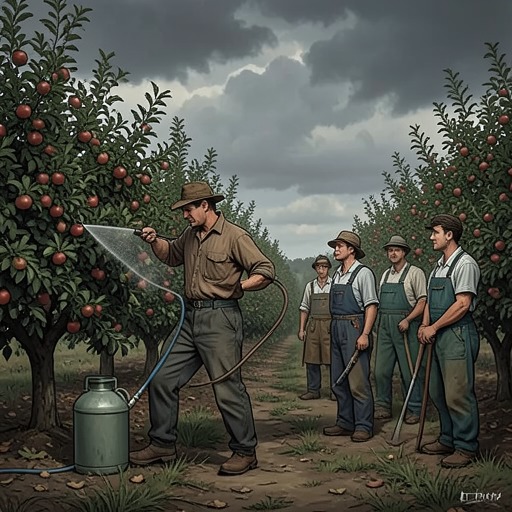
The book presents integrated control as an alternative to the cycle in which chemical treatment brings one crisis under control only for another to follow. In the apple orchards of the Annapolis Valley, the entomologist A. D. Pickett and his associates developed a program that made maximum use of natural controls and minimum use of insecticides. Rather than pursuing ever more toxic chemicals, they treated nature as an ally: predators and parasitic species were not incidental to pest management but essential parts of its design.
This approach was not simply a rejection of every insecticide. It sought to limit avoidable harm by using the smallest doses that could control a pest, and by choosing the timing of applications with the lives of beneficial species in mind. The distinction is practical as well as philosophical: pest control is judged not only by whether a target insect is suppressed, but also by what the intervention does to the organisms that would otherwise help regulate it.
Timing and selective application
The book gives the timing of nicotine sulphate as a concrete example. Applied before the apple blossoms turned pink, it spared one important predator, probably because the predator was still in the egg stage. A shift in application timing could therefore preserve a natural control without abandoning treatment of the pest. The program’s selectivity depended on attention to the orchard’s biological rhythms, not simply on the choice of a chemical.
When insecticides were used, the doses were kept to a minimum—just enough to control the pest without avoidable damage to beneficial species. The account describes the quantities as only ounces per 100 gallons, in contrast to the usual one or two pounds per 100 gallons. Even these materials were not treated as an endpoint: Pickett hoped further research would replace them with safer and more selective alternatives. Integrated control thus combined restraint in present use with continued efforts to reduce reliance on harmful chemicals.
Results in Nova Scotia
The modified spray program was tested against the practical standards of orchard production. Nova Scotia growers following it produced as high a proportion of first-grade fruit and obtained as good a yield as growers using intensive chemical applications. These results did not require matching the conventional level of insecticide expenditure: orchard outlays were only 10 to 20 percent of those in most other apple-growing areas.
The comparison matters because it undercuts the presumption that intensive chemical use is necessary for successful production. Integrated control did not ask growers to accept lower-quality fruit or diminished yields in exchange for ecological restraint. It showed that a program organized around natural controls and limited spraying could meet those production measures while costing substantially less.
Ecological and institutional significance
For the book, the achievement is not only economic or agricultural. The Nova Scotian entomologists’ program was presented as one of the few approaches in the country comparable to integrated control programs developed by some California entomologists, and as a model still too little emulated. Its importance lies in treating the orchard as an interdependent system: the control of a pest should not destroy the predators and parasites that contribute to control, nor damage the broader balance on which continued production depends.
The method also stands against the repeated substitution of one chemical problem for another. Instead of moving from crisis to crisis in pursuit of more toxic treatments, it begins from the possibility that useful allies already exist in nature and that management can preserve them through low doses and careful timing. Its results in Nova Scotia give that principle practical force: high-quality fruit, strong production, sharply lower insecticide costs, and a program the book describes as not doing violence to nature’s balance.