Iroquois County
Silent SpringIroquois County became one of the principal landscapes in Rachel Carson’s account of the costs of chemical pest eradication. A campaign intended to eliminate the Japanese beetle spread across more than 100,000 acres there, yet the beetle continued its westward movement; meanwhile, wildlife and domestic animals bore losses that the available research could only partially measure.
Setting and Eradication Campaign
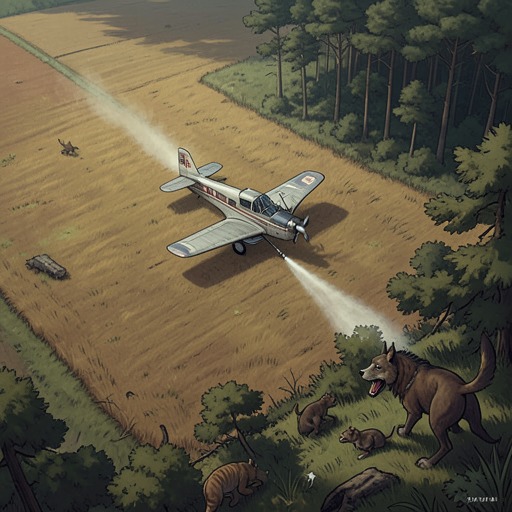
In 1954, the United States Department of Agriculture and the Illinois Department of Agriculture began a Japanese beetle eradication program in Sheldon and adjacent parts of Iroquois County. The first treatment covered 1,400 acres with dieldrin applied from the air. Another 2,600 acres received the same treatment in 1955, and the initial operation was apparently regarded as complete. Instead, further chemical applications followed. By the end of 1961, the area treated had grown to about 131,000 acres.
The expanding acreage transformed an ostensibly bounded eradication effort into repeated chemical treatment on a regional scale. Carson describes the campaign not simply by its declared target, but by the accumulating distance between the ambition of eradication and what the treatments accomplished. Heavy losses among wildlife and domestic animals were already apparent in the program’s early years.
Ecological and Local Consequences
The campaign’s toll was not limited to the beetle. In the surrounding account, Carson records wildlife and fish found dead in numbers after pesticide operations, and notes that a local school turned the collection of insecticide-poisoned birds into a science project. Such details make the consequences visible at the level of community life: poisoned animals became both evidence of exposure and material for children’s observation.
The effects also reached familiar uses of the landscape. Pheasant hunting, once good in the treated areas, was virtually abandoned because it had become unrewarding. The number of young in a brood declined, and pheasant numbers fell by roughly half. These losses show how a campaign directed at one insect could alter the abundance of other animals and diminish activities that had depended on them.
Results and Limits of the Record
Despite the havoc wrought in the name of eliminating the Japanese beetle, treatment of more than 100,000 acres in Iroquois County over eight years appears to have achieved only temporary suppression. The beetle continued moving west. The scale of the intervention thus did not produce the lasting result its eradication objective implied, even as its consequences spread beyond the target species.
The measured damage was itself incomplete. Illinois biologists’ findings were minimum figures, Carson emphasizes; their research program had not been adequately financed to provide full coverage. The full toll may therefore never be known, and a more comprehensive investigation might have revealed still greater destruction. Iroquois County’s significance in the book lies in this conjunction: extensive treatment, continuing movement of the pest, visible harm to wildlife and domestic animals, and a record too underfunded to establish the complete cost.