Lindane
Silent SpringLindane appears in the book not as an isolated remedy but as one element in a widening chain of exposure: it can alter soil processes, accumulate in food crops, persist in the body, and contribute to a pattern of chemical pressure that selects for resistant insects. Its significance lies in the way a substance intended to control pests becomes part of larger ecological and health problems, including effects that emerge gradually rather than as a single acute incident.
Soil and Agricultural Exposure
The book places Lindane among insecticides capable of disrupting nitrification, the process that makes atmospheric nitrogen available to plants. Experiments described in the text found that Lindane, together with heptachlor and BHC, reduced nitrification after only two weeks in soil. In separate experiments, Lindane was among several chemicals that prevented nitrogen-fixing bacteria from forming the root nodules leguminous plants need. These findings link its use not only to direct effects on target insects but also to changes in processes on which plant growth depends.
The movement of insecticides from soil into crops is described as variable, depending on soil type, crop, and the chemical’s nature and concentration. Soil rich in organic matter releases smaller quantities of poison than other soils, but carrots were the crop that absorbed the most insecticide among those studied. When Lindane was used, carrots accumulated concentrations higher than those in the soil itself. The book consequently raises the possibility that soils might need to be analyzed before certain food crops are planted: a crop could receive no direct spraying and still take up residues from contaminated ground.
Persistence and Human Exposure
The account of DDT provides a broader model for the book’s discussion of persistent, fat-soluble insecticides. It describes residues entering the body through food and other routes, then being stored in fatty tissues and organs; small dietary intakes can accumulate because the chemicals are slowly excreted. The text does not establish that Lindane follows every detail of DDT’s behavior, but it repeatedly treats Lindane as part of the wider chemical burden and identifies it in several contexts involving exposure and biological effects.
One of those contexts is a report from physicians at the Mayo Clinic. Malcolm Hargraves and his associates observed that almost without exception, patients they discussed had a history of exposure to various toxic chemicals, including sprays containing DDT, chlordane, benzene, Lindane, and petroleum distillates. This is presented as an association in patients’ exposure histories, not as proof that Lindane alone caused their illnesses. The book’s larger concern is that human beings encounter mixtures rather than one substance at a time, making effects difficult to isolate and increasing the importance of cumulative exposure and interactions among chemicals.
Cellular Effects and Cancer Concerns
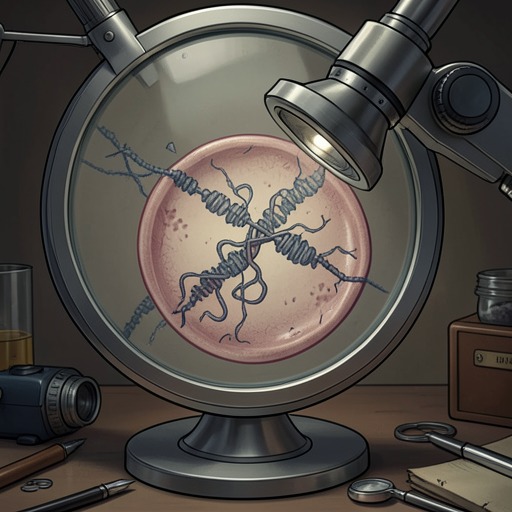
The book also cites experimental evidence concerning chromosome changes. Plants treated with BHC or Lindane developed severe abnormalities, including tumorlike swellings on their roots. Their cells enlarged as their chromosome numbers doubled; the doubling continued through subsequent divisions until further division became mechanically impossible. The account uses these plant experiments to show that chemical effects can reach the machinery of cell division, while distinguishing experimental observations from direct evidence of human disease.
The discussion of chromosome instability gives this observation a wider significance. The text notes that chromosome doubling had been considered important by early proponents of the theory that chromosome instability contributes to cancer, and asks whether it is coincidental that BHC and its relative Lindane had repeatedly been observed to double chromosomes in experimental plants and had also been implicated in cancer-related concerns. The passage poses a question and draws attention to a possible connection; it does not establish that Lindane causes cancer in people. Its force comes from the convergence of experimental findings and unresolved concern, rather than from a claim of settled causation.
Resistance and the Limits of Chemical Control
Lindane is also part of the history of insect resistance. In Egypt, BHC was substituted for DDT after flies had become resistant to DDT in some areas by 1948, but the replacement was effective for less than a year. The episode belongs to a recurring pattern in which the initial success of insecticides gives way to resistance and the need for another control measure. It illustrates how quickly a chemical alternative can lose its effectiveness when control depends on repeated chemical use.
By 1960, the book reports, 65 crop-destroying insect species had become resistant to insecticides. The list of substances to which resistance had developed included DDT, BHC, Lindane, toxaphene, dieldrin, aldrin, and even the phosphate insecticides from which much had been expected. Lindane therefore figures both in evidence of environmental and biological effects and in the practical failure of chemical control: its use belongs to a system that can affect non-target processes while encouraging the survival and spread of resistant pests.
Significance
Across these examples, Lindane’s role is cumulative rather than confined to a single application. It is linked to short-term reductions in soil nitrification, interference with nitrogen-fixing bacteria, residues in crops, chromosome doubling in experimental plants, reported histories of human chemical exposure, and resistance among pest insects. These claims differ in evidentiary kind: soil experiments and plant observations are described directly, patient histories indicate exposure associations, and cancer implications remain a question rather than a demonstrated human outcome.
That distinction sharpens the book’s warning. The concern is not simply that one insecticide may produce one immediate poisoning, but that persistent chemicals can move through soil, crops, organisms, and repeated control campaigns, with consequences that may be delayed or hard to assign to a single cause. Lindane becomes a telling example of that broader problem: chemical control can alter the conditions of agriculture and ecology even as the insects it targets adapt to it.