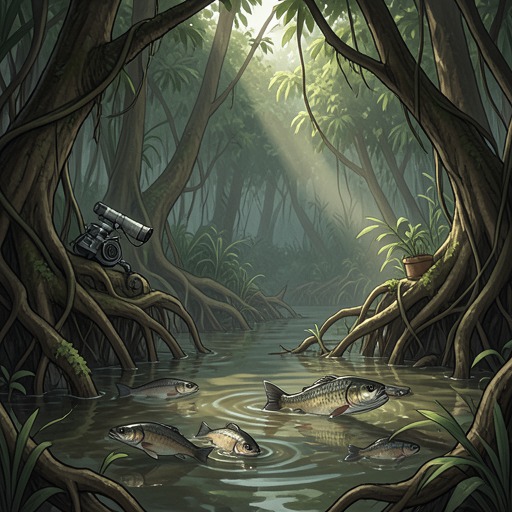
Mass Fish and Crustacean Deaths in St. Lucie County Salt Marshes (1955)
Silent SpringThe 1955 St. Lucie County salt-marsh poisoning was a pesticide kill on Florida’s eastern coast, where an effort to eliminate sandfly larvae with dieldrin devastated fish and crustacean life. Its measured scale—at least 20 to 30 tons of fish, representing about 1,175,000 individuals across at least 30 species—makes the episode one of Rachel Carson’s clearest accounts of the ecological cost of treating a connected wetland as though it were only an insect-control target.
Setting and purpose
Coastal waters receive contaminated river discharges and are also sprayed directly in attempts to control mosquitoes and other insects. Against that wider background, the Indian River country on Florida’s eastern coast offered a particularly graphic example of what pesticides could do to salt marshes, estuaries, and sheltered inlets.
In the spring of 1955, about 2,000 acres of salt marsh in St. Lucie County were treated with dieldrin to eliminate sandfly larvae. The application rate was one pound of active ingredient per acre. The stated target was insect larvae, but the marsh was not an isolated treatment surface: the operation exposed a broad aquatic habitat and the many forms of life within it.
The immediate kill
Scientists from the Entomology Research Center of the State Board of Health surveyed the aftermath. They judged the fish kill “substantially complete.” Fish were found dead across the affected shores, and sharks appeared in the area, drawn by dying fish in the water. The losses were not confined to a single kind of fish: mullets, snook, mojarras, and gambusia were among those reported dead, and the account states that no species was spared.
The survey’s minimum estimate for the immediate fish kill across the marshes, excluding the Indian River shoreline, was 20 to 30 tons—or about 1,175,000 fish belonging to at least 30 species. The estimate is explicitly bounded: it counts the marshes but excludes the river shoreline. Even on that limited accounting, it conveys a regional disaster rather than a localized loss around a few treated patches.
Different fates within the marsh
The effects varied among groups of aquatic life. Mollusks seemed unharmed by dieldrin, while crustaceans were virtually exterminated across the area. The aquatic crab population appeared to have been destroyed; fiddler crabs were almost entirely eliminated, surviving temporarily only in patches of marsh that the pellets apparently missed.
The sequence of deaths also exposed the connections among species. Larger game and food fish succumbed most rapidly. Crabs fed on and destroyed moribund fish, but were dead themselves the following day. Snails continued to feed on fish carcasses. The account thus records not only the first losses caused by spraying but a succession in which the surviving organisms encountered the poisoned aftermath in turn.
Ecological significance
Carson places the St. Lucie County episode within a broader criticism of direct pesticide treatment in coastal waters. The contrast between the narrow purpose—killing sandfly larvae—and the breadth of the reported damage makes the case an illustration of nonselective effects: a chemical applied against one target could alter the life of an entire marsh community, with sharply different consequences for fish, crabs, and mollusks.
The episode also gives concrete form to the book’s concern about ecological interdependence. The marsh’s inhabitants did not experience the application as separate species facing separate risks: the rapid loss of fish, the near-disappearance of crabs, and the deaths of crabs after feeding on dying fish unfolded as related consequences of one treatment. In Carson’s account, the survey figures and the brief food-chain sequence together show why insect-control programs must be judged by what happens throughout the habitat, not solely by whether they reach their intended target.