Microbial control of insects
Silent SpringMicrobial control of insects uses organisms that cause disease in insects as a means of limiting pest populations. In the account, it belongs to a broader search for ways to control insects without relying exclusively on broadly lethal chemicals: its agents range from bacteria and viruses to protozoan parasites, and insect pathogens are distinguished from chemical poisons by their narrow target range. The method is both old in its biological premise and comparatively new as a deliberate control program.
Biological basis and early history
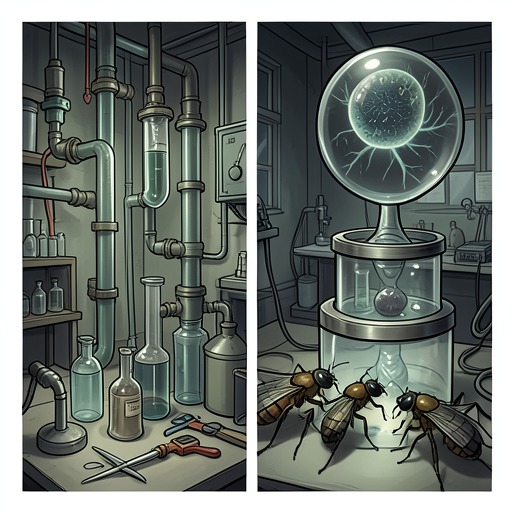
Insects, like humans, are vulnerable to disease. Their pathogens include viruses, bacteria, fungi, protozoa, microscopic worms, and other forms of minute life. The microbial world is not simply hostile to people: many of its members, the book observes, are allies. The possibility of directing insect disease against pests thus rests on an existing ecological relationship, rather than on inventing a poison that kills indiscriminately.
The idea of using microorganisms in this way was first envisioned by the nineteenth-century zoologist Elie Metchnikoff. It developed slowly across the closing decades of the nineteenth century and the first half of the twentieth. That gradual history matters: microbial control was not portrayed as an instant technical breakthrough, but as a body of knowledge taking shape over time. Earlier study of silkworm disease had also contributed to the understanding of infectious disease; the silkworm’s maladies were celebrated in medieval poetry, and research on them helped lead Louis Pasteur toward the principles of infection.
Bacterial control and practical trials
A decisive demonstration came in the late 1930s, when researchers discovered and used milky disease against the Japanese beetle. The disease is caused by spores of a bacterium in the genus Bacillus. Its importance in the account is practical as well as scientific: it provided conclusive evidence that an insect could be brought under control by introducing a disease into its environment. The method had a long history of use in the eastern United States, making it a classic example of bacterial control rather than merely a laboratory prospect.
Further hopes centered on another member of the same bacterial genus, Bacillus thuringiensis. Discovered in Germany’s province of Thuringia in 1911, it was found to cause fatal septicemia in flour-moth larvae. The book notes that bacterial insecticides had already been tried on a wide range of vegetables, especially in California, and that on crops their use did not present the same problem as on other settings: even a dust could be used. These trials suggest a practical route from knowledge of a pathogen to its application against a pest, while the evidence does not claim that every insect pest or crop had already been brought under control.
Viruses, parasites, and selective action
Microbial control also includes work with viruses. In California, young alfalfa fields were being sprayed with a solution made from the bodies of caterpillars that had died of a highly virulent disease. The preparation was aimed at the destructive alfalfa caterpillar. The account emphasizes the striking economy of the method: the bodies of only five diseased caterpillars could supply the virus solution. It is a concrete contrast with chemical control, in which a treatment is described by its toxic force; here the material is produced from the pest’s own disease.
Other organisms offered additional possibilities. A protozoan parasite had been found in the United States to reduce the egg-laying potential of the corn borer. That effect is not identical to killing an insect outright: by lowering reproduction, the parasite could suppress a pest’s capacity to multiply. Taken together, bacterial infections, viral disease, and protozoan parasitism show that microbial control is not one substance or one procedure, but a set of biological approaches that act in different ways.
Limits and significance
The book directly addresses a fear that the phrase microbial insecticide might suggest biological warfare dangerous to other life. It rejects that implication, contrasting insect pathogens with chemicals: the pathogens are described as harmless to organisms other than their intended targets. That selectivity is the central ecological distinction made for the approach. Rather than treating the surrounding living world as collateral damage, microbial methods seek to exploit vulnerabilities specific to insect pests.
The discussion presents microbial control as one part of a larger turn toward new concepts of insect management, alongside possibilities such as electronics and gamma radiation. Its significance lies not in a claim that biological methods can solve every pest problem, but in the alternative they establish: insect populations can sometimes be managed through diseases and parasites that already exist in nature. The approach reframes control from the broad application of lethal chemicals toward the deliberate use of relationships within the living world.