Moose
Silent SpringMoose are presented as animals whose survival depends on the particular structure of their habitat, not as interchangeable features of a landscape. In Rachel Carson’s account of the spraying in Bridger National Forest, the willow thickets that sheltered them were killed along with the sagebrush. When William O. Douglas revisited the area a year after the spray, the Moose were gone, part of a cascading loss that also included Beavers, their dam, the lake, and the large trout.
Habitat and Ecological Setting
The setting is the land of the sage: the high western plains and the lower slopes of the mountains above them, shaped over millions of years and marked by harsh climatic extremes. Carson describes its plants and animals as products of long adaptation to the conditions of the region. The sage itself is central to this account, but the habitat is not a single-species arrangement. Vegetation, animals, streams, and shelter form a local system whose parts have developed in relation to one another.
Within that system, willow thickets along the meandering streams provided the Moose with their own crucial habitat. Carson makes the relationship explicit by comparing willow to the Moose with sage to the pronghorn antelope: each animal depends on the vegetation suited to its way of life. The willows were therefore not incidental greenery beside the targeted sagebrush. They were the living cover on which the Moose’s place in the landscape depended.
The Spraying in Bridger National Forest
Land-management agencies sought to satisfy cattlemen’s demand for more grazing land, understood as grassland without sage. Carson frames this effort as an attempt to improve on nature’s arrangements, replacing a mixed landscape with one simplified for a human use. In the Bridger National Forest, the United States Forest Service sprayed about 10,000 acres of sage lands under pressure to create more grassland. The sage was killed as intended, but the operation also destroyed many plants beyond its target.
The spray killed the green ribbon of willows tracing the streams across the plains. When Douglas visited in 1959, the year of the spraying, he saw the willows shriveled and dying. The destruction was not confined to a change in vegetation: it removed the habitat the Moose needed and disrupted a wider community that had gathered around the stream corridors. A program described as improvement thus acted indiscriminately on the landscape, striking at relationships its stated goal did not account for.
Disappearance and Cascading Loss
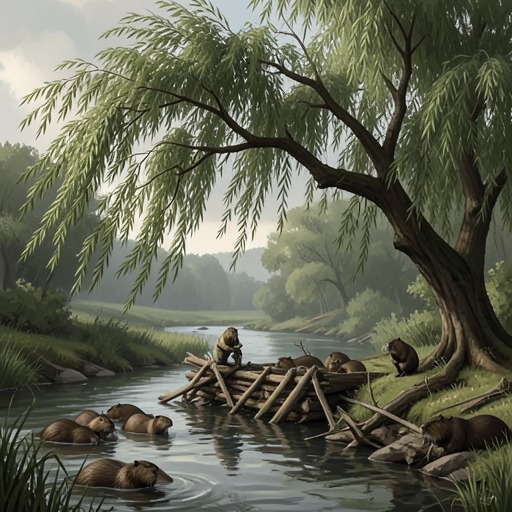
Carson records the consequence through Douglas’s return to the area a year later. The Moose were gone. The Beavers that had lived among the willows were gone too; without their skilled attention, the principal dam failed, and the lake drained away. The large trout had also disappeared, unable to live in the tiny creek left threading through the damaged landscape. These losses form a connected sequence rather than a set of unrelated absences: the spray destroyed willows, the altered habitat no longer sustained the animals, and the loss of the Beavers’ dam changed the water that had supported the lake and its fish.
Before the spraying, the region had been attractive for recreation, with excellent fishing and hunting. The aftermath reversed that account of the place. Its transformation is measured not only in dead plants but in vanished Moose, Beavers, and trout, a collapsed dam, and a lake drained away. The Moose’s absence is consequently both a specific ecological consequence and a sign of the scale of the intervention: the consequences extended well beyond the plant the agency meant to remove.
Significance in Carson’s Argument
The Moose give Carson’s account a concrete way to show that habitat is made of dependencies. Willow is to them what sage is to the antelope; destroy the plant, and the animal’s place in the system disappears with it. The comparison resists treating land as empty acreage awaiting conversion to grass. It directs attention instead to the different lives already supported by the mixed landscape.
The episode also exposes the limits of judging a control program by its intended target or immediate purpose. The spraying produced the planned destruction of sagebrush, but its effects traveled through willows, Moose, Beavers, the dam, the lake, and trout. The Moose are not described as participants in a human conflict over grazing, yet their disappearance makes the ecological cost of that conflict legible. In Carson’s account, the land is not passive scenery for a management decision: its interdependent inhabitants register, in their loss, what the decision has done.