New Jersey
Silent SpringNew Jersey enters the book as both the place where the Japanese beetle was first identified in the United States and an early center of efforts to control it through biological means. Its history offers a pointed contrast: the beetle’s arrival prompted a long campaign to restrain it, but the most durable response described is the spread of its natural enemies and disease, not indiscriminate poisoning.
The Beetle’s Discovery and Spread
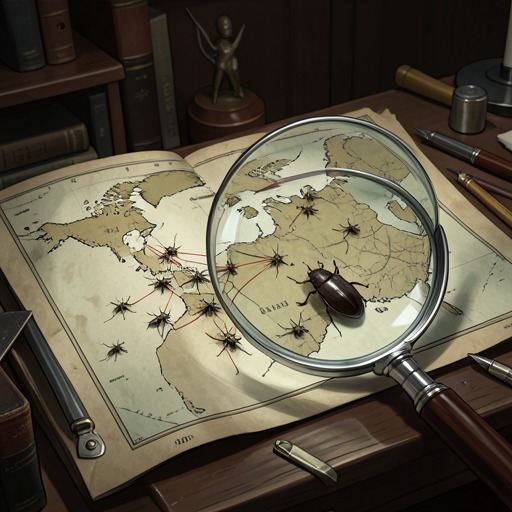
The Japanese beetle was first discovered in the United States in 1916, in a nursery near Riverton, New Jersey. A few metallic-green beetles were noticed there, at first without recognition of what they were; once identified, they marked the beginning of a new pest problem. In its first dozen years in the country, the beetle multiplied rapidly, free of the restraints that kept it in check in its native range.
The book places that local discovery within a wider change in the beetle’s fortunes. By 1945, it had become only a minor pest across much of the territory it had invaded. That decline followed the establishment of imported parasitic insects and fatal disease organisms, showing that the initial spread was not an inevitable march toward permanent infestation.
New Jersey as a Center of Biological Control
The effort to reintroduce natural checks began with sustained searching across the beetle’s native range. Between 1920 and 1933, 34 species of predatory or parasitic insects were brought from the Orient in an attempt to establish natural control; five became well established in the eastern United States. New Jersey was among the older infestation areas where another biological restraint, milky disease, became prevalent.
Milky disease was discovered in New Jersey in 1933 and was rather widely established in older beetle-infested areas by 1938. The disease organism lives as spores in the soil. When a beetle grub ingests them, they multiply in its blood and turn the grub abnormally white, giving the disease its familiar name. The account stresses its selectivity: it was described as harmless to earthworms, warm-blooded animals, and plants.
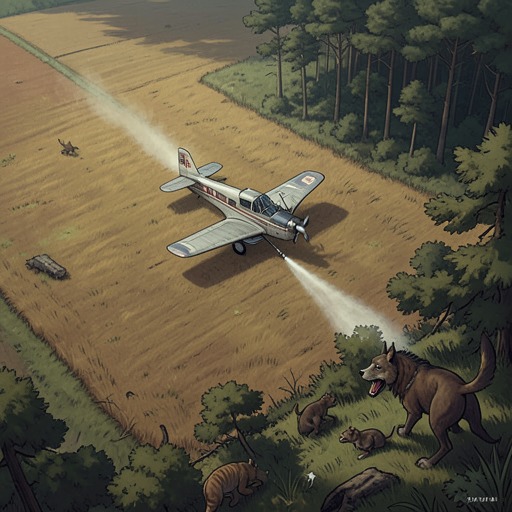
A control program launched in 1939 aimed not to blanket the landscape with a general poison but to accelerate the spread of the disease. Since the organism could not be grown in an artificial medium, a practical substitute was made from infected grubs: they were ground up, dried, and mixed with chalk. A gram of the standard dust contained 100 million spores. This concrete method joined biological knowledge to large-scale public action while preserving a distinction between the target pest and the surrounding life.
A Regional Program and Its Wider Significance
Between 1939 and 1953, the cooperative federal-state program treated about 94,000 acres in 14 eastern states. Additional areas on federal lands were treated, as were extensive areas by private organizations and individuals. New Jersey’s role therefore belongs to a regional campaign, not an isolated local experiment: the state was an early site where the disease was found and part of the landscape in which the approach could be developed and extended.
The book’s account sets this history against later programs that treated chemical power as the decisive answer to insect pests. In the Japanese beetle case, the beetle’s decline was attributed largely to imported natural enemies and disease, while the milky-disease program sought to hasten an ecological restraint already capable of spreading. New Jersey thus anchors a different model of intervention: one that acts on a pest through its biological relations rather than treating the whole environment as expendable.