Northwest Miramichi
Silent SpringNorthwest Miramichi is a watershed where a forest-protection campaign became a river-wide ecological crisis: in June 1954, aircraft sprayed its forests with DDT, killing the stream insects on which young salmon depended and wiping out that spring’s entire cohort. The account’s later qualification—that an extraordinary combination of circumstances spared the runs from anticipated destruction—makes the place an example of both pesticide harm and the contingency of ecological recovery.
Setting and ecological dependence
The watershed’s forest and stream life are linked in the book’s account through the food available to young salmon. The Canadian program targeted spruce budworm, a native insect that attacks several kinds of evergreens. Its practical priority was to save balsams, described as the mainstay of the pulp-and-paper industry; the campaign therefore treated forest protection as its immediate objective, while the consequences for aquatic life emerged downstream in the same landscape.
The 1954 spraying and salmon loss
In June 1954, planes crossed the forests of Northwest Miramichi in a crisscross pattern, leaving white clouds of settling mist. The spray was DDT dissolved in oil, applied at one-half pound per acre. It filtered through the balsam forests into the watershed, exposing the stream’s insect life along with the forest pests the operation was meant to control.
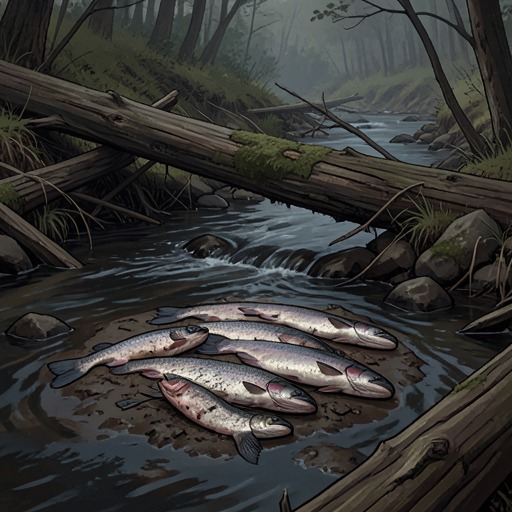
The loss of stream insects left young salmon without food. By August, none of the young salmon that had emerged from the gravel beds that spring remained: a whole year’s spawning had come to nothing. Older juveniles, hatched a year or more before, fared only slightly better. The damage was thus not merely a temporary interruption in feeding, but a severe blow to the successive young fish on which future runs depended.
Survival and its limits
The later account describes the Northwest Miramichi runs as having escaped the destruction that had been anticipated only through a very unusual combination of circumstances, one that might not recur for a century. This qualification matters: the survival of the runs did not demonstrate that spraying was harmless or that the watershed had been reliably protected. It marked a contingent reprieve after substantial losses.
After several years of observation, the situation remained mixed and offered little comfort to salmon-fishing enthusiasts if spraying continued. The episode therefore ends not with a secure recovery but with a warning about dependence on exceptional luck: the watershed’s future could not safely be inferred from the fact that its salmon runs had not yet suffered the full destruction expected.