Nova Scotia
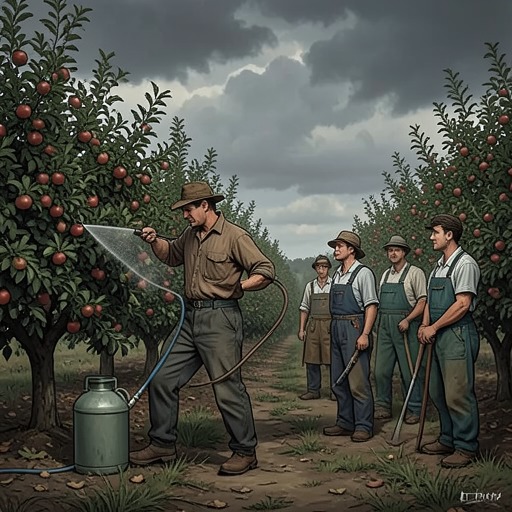
Silent SpringNova Scotia is the setting for an alternative to the escalating use of insecticides: an apple-orchard program developed by A. D. Pickett and his associates that sought to work with natural predators rather than suppress them indiscriminately. In the Annapolis Valley, their modified spraying produced as much first-grade fruit and as good a harvest as intensive chemical treatment, while costing substantially less and avoiding comparable damage to nature’s balance.
Setting and Agricultural Problem
Pickett began his work about thirty-five years before the account was written in the apple orchards of the Annapolis Valley, once one of Canada’s most concentrated fruit-growing districts. The prevailing confidence was that insecticides—at that time inorganic chemicals—would solve the orchards’ pest problems. But the book presents the promise of a chemical solution against a recurring pattern: suppressing one pest could unsettle the relationships that had kept other populations in check, leaving growers to confront a new crisis.
That pattern had become especially visible in the recurring problems of mites. Pickett described the experience as movement from one crisis to another, with each response trading one problem for the next. Rather than follow entomologists pursuing ever more toxic chemicals, he and his associates chose a different course, recognizing that natural enemies could be allies in control. The orchard was not treated as a battlefield in which every insect had to be destroyed; it was a living system in which the timing and selectivity of intervention mattered.
A Selective and Timed Program
The program relied on restraint and precise timing as well as on the choice of materials. Pickett took particular care to select chemicals that would do as little harm as possible to insect parasites and predators. Timing could spare a useful predator even when an application was made: applying sulphate before the apple blossoms turned pink meant that one important predator was probably still in its egg stage, and so escaped the treatment.
The approach also refused to make newer insecticides routine substitutes for the inorganic chemicals used earlier. Pickett warned that if DDT, parathion, chlordane, and other new insecticides became standard control measures, entomologists concerned with biological control might as well abandon their effort. His objection was not simply to a particular product, but to a system in which escalating chemical use repeatedly sacrificed natural checks and set up another outbreak. The program therefore aimed to make each intervention compatible with the continued action of predators and parasites.
Results and Significance
Orchardists in Nova Scotia who followed Pickett’s modified spray program obtained as high a proportion of first-grade fruit and as good a level of production as growers relying on intensive chemical applications. They achieved those results at substantially lower cost: insecticide outlays in the province’s apple orchards amounted to only 10 to 20 percent of the spending typical in most other apple-growing areas. The comparison made the alternative practical as well as ecological; it did not ask growers to accept inferior yields in exchange for restraint.
The book treats the program’s deeper achievement as its refusal to do violence to nature’s balance. Its significance lies in the conjunction of viable production, lower chemical expenditure, and the preservation of natural relationships that intensive spraying could disrupt. Nova Scotia thus stands as a concrete counterexample to the apparent inevitability of the chemical treadmill: pest management could be organized around selective applications and biological allies, not simply answered with stronger poisons and another cycle of crisis.