Pesticide poisoning
Silent SpringPesticide poisoning in Silent Spring is not a single medical event but a spectrum of harm produced by exposure to potent chemicals. The book connects immediate illness and death to the less visible accumulation of persistent pesticides, and insists that risk cannot be understood by considering one chemical, one dose, or one exposed organism in isolation. Through examples of human and animal poisoning, it presents the body as both a site of chemical action and a place where environmental contamination gathers over time.
Forms of Exposure and Toxic Action
The book distinguishes newer synthetic insecticides by their biological potency: they do not merely poison in a general sense, but can enter vital bodily processes and alter them, sometimes with deadly consequences. The described mechanisms include destroying enzymes that protect the body, blocking oxidation processes through which it receives energy, and interfering with normal organ function. Poisoning therefore means more than a brief reaction to contact; some chemicals disrupt the processes on which ordinary bodily activity depends.
The organic phosphates form a particularly acute hazard. The book describes them as among the world's most poisonous chemicals and identifies the immediate danger to people applying sprays or encountering spray drift, treated vegetation, or discarded containers. Exposure can occur outside the work of spraying itself: residue on a plant or an abandoned package can become the route by which a chemical reaches someone who did not intend to handle it.
Sudden Poisoning and Its Reach
A Florida incident illustrates how a discarded container could carry danger into ordinary life. Two children found an empty bag that had once held parathion and used it to repair a swing. Both children died, and three playmates became ill; tests established that the deaths were caused by parathion poisoning. The example makes the route of exposure central: the chemical's danger persisted in an object after its original use, and the children encountered it through an everyday activity rather than through an organized application.
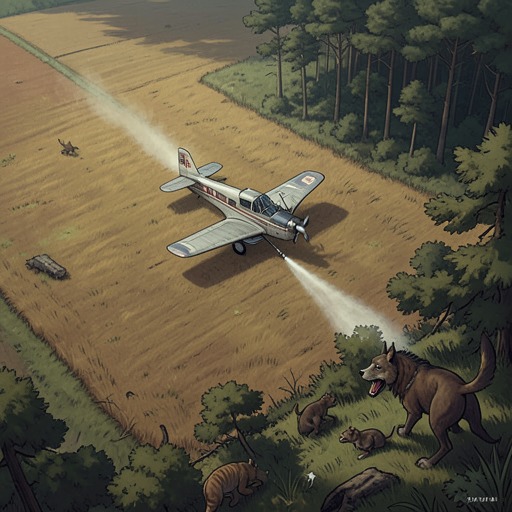
A separate account of the 1959 aerial aldrin treatment in southeastern Michigan shows how a large-scale control program could affect a wider community of living things. Some 27,000 acres, including numerous suburbs of Detroit, were heavily dusted from the air with aldrin pellets. Reports from the area described many dead birds and no live ones at some feeders; birds found in a dying condition showed signs associated with insecticide poisoning, including tremors, inability to fly, paralysis, and convulsions. The effects were not confined to birds: a local veterinarian reported a surge of sick dogs and cats, with cats especially affected. The account describes severe illness in the cats and notes the veterinarian's advice to keep them indoors or wash their paws after they went outside. The episode makes the household part of the exposure landscape: an aerial treatment could reach wildlife, pets, and the people responsible for them.
Persistence, Storage, and Chronic Risk
The book sets acute poisoning against a less conspicuous danger: the retention of pesticides in the body. DDT is fat-soluble, and after entering the body it is stored largely in organs rich in fatty substances, including the adrenals, testes, and thyroid; substantial amounts are also deposited in the liver, kidneys, and the protective fat around the intestines. This distribution helps explain why exposure cannot be assessed only by looking for an immediate reaction.
Storage can begin with very small intake, including residues present on many foodstuffs, and continue as the chemical is retained. The book gives a specific illustration of this magnifying effect: a dietary intake of one part per million can result in storage of about 10 to 15 parts per million. Because small amounts are cumulatively stored and excreted only slowly, repeated exposure may continue to matter long after any single encounter has passed. The resulting concern is chronic poisoning and degenerative changes in the liver and other organs, rather than only a dramatic episode of sudden illness.
The account of grebes at Clear Lake, California, offers a wildlife example of the same problem of hidden accumulation. After a third assault on the gnat population in 1957, more grebes died. Examination found no evidence of infectious disease; analysis of the birds' fatty tissues instead revealed an extraordinary DDD concentration of 1,600 parts per million. The contrast between the absence of detected infection and the chemical found in the birds' tissues redirects attention from a familiar disease explanation to pesticide contamination accumulated in wildlife.
Mixtures and the Problem of Attribution
The book argues that real exposure rarely resembles a controlled test of one substance at a time. A human being, unlike a laboratory animal living under rigidly controlled conditions, is not exposed to only one chemical; pesticides from different groups can interact with one another and with other chemicals. Those combinations complicate the interpretation of poisoning because their effects may not be predictable from the properties of each substance considered separately.
Research on malathion and other organic phosphates gives the warning a concrete scale. Scientists at the Food and Drug Administration found that simultaneous administration of malathion and certain other organic phosphates could produce massive poisoning, up to 50 times as severe as a prediction based simply on adding their separate effects. The result challenges the assumption that each chemical's risk can be evaluated independently and then combined arithmetically. In the book's account, mixture exposure is not a marginal complication but a central fact of the conditions in which people live.
The Book's Frame of Public Risk
Rachel Carson began writing Silent Spring in 1958, aged fifty, after most of a professional life as a marine biologist and writer with the U.S. Fish and Wildlife Service. She and her scientific colleagues had become alarmed by the widespread use of DDT and other long-lasting poisons in agricultural control programs. Pesticide poisoning thus enters the book not merely as an inventory of isolated accidents, but as a public question about the scale, duration, and oversight of chemical use.
The book contrasts the visible crisis of acute illness or death among farmers, spray workers, pilots, and others exposed to substantial quantities with the larger problem of exposure that accumulates gradually. Even a single exposure can precipitate acute poisoning when the amount is large enough, but the text identifies this as only part of the danger. Persistent residues, slow excretion, and interactions among chemicals extend the issue beyond an identifiable incident or individual victim. The subject's significance lies in that expanded frame: poisoning may announce itself suddenly, yet its causes and consequences can be distributed across food, work, treated landscapes, and the body over time.