Pesticide treadmill
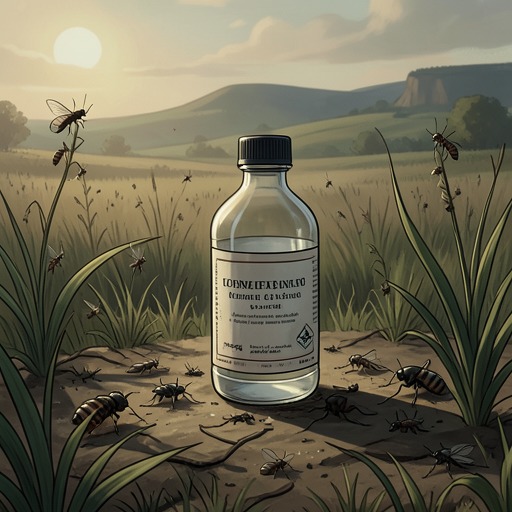
Silent SpringThe pesticide treadmill is the self-reinforcing cycle in which reliance on chemical control makes further chemical intervention seem necessary. Pesticides may suppress a target briefly, but they can also remove its natural checks, provoke outbreaks of other pests, and select for resistance. The apparent answer—stronger or different chemicals—then renews the conditions for the next crisis. Silent Spring presents this cycle not as an isolated technical failure but as a pattern with ecological consequences and institutional momentum.
Definition and mechanism
Marshall Laird compares chemical control to a treadmill: once people have stepped onto it, they fear stopping because of the consequences. The image captures a system in which each treatment appears to demand the next. Rather than reaching a stable endpoint, control becomes an escalating commitment: pests persist or rebound, and the means used against them can deepen dependence on further spraying.
The mechanism has more than one form. Chemical applications can kill predators along with the intended target, leaving fewer natural restraints when surviving pests multiply. They can also favor individuals that withstand a pesticide, until the chemical that once worked no longer controls the population. These processes are distinct but can reinforce the same cycle: ecological disruption creates new outbreaks, while resistance narrows the effectiveness of the available treatments.
Outbreaks and ecological reversals
The codling moth example shows how a promised solution can reverse into a new crisis. Earlier methods had not reliably solved the insect problem; chemicals and improved spraying equipment were added, and enthusiasm for spraying increased, yet the problem did not improve. DDT was then promoted as a way to end the nightmare of codling moth outbreaks. Instead, its use was followed by an unprecedented scourge of mites. Chemical control had not simply failed to eliminate the original difficulty: it had helped replace it with another.
A different reversal follows the destruction of predators. In one account, all the predators had been killed and new populations had not had time to become established. With the natural checks absent, conditions were clear for a tremendous population explosion. The timing matters: the outbreak was not evidence that chemical control needed only a more powerful application, but a consequence of removing the organisms that had restrained the pest.
The book also places the treadmill within a broader record of chemical campaigns. By the late 1950s, public misgivings about aerial distribution of lethal chemicals over millions of acres had grown, and mass-spraying campaigns against the gypsy moth and fire ant intensified those doubts. The scale of these programs made the treadmill more than a private or local problem: intervention could spread widely even as its collateral consequences and uncertainties became harder to contain.
Resistance and diminishing returns
Houseflies and Culex mosquitoes illustrate the treadmill as a sequence of short-lived chemical victories. They began to show resistance to sprays; in 1948, chlordane was introduced as a supplement to DDT and initially gave good control. By August 1950, chlordane-resistant flies had appeared, and by the end of that year the houseflies and Culex mosquitoes seemed resistant to it. Resistance developed as rapidly as new chemicals were brought into use.
By the end of 1951, DDT, methoxychlor, chlordane, heptachlor, and benzene hexachloride had joined the list of chemicals that were no longer effective against the flies. The succession makes the cycle concrete: a new compound restores control for a time, resistance follows, and the list of dependable options contracts. Chemical novelty postpones the reckoning without resolving the underlying dynamic.
The same predicament appears in programs aimed at disease-carrying insects. Agencies were responding to resistance by switching from one insecticide to another, but the book warns that this cannot continue indefinitely, whatever ingenuity chemists bring to supplying new materials. Dr. Brown describes the course as a one-way street whose length is unknown. If the dead end arrives before control of disease-carrying insects is achieved, the consequences could be critical. The metaphor shifts the treadmill from a cycle that merely wastes effort to a narrowing route with a potentially dangerous terminus.
Institutions and the costs of commitment
The treadmill is sustained not only by biology but by decisions about what counts as a threat and which responses appear politically available. In 1957, the United States Department of Agriculture abruptly changed its official attitude toward the fire ant. It launched an extensive publicity campaign, using government releases and motion pictures to present the insect as a serious danger. Congressional support for the project was initially secured through claims later discredited, including representations that the ant threatened southern agriculture and the young of ground-nesting birds.
The campaign proceeded despite the accumulating costs of the proposed control effort. When the program began in 1958, a million acres were treated in its first year; research conducted afterward was, in the book’s phrase, effectively post mortem. Studies by state and federal wildlife biologists and several universities documented losses that reached the complete destruction of wildlife in some treated areas. Poultry, livestock, and pets were also killed. The Agriculture Department brushed aside evidence of damage, a response that illustrates how institutional commitment can persist even as the costs it produces become visible.
The consequences extended beyond the treated land. Among woodcocks that wintered in Louisiana and bred farther north, 90 percent of those examined contained dieldrin or a form of heptachlor, at levels reaching 38 parts per million. Their contamination was connected to feeding: woodcocks probe for earthworms, and surviving worms in Louisiana carried the poisons. The episode gives the treadmill a long reach. Chemicals used for a control campaign could enter organisms and move beyond the immediate target and application site, while official knowledge about risks remained incomplete. Research into heptachlor’s peculiar nature came after the program had begun; a later inquiry into milk in Louisiana and Texas found that no tests had been made, so it was simply unknown whether the milk was contaminated.
Significance
The pesticide treadmill links the book’s separate examples into a recurring causal pattern. A treatment can suppress one problem, remove predators that restrained another, or select for resistant survivors; the resulting difficulty then serves as a reason to spray again. The cycle is especially hard to escape when programs are already large, publicized as urgent, and supported by claims that later prove unreliable. In such circumstances, evidence of damage may arrive after deployment and still fail to redirect policy.
The concept also clarifies the contrast between chemical control and biological methods. The book notes that biological approaches had advanced unevenly and that spectacular insecticides of the 1940s led some applied entomologists to turn away from them. Yet the goal of an insect-free world continued to recede. The treadmill names the cost of confusing forceful intervention with durable control: each apparent advance can be followed by resistance, resurgence, or a new ecological disturbance. Its central warning is not simply that a pesticide may be dangerous, but that dependence on repeated chemical fixes can make the next application seem unavoidable even as the system becomes less controllable.