Rivers of Death
Silent Spring“Rivers of Death” is the title of a chapter in Rachel Carson’s Silent Spring, where waterways become routes by which insecticides carry the consequences of pest-control programs far beyond their intended targets. The phrase turns a sequence of local fish kills into an account of ecological connection: chemicals enter streams, lakes, and rivers, and the living communities bound to those waters bear the cost.
A chapter organized around connected waters
The chapter opens from the green depths of the offshore Atlantic and follows the unseen paths fish take back toward the coast. That movement supplies its governing image: water links distant places and species, so a chemical application on land can become a disturbance carried downstream. The river is not merely a setting for damage but a means by which damage travels.
This structure belongs to the larger argument that led Carson to write Silent Spring. In 1958, at fifty, she set aside other research and writing projects after she and her scientific colleagues became alarmed by widespread use of DDT and other persistent poisons in agricultural programs. She had concluded that these substances were destroying wildlife and habitat and endangering human life. When magazine publishers rejected an article proposal, fearing the loss of advertising, the warning instead took shape as a book.
The evidence of poisoned streams
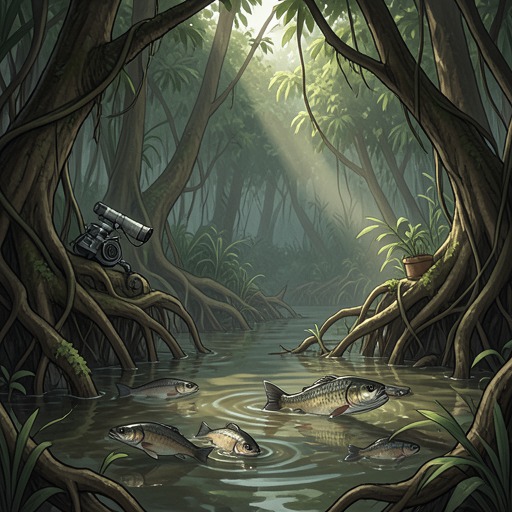
In one account, unmistakable signs of disaster appeared soon after spraying ended. Within two days, dead and dying fish, including young salmon, lay along a stream’s banks; brook trout were among them, while birds were dying along roads and in the woods. The stream’s life had been stilled. Before the spraying, its waters supported a rich assortment of organisms that formed food for salmon and trout, including caddisfly larvae. The loss was therefore not confined to conspicuous dead fish: it reached the smaller life on which the fish depended.
A separate account follows contamination into the Colorado River. After accumulated gravel, sand, and rubble were flushed from a lake, insecticides lodged in the debris were released and carried into the lake and then the river. Chemical tests later established their presence. As the lethal mass drifted downstream, fish died along a stretch extending 140 miles from the lake; later seining found the kill almost complete. The sequence makes the river’s reach measurable: a chemical residue held in accumulated material could be released by flushing and carried far beyond its original resting place.
Altered landscapes, widened costs
The chapter’s waterborne deaths belong to a broader critique of attempts to remake natural systems for single human uses. On the western plains, the sage country had formed through long natural processes, and its plants and animals had evolved in relation to the region’s harsh climate. The pronghorn and sage grouse were among the animals closely fitted to that habitat. Yet land agencies, responding to cattlemen’s demand for grazing, sought grassland without sage and treated the existing vegetation as an obstacle to improvement.
The effects of broad spraying were not limited to the intended plants. In the Bridger National Forest, the United States Forest Service sprayed about 10,000 acres of sage country under pressure to create more grazing land. The chapter presents this as an example of the shotgun approach: many plants beyond the target were eliminated. Willows, too, were killed by the same indiscriminate spray. When William O. Douglas visited in 1959, the year of the spraying, he saw them shriveled and dying. The damage reached beyond vegetation: willows had supported beavers, and the area had offered fishing and hunting as well as habitat.
The argument carried by the title
The phrase “Rivers of Death” condenses the chapter’s movement from a visible aftermath to the connections that produced it. A fish kill is not an isolated misfortune when insecticides have also silenced the stream’s food web; a river’s contamination cannot be contained to the place where a chemical was applied. Carson’s examples trace both direct destruction and the less immediately visible transfer of poisons through water and habitat.
That emphasis explains the chapter’s place in the book’s larger warning. The same confidence in chemical intervention appears in programs directed at insects, from the 1959 aerial dusting of 27,000 acres in southeastern Michigan, including Detroit suburbs, with aldrin, to later campaigns whose research followed rather than preceded their launch. Against such administrative momentum, the chapter makes ecological consequence legible through particular waters, species, and altered landscapes. The title names the cumulative result: when control ignores interdependence, the force that travels downstream is not improvement but loss.