Roy Barker
Silent SpringRoy Barker is identified in Silent Spring as a scientist with the Illinois Natural History Survey whose 1958 research connected the fate of robins to insecticide-treated elm trees by way of earthworms. His contribution was to make an otherwise difficult-to-see chain of exposure legible: DDT remained on leaves and bark, passed into fallen leaf litter, accumulated in earthworms, and reached robins that fed on them. In Carson’s account, Barker’s findings turn the robins’ deaths from an isolated mystery into evidence of how a pesticide can move through an ecosystem.
Identity and Role
Barker appears in the discussion of robin deaths associated with the spraying of elm trees. Carson calls him Dr. Roy Barker and identifies his institutional affiliation as the Illinois Natural History Survey at Urbana. The account gives no personal history or broader career details; it presents him through the specific research that helped explain the birds’ fate.
That research, published in 1958, supplied what Carson describes as a key piece in the puzzle. The puzzle was not simply whether robins encountered DDT, but how an insecticide applied to trees could persist and reach birds through an intermediary in the soil. Barker’s work traced the connection between the elms and the robins through earthworms, making the route of exposure central to understanding the consequences of tree spraying.
The Research and Its Ecological Chain
The chain began when elms were sprayed in spring. Carson notes that the application could be substantial: usually two to five pounds of DDT per 50-foot tree. The insecticide left a film on leaves and bark, and rain did not wash it away. When leaves fell in autumn, they accumulated in wet layers on the ground and began the gradual process of becoming part of the soil.
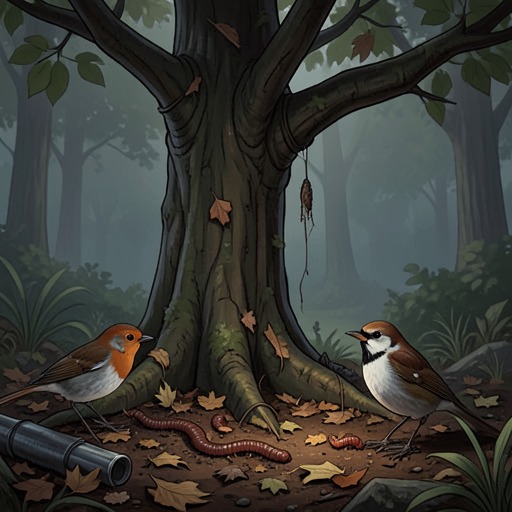
Earthworms feeding in that leaf litter supplied the next link. Elm leaves were among their favored foods, so the worms swallowed the insecticide as they consumed the leaves. Barker found DDT deposits throughout the worms’ digestive tracts, blood vessels, nerves, and body walls. Some worms undoubtedly died, but those that survived could concentrate the poison in their bodies, becoming what Carson calls biological magnifiers. The contaminant had therefore moved well beyond the surface where it was first applied: persistence on foliage led to exposure in the leaf litter and accumulation in a living food source.
In spring, robins returned and fed on earthworms. As few as eleven large worms could transfer a lethal dose of DDT to a robin. That number was small in relation to a bird’s ordinary feeding pace: robins could eat ten to twelve worms in as many minutes, and eleven worms represented only a small part of a day’s food. The figures make the danger concrete. A bird did not need to consume an extraordinary quantity of prey for contaminated worms to become consequential.
Significance in the Account of Robin Deaths
Barker’s research explains how the consequences of spraying could extend beyond the intended treatment of elm trees. The route runs through ordinary seasonal processes—spraying in spring, leaves falling in autumn, worms feeding in the litter, and robins returning in spring. Each step links a management decision to a later exposure, across both habitat and season. The apparent distance between a tree treatment and a bird’s death is bridged by the feeding relationships that connect them.
Carson notes that not every robin received a lethal dose, while also pointing to another consequence that could threaten the population. Barker’s findings therefore contribute to a wider argument than the explanation of individual deaths: non-target wildlife can be exposed through food, and the effects of a chemical application may be redistributed and intensified as it passes between organisms. His role in the narrative is evidentiary and clarifying. By tracing DDT from elm foliage through earthworms to robins—and quantifying how little contaminated prey might suffice—his work makes the ecological connection underlying the episode visible.