Salmon
Silent SpringSalmon are portrayed as travelers whose return journeys connect the open Atlantic to the particular freshwater tributaries where their lives began. Their life cycle makes them more than a measure of river health: their eggs, young, food, and spawning habitat are woven into a larger community, so that a single season of aerial spraying can interrupt an ancient pattern. In the Miramichi watershed, the damage was followed by a partial recovery, but the account warns that repeated spraying elsewhere brought alarming declines. A separate discussion of western sage country places Salmon within a broader argument about the ecological systems disrupted when land is reshaped for human use.
Return to the Miramichi
For thousands of years, Salmon had followed the outflow of coastal rivers as an unseen route through the sea. In the summer and fall of 1953, they left feeding grounds in the far Atlantic and ascended the Miramichi River in New Brunswick, each returning to the tributary where it had spent its first months or years. The journey led toward upper reaches fed by shadowed brooks, where balsam, hemlock, and pine shaded the streams and helped provide the spawning grounds Salmon need to survive.
The return was part of an old and recurring cycle that had made the Miramichi one of North America’s finest salmon streams. Yet the life carried by that cycle depended on more than the adults’ arrival. Salmon eggs lay through fall and winter in shallow, gravel-filled stream beds; newly hatched fish remained there, about half an inch long, living from their large yolk sacs before they began searching for small insects. In spring 1954, the newly hatched fish shared the river with young Salmon from earlier hatchings, one or two years old, their bright coats marked with bars and red spots. These older juveniles fed voraciously on the varied insect life of the streams.
Spraying and the broken cycle
The river’s food web was exposed when insecticide spraying took place in the watershed. Spray pilots made no effort to avoid streams or turn off their nozzles while flying over them. Even if they had, the account notes, drift could carry the chemical so far that the result might have been little different. The practical reach of the spraying therefore extended beyond the intended target: into waters supporting the young Salmon and the organisms they ate.
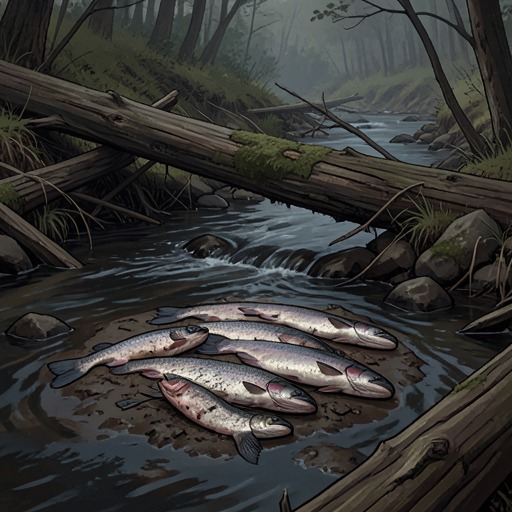
Soon after spraying ended, dead and dying fish appeared along the stream banks. Within two days, many young Salmon were among them, as were Brook trout; birds were dying along roads and in the woods. The stream’s life was stilled, and the rich assortment of aquatic organisms that had fed Salmon and trout was also struck. The sequence makes the harm legible not as a single loss of adult fish but as damage to the interconnected stages and food sources on which a river population depends.
Recovery and warning
The Northwest Miramichi’s Salmon runs remained in relatively good condition because spraying was done in only one year. Many young fish completed their stream growth rapidly, went to sea early, and returned in 1959 in large runs of grilse. That return offered evidence of resilience, but it was not evidence that the spraying had been harmless: the recovery was tied directly to the fact that the intervention was not repeated there year after year.
Other streams in the watershed supplied the contrast. Where spraying was repeated, Salmon populations were declining alarmingly. The distinction between a one-time application and recurring treatment turns the Miramichi account into a warning about cumulative pressure: the same river system that could produce a strong return after a single disrupted season could suffer sustained losses under repeated spraying.
Salmon and the land’s ecological balance
The book also places Salmon alongside the pronghorn and sage grouse in its description of western sage country, a landscape shaped over millions of years by the uplift of the Rocky Mountain system and by harsh climatic extremes. These animals and plants had evolved in relation to the land. The passage’s later emphasis on the Miramichi makes the parallel significant: in both settings, a species cannot be understood apart from the habitat and living relationships that sustain it.
Land-management agencies, seeking more grazing land for cattle, treated grass without sage as an improvement. The resulting spray was described as indiscriminate, eliminating many plants beyond its intended target. A reported example from Bridger National Forest in Wyoming showed willows dying under the same spray that killed sagebrush, with consequences for the Beavers that depended on the willows. Read beside the salmon narrative, this western case reinforces the book’s central ecological point: interventions aimed at simplifying or controlling nature can unsettle the wider communities on which wildlife depends.