Spruce budworm
Silent SpringSpruce budworm is a native insect that attacks several kinds of evergreen trees and can become extraordinarily abundant in eastern Canada in roughly 35-year cycles. In Rachel Carson’s account, its periodic outbreaks prompted vast DDT-spraying campaigns intended to protect forests, but the treatment carried poison into streams and disrupted the wider web of forest life. The insect therefore matters not only as a forest pest but as the focus of a conflict between a narrowly defined control objective and the ecological consequences of pursuing it with persistent chemicals.
Biology and recurrent outbreaks
Spruce budworm attacks several kinds of evergreens. Its populations do not remain at a constant level: in eastern Canada, they seem to become extraordinarily abundant about every 35 years. The early 1950s brought one such upsurge, turning a native insect into the target of an expanding effort to protect vulnerable forests.
That recurring rhythm complicates the idea that an outbreak is simply an emergency demanding the most sweeping available remedy. The budworm’s abundance was part of a pattern observed over time; the policy response, by contrast, rapidly enlarged the area treated. Carson’s account sets those different scales against each other: a periodic fluctuation in insect populations met an increasingly extensive chemical campaign.
DDT spraying and its consequences
The Canadian government began spraying to combat the budworm on a small scale, then accelerated the program suddenly in 1953. Instead of treating thousands of acres, the campaign reached millions of acres of forest in an effort to save the balsams. In the summer that followed, the Northwest Miramichi watershed was included in the vast spraying program. The intervention thus extended beyond the trees under attack to a watershed and its connected aquatic life.
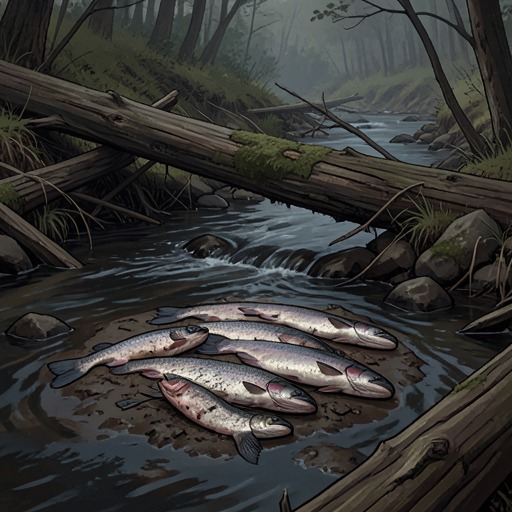
Carson places the spraying against a vivid account of young salmon feeding in the stream on varied insect life. As summer approached, the scene changed: the watershed had become part of the budworm-control operation. In describing the consequences, she emphasizes that forest spraying was not an isolated treatment of one insect. Chemicals applied across wooded land could reach running streams, making fish vulnerable to a policy designed around protecting trees.
The larger eastern Canadian situation was notable both for the extent of forest spraying and for the wealth of facts collected about its effects. Carson observes that Maine faced a related combination of spruce and balsam forests, forest-insect control, and salmon runs. The comparison widens the issue beyond one watershed: where forest management and fisheries share the same landscape, the consequences of spraying can cross from terrestrial targets into waterways and the livelihoods and species associated with them.
The limits of chemical control
Carson argues that chemical spraying is neither the only nor the best way to control forest insects. She divides the threat pesticides pose to fish into distinct problems, beginning with fish in running streams in northern forests. This framing changes the question from whether a pesticide can reduce budworm numbers to whether a control program can protect the forest without imposing damage on the aquatic systems linked to it.
The future of salmon fisheries in New Brunswick, she writes, may depend on finding a substitute for drenching forests with DDT. The scale of that concern is inseparable from the scale of treatment: spraying millions of acres offers a broad intervention, but also exposes much more than the intended insect. The budworm’s status as a native, periodically abundant species further sharpens the tension between attempting to suppress a forest process and preserving the interconnected life of forests and streams.
Alternatives and changing methods
The book points toward alternatives rather than treating chemical spraying as inevitable. In eastern forests of Canada and the United States, bacterial insecticides are presented as one possible answer to problems posed by forest insects such as the budworm and the gypsy moth. In 1960, both countries began field tests using a commercial preparation of Bacillus thuringiensis.
Some early results were encouraging. In Vermont, the end results of bacterial control were as good as those obtained with DDT. A technical obstacle remained: researchers needed a carrying solution that would make bacterial spores adhere to evergreen needles. The difficulty was practical, not a reason to abandon the method; bacterial insecticides could already be used on crops, where even dust could serve as an application form.
This alternative gives the budworm episode its larger significance. The choice is not presented as a simple opposition between protecting forests and allowing damage. Rather, the account contrasts blanket chemical treatment with the search for a control method that might achieve comparable results without upsetting natural controls. The early bacterial trials do not establish that the problem was solved, but they show that the means of control could be reconsidered—and that the consequences for streams and forest life belonged in the measure of success.