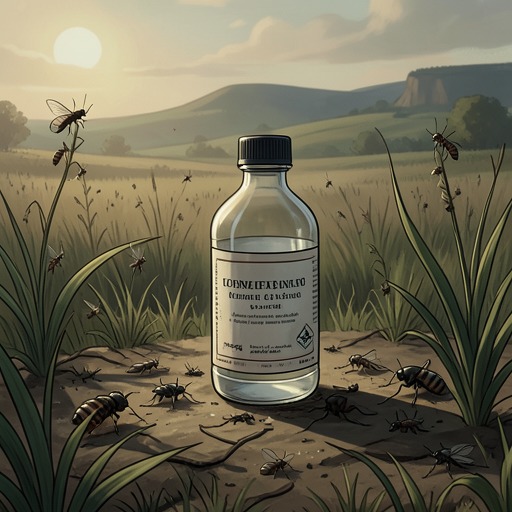
Survival of the fittest
Silent SpringSurvival of the fittest is the principle Rachel Carson invokes to explain how intensive insecticide use selects for resistant insects rather than securing lasting control. In Silent Spring, the process turns the apparent force of chemical warfare against its users: spraying removes the more vulnerable members of a population, while survivors pass inherited toughness to their descendants. The result is not simply resistance to one product but a recurring escalation in which ever more toxic chemicals are sought, even as treated pests can surge back in greater numbers.
The Principle Under Chemical Pressure
Carson sets the principle against the expanding use of long-lasting poisons in agricultural control programs. In 1958, when she began writing the book that became Silent Spring, she was a marine biologist and writer with the U.S. Fish and Wildlife Service. She and her scientific colleagues had become alarmed by widespread pesticide use. The evolutionary mechanism offered a way to understand why an intervention that appeared powerful in the short term could make its target harder to control over time.
The point is not that every insect is equally capable of resisting a chemical attack. An original population varies in structure, behavior, and physiology. When spraying kills the weaker members, insects with an inherent quality that lets them escape harm are more likely to survive. Those survivors become the parents of the next generation; through inheritance, their descendants carry the same qualities of toughness. Repeated exposure thus changes the population’s composition, shifting it from a mixture of more and less vulnerable insects toward resistant strains.
From Survivors to Resistant Populations
Carson presents this sequence as a direct instance of natural selection. The insecticide does not need to create toughness in each individual it fails to kill. Rather, it sorts among existing variation: susceptible insects die, and those with qualities that confer survival leave more descendants. After a few generations of intensive spraying, a population that once included both weak and strong members may consist entirely of tough, resistant strains.
The phrase “survival of the fittest” consequently names a population-level change, not a guarantee that the strongest individual prevails in every encounter. The relevant advantage is specific: an inherited quality that permits survival under a particular chemical attack. The pesticide becomes a selective pressure, and the survivors’ reproductive success carries that advantage forward. In Carson’s account, Darwin’s principle is not an abstract maxim but a mechanism visible in the changing effectiveness of insect control.
The Escalation Cycle
Resistance helps drive what Carson describes as an ongoing escalation since DDT became available for civilian use. Once insects evolve populations immune to a particular insecticide, the response is to develop a deadlier material; resistance then makes still more powerful chemicals seem necessary. Each apparent solution creates pressure for another. The chemical war cannot be won by simply increasing the force of the attack, because the attack helps select the organisms able to withstand it.
A second process compounds this failure: destructive insects may undergo a flareback, or resurgence, after spraying, returning in numbers greater than before. Resistance and resurgence are distinct consequences, but together they undermine the promise of permanent control. One leaves a population increasingly able to survive the chosen poison; the other can leave more pests than the treatment was intended to suppress. The cycle therefore produces both a tougher target and, at times, a renewed abundance of that target.
A Principle Across Ecological Change
Carson’s wider examples place this selection process within a landscape already shaped by long ecological relationships. On the western plains, sage developed under harsh climatic extremes, and animal life evolved in relation to the land. The pronghorn antelope and sage grouse are described as closely adjusted to this habitat. When land-management agencies sought grassland without sage to satisfy cattlemen’s demand for more grazing, the intended improvement disturbed a system whose plants and animals were adapted to one another.
The same indiscriminate logic appears in the account of spraying: a measure directed at one target can eliminate other plants as well. In the Bridger National Forest, the U.S. Forest Service sprayed some 10,000 acres of sage country. Willows, like sagebrush, were killed by the spray, damaging vegetation on which beavers depended. These examples concern ecological consequences beyond insect resistance, but they clarify the larger significance of Carson’s argument: chemical interventions operate within systems of dependence and selection, not on isolated targets.
The principle also gives the book’s account of postwar pesticide programs a historical frame. The beetle introduced into the United States initially multiplied rapidly in the absence of restraints that kept it in check in its native land. By 1945 it had become a pest of only minor importance across much of the territory it had occupied, largely because parasitic insects had been imported from the Far East and disease organisms fatal to it had become established. This history contrasts with chemical escalation: a pest population can decline through biological restraints, whereas repeated chemical attacks may select survivors able to resist the treatment.
The Limits of Chemical Victory
Carson’s argument recasts resistance as a consequence built into the strategy of intensive spraying, rather than an unexpected exception that can be permanently overcome by finding a stronger poison. Because survivors reproduce, the method changes the population it is meant to control. Because resurgence can follow spraying, even a dramatic immediate reduction does not establish durable success. The promise of a final chemical victory is therefore contradicted by the processes the campaign sets in motion.
In this account, “survival of the fittest” is both an evolutionary explanation and a warning about human control. The chemical response selects for the very qualities that frustrate it, while the demand for stronger treatments deepens the cycle. The principle connects an insect’s inherited advantage to a broader failure of control: when intervention ignores adaptation and ecological relation, apparent mastery can become the condition for its own defeat.