Texas Game and Fish Commission
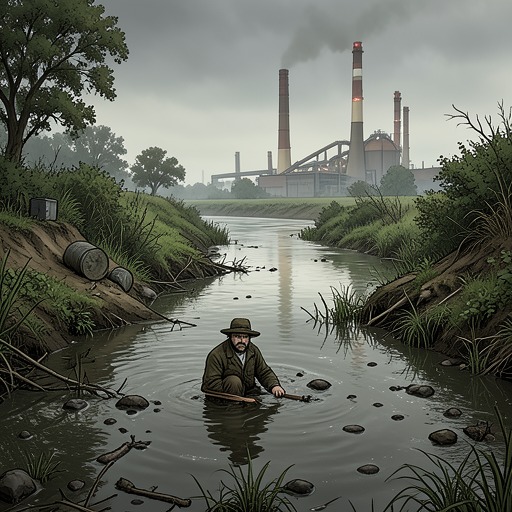
Silent SpringThe Texas Game and Fish Commission appears in Rachel Carson’s account as an investigating state agency whose officers traced an insecticide odor through Austin’s storm-sewer system to a chemical plant. Their inquiry linked long-standing disposal practices and a recent sewer flushing to a lethal contamination moving from a lake into the Colorado River, turning a fish kill into evidence of how industrial residues could persist out of sight and then be abruptly carried downstream.
Institutional Role in the Investigation
The Commission enters the episode not as the source of the pollution but as the public body following its trail. Investigators in Austin noticed an odor associated with chlordane and toxaphene, especially strong in the discharge from one storm sewer. That sewer had previously been associated with trouble from industrial wastes, so the odor connected a familiar route of concern to a new and more specific suspicion: insecticides might be moving through the drainage network.
Commission officers followed the sewer back from the lake, checking its openings as they went. They detected an odor like benzene hexachloride at each opening as far back as a feeder line from a chemical plant. This stepwise tracing mattered because it replaced a general report of polluted water with a path that could be investigated: from the lake, into the sewer, along its feeder line, and toward an industrial source.
Tracing the Source
The plant produced DDT, benzene hexachloride, chlordane, and toxaphene, along with smaller quantities of other insecticides. Its manager acknowledged that powdered insecticide had recently been washed into the storm sewer. More consequentially, he said that disposing of insecticide spillage and residues in this way had been common practice for ten years. The Commission’s investigation thus uncovered more than a single accidental release: it found a repeated means by which chemical residues entered the sewer system.
The officers continued the inquiry beyond the first plant. They found other plants where rainwater or ordinary cleanup water could carry insecticides into the sewer. The evidence pointed to a network of contributing routes, not simply one isolated drain. That distinction widened the significance of the investigation: chemicals could enter urban waterways through routine handling and disposal, even when no dramatic spill was reported.
The Sewer Flush and the Downstream Kill
The final link was the timing of a maintenance operation. A few days before the lake and river water became lethal to fish, the entire storm-sewer system had been flushed with several million gallons of high-pressure water to clear debris. The flushing likely dislodged insecticides lodged among accumulated gravel, sand, and rubble, carrying them into the lake and then onward into the river. Chemical tests later confirmed the insecticides’ presence.
The sequence gave the fish kill a concrete mechanism: residues accumulated in the sewer; a large-volume, high-pressure flush mobilized them; and contaminated water carried the chemicals into the lake and downstream. As the lethal mass moved down the Colorado, the damage extended far beyond the original drainage system. For 140 miles below the lake, the fish kill was described as almost complete. The Commission’s tracing work therefore connected a local sewer system and industrial disposal practices to a river-scale ecological consequence.
Significance
The episode shows the Commission exercising an investigative role at the intersection of public infrastructure, industrial practice, and aquatic life. Odor supplied an initial clue, the officers’ route-tracing located a likely source, the plant manager’s admission established habitual disposal, and the sewer-flushing schedule explained how accumulated material could suddenly become a lethal release. Each finding filled a different part of the causal chain.
Carson’s account makes the maintenance operation a reversal: a flush intended to clear debris instead released insecticides that had been stored within the debris. The pollution was not confined to the moment when chemicals entered the sewer; it persisted in the system until water pressure carried it into the lake and river. By documenting that chain and its 140-mile reach, the investigation illustrates why chemical contamination could remain hidden in ordinary drainage infrastructure before becoming visible as mass fish mortality.