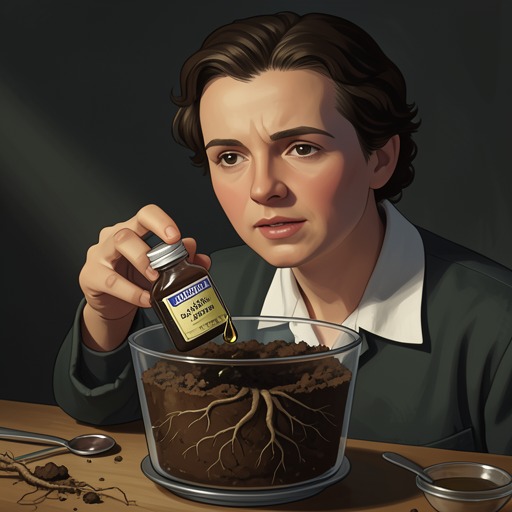
The body's internal ecology
Silent SpringThe body's internal ecology is the idea that the human organism, like the visible natural world, is an interconnected system in which small disturbances may reverberate far beyond their point of origin. In Silent Spring, this concept gives form to the less obvious danger of pesticides: a chemical exposure may be stored, combined with other exposures, and followed over time by effects that appear in organs or tissues seemingly remote from the original injury. It challenges the habit of recognizing harm only when illness is immediate and unmistakable.
From the visible web to the body
Carson introduces this inner ecology by moving from familiar environmental relationships to the less visible relations within a human body. The elm-leaf, earthworm, and robin cycle is part of the observable world, a chain through which contamination can pass. The body has its own interconnected order, but its links are harder to see: a minute cause may produce a large effect, and that effect may emerge far from the site of the initial injury.
The contrast is not between nature outside and an organism sealed off from it. People are part of nature and cannot simply escape pollution once it has become widely distributed. The internal ecology extends the book’s account of ecological connection inward: the same difficulty of isolating one link in a larger web recurs inside the body, where the chain of cause and consequence is less visible and may unfold over time.
Accumulation and delayed harm
DDT provides a concrete example of how an exposure can persist within the body. Because it is fat-soluble, it is stored chiefly in organs rich in fatty substances, including the adrenals, testes, and thyroid; substantial amounts also accumulate in the liver, kidneys, and protective fatty tissues around the intestines. This storage begins even with very small intake, as residues are present on many foodstuffs, and continues as the body retains the chemical.
The account emphasizes that these stores are not merely temporary traces. Pesticides may be cumulatively stored and only slowly excreted, making chronic poisoning and degenerative changes in the liver and other organs a real concern. The significance lies partly in the mismatch between exposure and consequence: a small intake may not produce an obvious immediate crisis, yet repeated exposure and slow elimination allow the substance to remain and build up. The internal ecology makes that temporal gap central to understanding risk.
Interactions and elusive causes
A person’s chemical exposure is rarely confined to one substance. Carson notes that people encounter insecticides from different groups as well as other chemicals, and that these substances can interact in soil, water, or the bloodstream. The resulting effects cannot always be predicted by considering each chemical in isolation. Food and Drug Administration scientists, for example, found that simultaneous administration of malathion and certain other organic phosphates could cause poisoning as much as fifty times more severe than an estimate based simply on adding their separate effects.
Such interactions complicate the effort to connect a disease with a particular exposure. A change at one point—even at the level of a single molecule—may reverberate through the system and initiate changes in organs or tissues that seem unrelated. The body’s internal ecology therefore makes simple cause-and-effect stories unreliable: the location where harm becomes apparent may not be where the original injury occurred, and the initiating exposure may be one element in a mixture rather than an isolated agent.
Evidence, diagnosis, and significance
Carson presents the discovery of disease agents as a patient process of assembling facts that may at first appear distinct and unrelated. Medical evidence must be drawn from research across widely separated fields, because cause and effect may be separated both in space and in time. The visible, immediate effect is easier to recognize; when illness does not arrive promptly in an unmistakable form, people may deny that harm exists at all.
The concept thus changes what counts as evidence of pesticide injury. The absence of sudden illness does not establish safety, just as a disorder appearing in one part of the body does not prove that its cause began there. By setting acute poisoning beside cumulative storage, slow excretion, and chemical interaction, Silent Spring describes a problem of both biology and knowledge: damage may be real while its pathway remains difficult to demonstrate. The body's internal ecology names that hidden network and explains why tracing delayed harm requires attention to accumulation, relationships among exposures, and effects that surface far from their beginnings.