Urbana
Silent SpringUrbana, Illinois, serves in Rachel Carson’s account both as a center of natural-history research and as a measure of the failure of routine pesticide campaigns. The city’s university campus lost most of its elms despite years of spraying against Dutch elm disease, while work by the Illinois Natural History Survey helped reveal how pesticide-treated trees could expose robins through earthworms. Together, these episodes make Urbana a place where ecological connections and the costs of trying to override them become visible.
Research and Ecological Connections
In Urbana, Dr. Roy Barker of the Illinois Natural History Survey supplied a crucial part of the explanation for the fate of poisoned robins. His 1958 research traced the link from elm trees to earthworms and then to robins: trees were sprayed, and the earthworms that fed among them carried the poison onward. Because earthworms are a principal spring food of robins, a treatment directed at trees could reach birds through an apparently separate part of the food web. The account also reports that a laboratory robin had gone into violent tremors after being fed such worms, evidence that helped connect the exposure pathway to a visible effect.
This chain gives Urbana more than the role of a research location. The work conducted there clarified how an action aimed at one organism could affect another through shared habitat and feeding relations. The consequences of spraying did not stop at the target tree; they travelled through the ground and into the birds that depended on it.
The University’s Elms
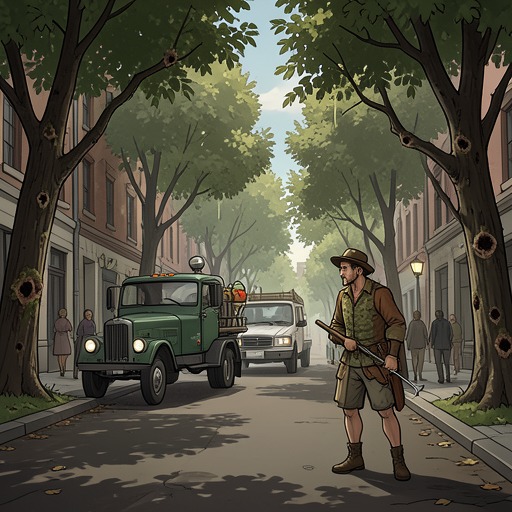
Dutch elm disease first appeared in Urbana in 1951, and spraying began in 1953. By 1959, after six years of treatment, the University of Illinois campus had lost 86 percent of its elms. Half of those losses were attributed to Dutch elm disease, so the campaign did not prevent the disease from taking a severe toll even among the trees it was meant to protect.
The figures sharpen the contrast between sustained intervention and its results. Six years of spraying did not preserve the campus landscape: most of its elms were gone, and disease accounted for only half of that loss. Urbana’s record thus places the costs and limited success of chemical control alongside the wider ecological evidence, showing why the visible target of a campaign cannot be considered in isolation.
Significance in the Book
The two Urbana episodes illuminate different stages of the same argument. Barker’s research makes the indirect consequences of spraying legible by following poison through trees, earthworms, and robins; the campus record tests the promised effectiveness of spraying against disease over time. One reveals an unintended route of harm, the other a striking failure to protect the intended landscape.
By placing scientific investigation and local losses in the same city, Carson’s account turns Urbana into a concrete example of ecological interdependence and the limits of chemical remedies. The elms’ decline and the robins’ exposure are not separate curiosities: they show how a management decision can reach beyond its stated target while failing to secure the result it promised.