the conservation of variety
Silent SpringThe conservation of variety is the principle that a healthy living community depends on the presence of multiple species and relationships, not on uniformity imposed for convenience. Rachel Carson develops the idea through two contrasting landscapes: towns planted almost entirely with elms, where Dutch elm disease leaves trees and birds dying together, and western sage country, where agencies’ efforts to replace sagebrush with grass disrupt a system shaped over long periods. In both cases, simplifying nature makes the landscape more vulnerable and transfers the costs of “improvement” to other living things.
Definition and Ecological Basis
Carson presents the conservation of variety as the key to a healthy plant or animal community, naming British ecologist Charles Elton as the source of the phrase. Variety here is not ornament or abundance for its own sake. It is a practical condition of ecological resilience: a community made up of different species is less likely to lose its defining life when a disease, poison, or management decision strikes one component.
The western plains illustrate why diversity is rooted in place. The land of the sage occupies high plains and lower mountain slopes, shaped by the uplift of the Rocky Mountain system millions of years ago and by harsh climatic extremes. Over ages of natural experimentation, plant and animal life adapted to the land’s demands. The sagebrush and the pronghorn antelope are among the forms of life Carson describes as closely fitted to that habitat. The landscape is not empty space awaiting improvement; its existing composition embodies a long history of adjustment between organisms and environment.
Uniformity and the Elm Epidemic
The danger of uniformity appears in Carson’s account of towns that planted elms along streets and throughout parks. A generation earlier, people did not understand that filling large areas with a single tree species invited disaster. When Dutch elm disease spread, the trees died, and birds dependent on that environment suffered as well. The loss therefore did not stop at the disappearance of a favored street tree: it reached beyond the elms into the living community around them.
Carson argues that efforts to respond to the epidemic should favor a variety of tree species, including resistant European elms where appropriate, rather than replace one uniform planting with another. The aim is not simply to restore trees quickly, but to prevent a future epidemic from depriving a community of its trees all at once. The elm example turns the conservation of variety into a concrete planning principle: diversity can limit the scale of a shared vulnerability.
Sagebrush, Grazing, and the Costs of Improvement
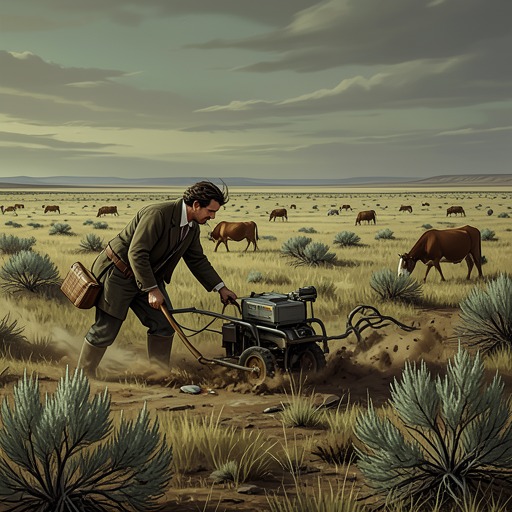
The same conflict unfolds across the western range. Land-management agencies, responding to cattlemen’s demand for more grazing land, treat grassland as an improvement and sagebrush as an obstacle. But the sage country was already a living system, including vegetation on which wildlife depended. Where agencies seek grass without sage, the change is not merely a different appearance of the range; it alters the habitat and its relations.
The spraying can also eliminate plants that were not the intended targets. Carson describes this as an effect associated with the shotgun approach to nature: a broad intervention does not respect the distinctions between the species people wish to remove and the other vegetation occupying the same place. In the Bridger National Forest in Wyoming, the United States Forest Service sprayed about 10,000 acres of sage country. The immediate rationale was range improvement, but the operation reached beyond sagebrush, killing willows as well.
Those willows mattered to beavers that depended on them. Before the spraying, the region was also valued for recreation, fishing, and hunting. When William O. Douglas visited in 1959, the year of the spraying, he saw willows shriveled and dying. What was presented as a straightforward gain in grazing ground thus involved a wider loss: vegetation, animal dependence, and the qualities that made the place useful to people beyond the cattle industry.
Significance
Across the town and the range, Carson traces a recurring consequence of treating living systems as if they could be reduced to a single desired product. Elm monoculture leaves a community exposed to the failure of one species; sagebrush eradication, intended to produce grass, damages other plants and the animals and human uses connected to them. The cases differ in setting and immediate cause, but both show that ecological effects travel across relationships rather than stopping at the official target.
The principle also changes how an intervention should be judged. A measure cannot be called an improvement merely because it produces more of the resource its advocates want. Its consequences for the surrounding community, including species not named as targets, are part of the result. The conservation of variety therefore links ecological knowledge to responsibility: preserving different forms of life is not resistance to change for its own sake, but protection against the cascading losses that follow when landscapes are made uniform.